
Zone 1a to zone 8a — that’s the range Alaska covers, wider than almost any other state, and it’s why a delphinium that comes back reliably in Juneau can vanish overnight in Fairbanks. Anchorage’s coldest month averages an 11°F low and never sees a single 90°F day, so the flowers that hold up here aren’t the showy heat-lovers from a mail-order catalog. They’re the fast, cold-tolerant ones built for short summers and hard freezes — and knowing which is which starts with your own zone, not a generic list.
What thrives in Alaska

Cold hardiness comes first
The flowers that succeed in Alaska share a short list of traits: they finish their bloom cycle fast, they don’t need real heat to set flower, and they can take a hard freeze on either end of the season without dying back to nothing. Alaska’s USDA rating spans zone 1a up to zone 8a, one of the widest ranges of any state, so a plant that survives winter comfortably in Juneau can die outright in Fairbanks. Check your own zone before you buy, not the zone printed on a general “Alaska” plant list.
Cold hardiness matters more here than almost anywhere else in the country. NOAA’s 1991-2020 climate normals put Anchorage’s coldest month at a mean daily minimum of 11°F, and that’s the mild end of the state. A flower rated hardy to zone 4 or colder as a perennial will generally come back in Southcentral Alaska. Anything softer needs to be grown as an annual or brought indoors for winter.
Heat and long daylight
Heat is the other side of the coin, and Alaska simply doesn’t have much of it. NOAA’s Anchorage normals show an average of 0.0 days a year reaching 90°F, meaning the plants that need real summer heat to ripen or bloom well either fail outright or need a greenhouse. Heat-loving bedding plants that put on a full season of color in warmer states, the kind covered in our guide to flowers that actually thrive in California, mostly sulk or rot here instead of blooming.
What fills the gap are cold-hardy annuals and short-season perennials: pansies and violas, calendula, Iceland poppies, snapdragons, and sweet peas all tolerate a light frost and don’t ask for tropical warmth to flower. Drought tolerance rarely decides success in Southcentral Alaska’s wetter, cooler summers, but it matters more in the drier Interior, where afternoon sun and low humidity dry out a bed fast despite the cool air.
Long summer daylight is Alaska’s compensating factor. Eighteen to twenty hours of light through June and July push many short-season flowers through their whole life cycle in weeks rather than months, which is part of why fast annuals outperform slow tropical types here regardless of how little heat they get.
Native plants worth the space
Widespread natives to build around
Native and near-native flowers earn their keep because they’ve already solved Alaska’s problems: short season, cold winters, and long but often overcast summer daylight. Once established, a native perennial typically needs far less water and no winter protection compared to an imported ornamental, because its root system and dormancy cycle are already tuned to the local freeze-thaw pattern.
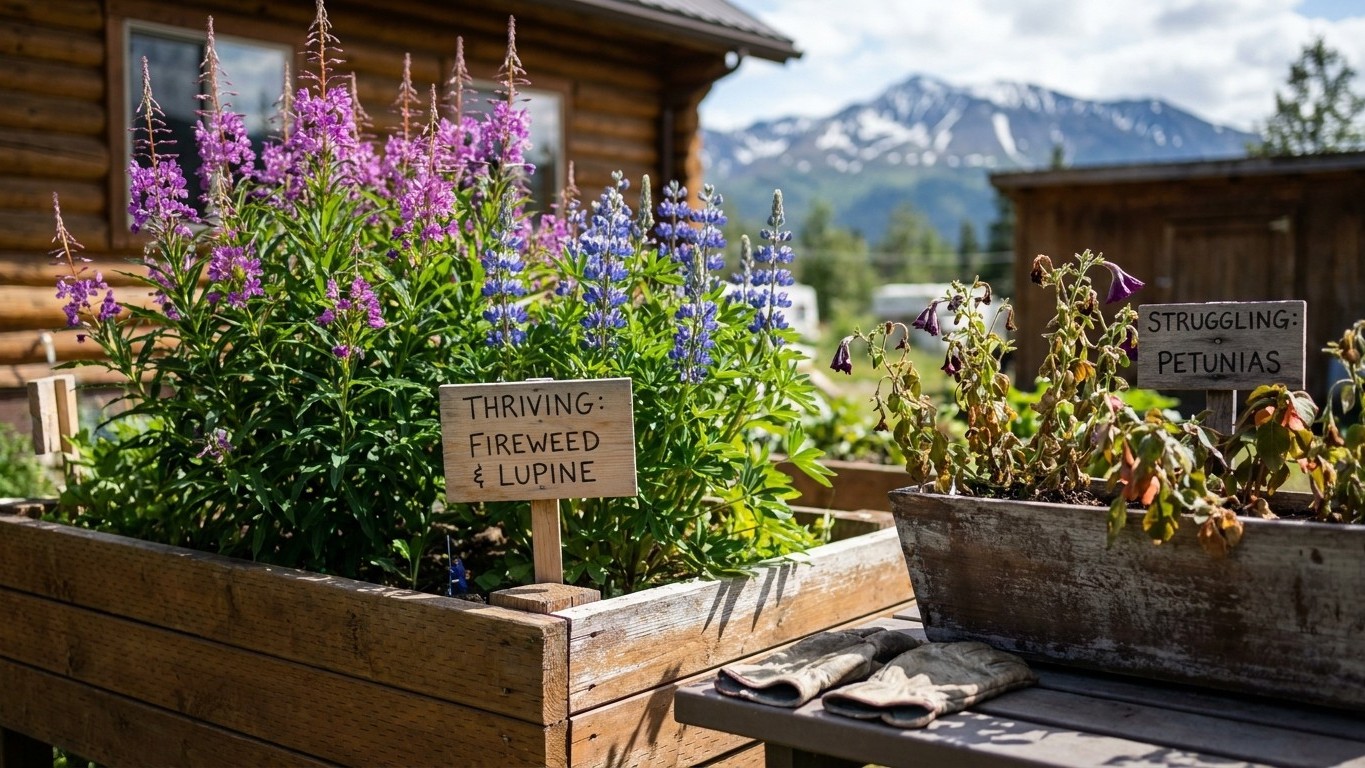
Fireweed (Chamaenerion angustifolium), with its tall spikes of pink-purple flowers, is one of the most recognizable native perennials across the subarctic and boreal regions of Alaska and neighboring Canada. Dwarf fireweed, a shorter relative found on gravel bars and roadsides, works better in a cultivated border where the six-foot common form would take over the whole bed by midsummer.
Nootka lupine (Lupinus nootkatensis), native to coastal areas of the North Pacific including Southeast Alaska, sends up blue-purple pea-flower spikes and, like other lupines, fixes nitrogen in the soil as it grows. Alpine forget-me-not (Myosotis alpestris), Alaska’s state flower, is native to alpine and subalpine habitat across the wider circumpolar region and forms low mats of small blue flowers with a yellow eye.
What natives do for pollinators
Wild geranium (Geranium erianthum), native to coastal forests and meadows of the North Pacific rim, produces purple-veined lavender flowers in early summer and tolerates the partial shade found under birch and spruce, where fussier ornamentals struggle. Pollinators native to Alaska, especially bumblebees, rely on these plants specifically because they bloom on the same short calendar the insects are active on, so a native patch does more for a local bee population than an imported annual blooming on a different schedule.
Many of the same cool-summer natives that anchor gardens in Washington also show up in Southeast Alaska’s coastal forests, since the two regions share the same wet, mild Pacific air mass even though Alaska’s winters run far colder. That overlap makes Pacific Northwest native plant lists a reasonable starting point for gardeners in Southeast Alaska, though anything from lower elevations further south still needs a hardiness check against local conditions before it goes in the ground.
Perennials that come back

Whether a perennial survives an Alaska winter comes down to its hardiness rating, and that number has to be read against your own zone, not the state average. The USDA map spans zone 1a to 8a across Alaska, so a plant tag reading “hardy to zone 4” is a real gamble in the Interior but a safe bet in Anchorage or the milder parts of Southcentral and Southeast.
What comes back reliably
Peonies, rated hardy to roughly zone 3, are among the most reliable perennial flowers in Southcentral Alaska and can live for decades in the same bed once established. Daylilies bred for northern hardiness, delphinium, and lupine also return year after year in the milder zones near Anchorage and Juneau. Bleeding heart and hosta, both rated to zone 3 or 4 depending on the cultivar, tolerate the shorter season as long as they’re planted where snow cover is dependable, since snow acts as insulation against the coldest air.
| Plant | Typical hardiness zone | Behavior in Alaska |
|---|---|---|
| Peony | Zone 3 | Reliable perennial in Southcentral and Interior |
| Delphinium | Zone 3-4 | Reliable perennial in milder zones |
| Daylily (northern-bred) | Zone 3-4 | Reliable perennial near Anchorage and Juneau |
| Dahlia | Zone 8 and warmer | Grown as an annual, tubers dug each fall |
| Snapdragon | Zone 7-9 | Grown as an annual |
What gets grown as an annual instead
Plenty of garden-center perennials are only perennial in a much milder climate and get treated as annuals here. Dahlias, tender in anything colder than about zone 8, need their tubers dug and stored indoors over winter if you want to keep them, which is standard practice across nearly all of Alaska. Geraniums in the Pelargonium sense (not the hardy native Geranium erianthum mentioned earlier), snapdragons, and many salvias behave the same way: they bloom all summer and then die with the first hard freeze unless brought inside.
Reading a plant tag against your own zone is the single habit that prevents the most disappointment. A tag reading “zone 5-9” means the plant is not reliably hardy anywhere colder than zone 5, and since even Anchorage sits at the milder end of Alaska’s 1a-8a range, that plant needs to be treated as an annual, dug up each fall, or grown in a container that can be moved indoors for winter.
Putting a border together
Start with height and work from the back of the bed forward: tall delphinium or lupine spikes at the back, mid-height peonies and daylilies in the middle, and low-growing pansies, alyssum, or forget-me-not along the front edge. Leave real space between plants at planting time even though the bed looks sparse in early June, because Alaska’s long summer daylight pushes growth fast once the soil warms, and a border planted tight in spring is overcrowded by August.
Succession of bloom in a short season
With a frost-free window running from roughly May 3 to May 12 at the start to September 22 to October 1 at the end, based on NOAA’s 1991-2020 normals for the Anchorage area, the whole growing season runs about 143 days, and other parts of the state have far less. That means bloom succession has to be planned tightly rather than spread out over months. Iceland poppies and pansies, both frost-tolerant, can go in near the start of that window and carry color while slower perennials like peonies and delphinium are still building foliage. By midsummer, lupine, daylilies, and calendula take over, and fast annuals like nasturtium and sweet pea fill in through the final weeks before the first fall frost.
Repeating a color at intervals down the bed, rather than clustering every plant of one color in a single block, reads better from a distance and hides the gaps that show up when one species finishes blooming before its neighbor starts. A simple version: repeat a blue-purple note, lupine, delphinium, or forget-me-not, every four to six feet along the border, and let everything else vary around it.
Raised beds and south-facing slopes warm up faster in spring, which matters more in Alaska’s short season than almost any other design choice. A bed that warms even a week earlier than the surrounding ground effectively adds a week of bloom time to every plant in it.
Local help
The University of Alaska Fairbanks Cooperative Extension Service maintains plant lists and hardiness guidance tuned to Alaska’s specific zones, and its Master Gardener program trains volunteers in many of the state’s larger communities to answer exactly the zone and variety questions a general guide can’t. Call or email your local extension office before committing to anything borderline for your zone, since the printed hardiness rating on a plant tag is a national average and the extension office’s list reflects what has actually survived nearby winters. For more on gardening across the state’s very different climates, see our other Alaska guides.
Common questions
Can I grow roses in Alaska?
Some very hardy shrub roses, particularly rugosa types, survive in the milder zones near Anchorage and Juneau, but most hybrid tea and floribunda roses aren’t hardy enough for Alaska’s winters. Check the specific cultivar’s zone rating against your own before planting one in the ground, and expect to grow anything softer than rugosa in a large container you can move.
Why did my pansies survive a frost but my petunias didn’t?
Pansies and violas tolerate temperatures well below freezing without damage, while petunias are tender and die back at the first light frost. It’s a genuine difference in cold hardiness between the two species, not something you did wrong.
Do I need to bring dahlias inside every year?
Yes, across nearly all of Alaska. Dahlia tubers aren’t hardy in anything colder than about zone 8, so they need to be dug up after the first fall frost and stored indoors over winter, then replanted once the danger of the last spring frost has passed.
My perennial died over winter. Isn’t a perennial supposed to come back?
It’s still botanically a perennial, but if it isn’t hardy to your zone, Alaska’s winter kills it anyway and it behaves like an annual in your garden regardless of what the label says. Compare the zone number on the tag to your own zone on the USDA map before assuming a perennial purchase is a one-time cost.
Related guides
- Flowers That Actually Thrive in California, and the Ones That Struggle