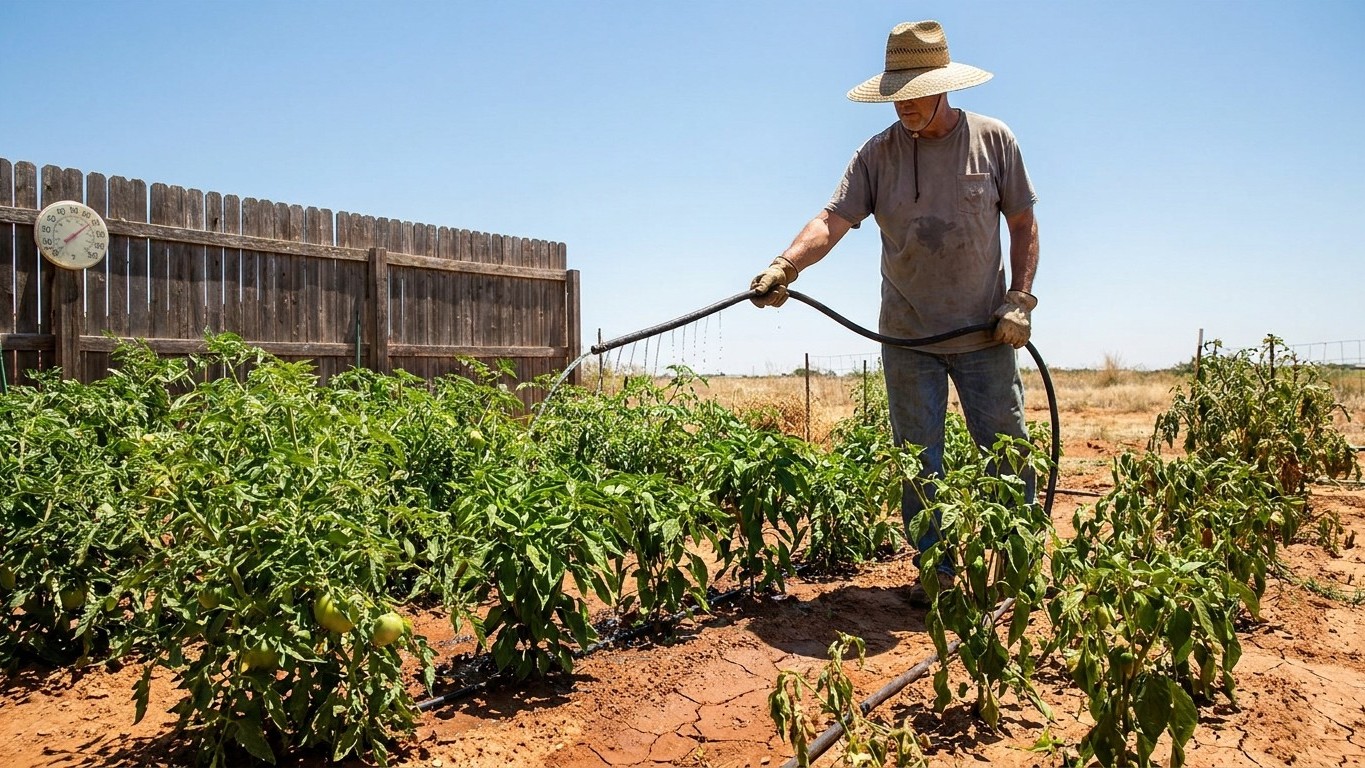

Texas gardens don’t fail from neglect. They fail from misreading the state’s own extremes: a Gulf Coast summer that logs over 100 days above 90°F, soil that ranges from sticky coastal clay to sandy Panhandle loam, and a hardiness map that spans four full zones. Get the watering math wrong here and you’ll know it within a week.
What the climate asks of you

Start with the number that rules the growing season: at the Houston reference station, NOAA’s 1991-2020 Climate Normals put the average at 102.4 days a year at 90°F or hotter. That’s not a heat wave. That’s a third of the calendar spent pushing water out of leaves faster than most root systems can pull it back in. A cool-season lawn or a shallow-rooted annual simply cannot coast through that stretch on luck.
Rainfall totals for June, July and August aren’t part of the verified dataset behind this guide, and Texas is too large a state to guess at a single summer rainfall figure that would hold true from the Rio Grande Valley to the Panhandle. What the heat-day count already tells you is enough to plan around: with more than a hundred days a year at or above 90°F concentrated mostly in the warm months, evaporation from soil and transpiration from plants run high for a long stretch, and any rain that does fall gets used up fast. Treat summer as the season where the garden depends on you, not the sky, and confirm actual local rainfall patterns with your county’s Texas A&M AgriLife Extension office before you set a schedule.
Soil changes the math
The USDA Plant Hardiness Zone Map lists Texas across zones 6a to 10a, a range wide enough that a planting calendar built for Houston tells you almost nothing useful in Amarillo or Lubbock. Soil texture shifts just as much across that distance. Coastal clay near Houston holds water and drains slowly; sandy soils common in parts of Central and East Texas let water pass straight through. On sandy ground, the same watering session that would keep a clay bed moist for five days might be dry again in two. Know which soil you’re standing on before you trust any generic watering interval, including the ones in this article.
How much, how often
The standard garden guideline is roughly one inch of water a week, delivered in one or two deep sessions rather than a handful of shallow ones. Shallow, frequent watering trains roots to stay near the surface, where Texas heat bakes them fastest. Deep, infrequent watering pushes roots down toward moisture that survives longer between sessions, and that’s the difference between a bed that limps through August and one that doesn’t.
Skip the calendar and check the ground instead. Push a finger, or better, a trowel, two inches into the soil near the base of the plant. If it comes out dry at that depth, water. If it’s still damp, wait. This habit becomes especially important for Watering Pots and Containers in Texas, since containers dry out far faster than garden beds, and equally important when Watering Through a Dry Spell in Texas, and it does more to prevent both drought stress and root rot than any fixed schedule, especially in a state where soil texture swings as widely as it does across Texas.
Sandy soil in parts of Central and East Texas holds so little water that it may need shorter, more frequent soakings than a generic weekly rule suggests. Heavy clay, common closer to the Gulf, holds a week’s worth of water but drowns roots if it’s soaked again before it has actually dried out, and it should never be dug or walked on while wet, since that compacts it into something closer to brick. With no dependable summer rainfall figure to lean on for the whole state, the safest working assumption during the hottest stretch of the year is that irrigation is doing most of the job, not the sky.
- Check soil moisture first. Two inches down with a finger or trowel; water only if it’s dry there, regardless of the surface.
- Water in the morning. Early hours let the plant take up moisture before the day’s heat, cutting evaporation loss that’s steep once temperatures near 90°F.
- Aim at the base, not the leaves. Wet foliage in Texas humidity is an invitation to fungal disease.
- Deliver about one inch per week, split into one or two sessions rather than daily sprinkles.
- Adjust for soil texture. Sandy beds may need a second, shorter session midweek; clay beds may need less frequent but slower, deeper watering to avoid runoff.
- Let clay dry between waterings. Never soak or work heavy clay soil while it’s still wet from the last session.
Restrictions and rules
Watering restrictions in Texas aren’t set at the state level in any uniform way. They’re issued by individual municipal water utilities and groundwater districts, and they change based on reservoir levels, drought stage declarations, and local ordinances that can shift from one summer to the next. A city under Stage 2 drought restrictions in July might lift them by September, or tighten them further if conditions worsen.
Because rules vary this much by provider, the only reliable move is to check directly with your local water utility or municipal water district before setting an irrigation timer. Many utilities publish designated watering days by address, time-of-day bans on daytime watering, or limits on hose-end sprinklers during declared droughts. Your county office of Texas A&M AgriLife Extension can also point you to the applicable district and its current status.
Given that the state logs over a hundred days a year above 90°F at the Houston reference station alone, and that heat-driven demand for municipal water climbs right alongside it, restrictions are a real possibility in most Texas communities during peak summer, not a rare exception. Building in the assumption that your watering days might be limited, rather than discovering it mid-drought, saves both plants and fines.
Using less
Cutting water use in a Texas garden isn’t about watering less often and hoping. It’s about making every gallon last longer once it hits the soil, which matters more here than in milder climates given how many days a year push past 90°F.
- Mulch, two to three inches deep. A layer of shredded bark or straw around plants slows evaporation dramatically and keeps soil temperature down, which matters directly through a summer with over a hundred 90-degree-plus days.
- Drip irrigation instead of overhead sprinklers. Drip lines deliver water at the root zone with far less lost to evaporation or wind drift, a real advantage during Texas’s hottest, driest stretches.
- Group plants by water need. Thirsty vegetables and drought-tolerant natives shouldn’t share a zone; watering to satisfy the thirstiest plant wastes water on the others.
- Work organic matter into the soil. Compost improves water retention in sandy soil and improves drainage in heavy clay, which softens the extremes found across Texas’s different regions.
- Collect rainwater where local rules allow it. A rough rule used by extension programs nationally is that one inch of rain falling on a 1,000-square-foot roof yields around 600 gallons of runoff. In a state where heavy downpours can be followed by long dry stretches, a barrel fills fast during a storm and can sit empty for weeks afterward, so it works best as a supplement to a watering routine, not a replacement for it.
Common questions
What USDA hardiness zone is Texas in?
Texas spans USDA zones 6a to 10a, one of the widest ranges of any state. That means a planting or watering calendar built for Houston’s mild Gulf climate won’t match conditions in the Panhandle, Hill Country, or West Texas. Always check your specific zone rather than relying on a single statewide figure.
When is the last spring frost in Texas?
At the Houston reference station (IAH), the 30-70% probability window for the last 32°F freeze runs from February 4 to March 1. This is specific to the mild Gulf Coast end of the state; the Panhandle and North Texas see frost risk continue much later into spring, so this window shouldn’t be used as a statewide planting date.
When does the first fall frost typically hit?
Again at the Houston station, the 30-70% probability window for the first 32°F freeze in fall falls between December 1 and December 19. Even nearby Hobby Airport runs about two weeks milder than this figure, which underlines how much frost timing shifts even within a single metro area, let alone across the state.
How do I find current watering restrictions for my area?
Contact your municipal water utility or groundwater district directly, since restrictions are set locally and change with drought conditions rather than by a single statewide rule. Your county’s Texas A&M AgriLife Extension office can also help identify which district covers your address and point you to its current watering schedule.