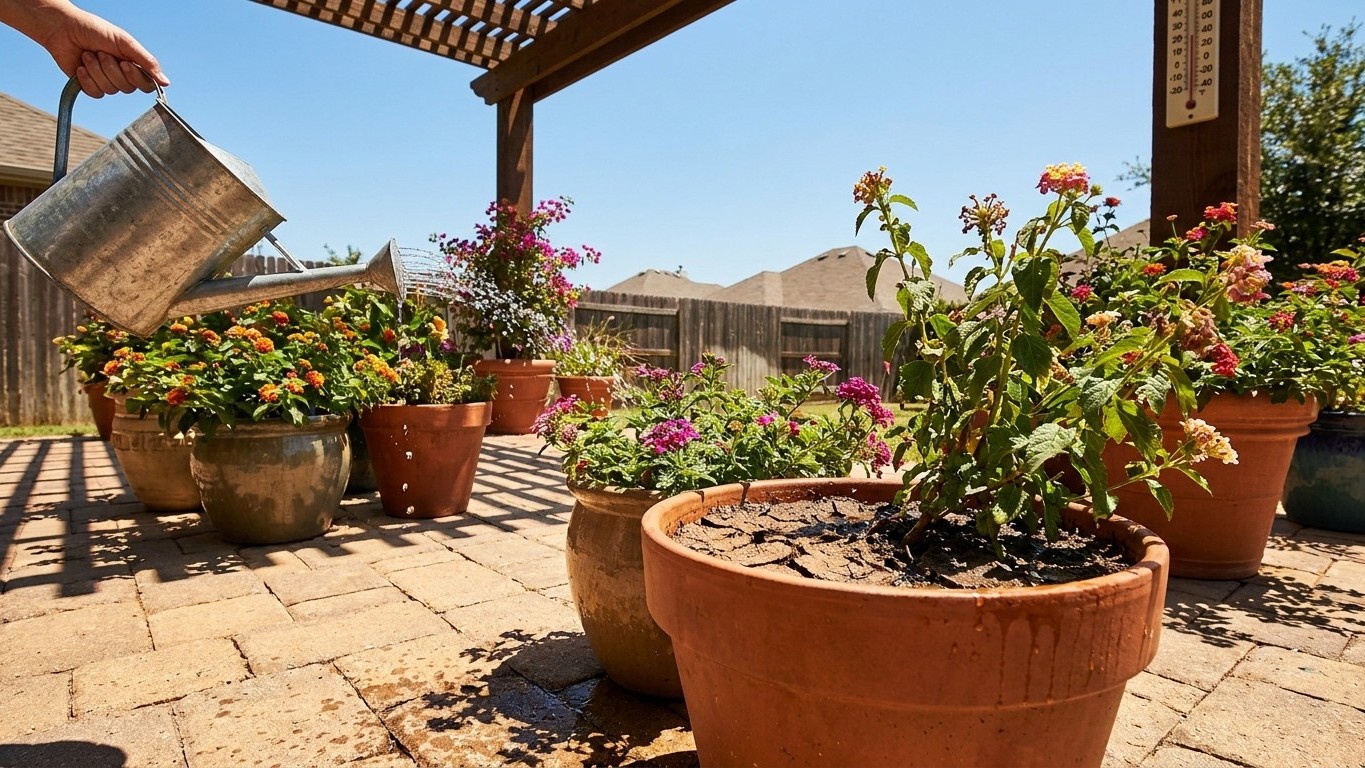

An inch of water a week is the rule of thumb for garden beds, but containers in Texas burn through that fast. With July delivering just 3.77 inches of rain and the state averaging 102.4 days a year at or above 90F, potted plants dry out days before an in-ground bed would even notice. The gardener, not the sky, ends up doing most of the watering.
What changes here

Two numbers set the terms for every pot on a Texas patio: 3.77 inches of rain in July, the driest month of summer, and 102.4 days a year that hit 90F or higher. Together they mean the heat load is doing far more work on a container’s soil than the rainfall is replacing. A garden bed pulling moisture from several feet of ground can coast through a dry stretch. A container holding maybe a gallon or two of potting mix has no such reserve, and the sun is hammering it from all sides, not just the top.
Run the arithmetic on July. That 3.77 inches falls over roughly four and a third weeks, which works out to a little under an inch a week on paper, about 0.85 inch. That number would satisfy a garden bed. It does not satisfy a container, because rain in a Texas July rarely arrives as a gentle, evenly spread inch. It comes as a scattered thunderstorm that dumps hard for twenty minutes and quits, and a good share of that runs straight off a potting mix that’s already crusted dry, or misses the pot altogether if it’s tucked under a porch roof or patio overhang, which is exactly where a lot of container gardens live.
| Month | Average rainfall |
|---|---|
| June | 6.0 inches |
| July | 3.77 inches |
| August | 4.84 inches |
June and August bring more rain on average than July, but neither one changes the core math for a container. A pot doesn’t store water the way ground soil does. Sandy garden soil lets an inch of rain pass through within a day; heavy clay can hold that same inch for a week. A container splits the difference badly: potting mix drains fast like sand, but there’s no deep reservoir underneath to draw on once the surface dries, so the plant feels the shortage almost immediately. The 14.6 inches of total summer rainfall (June through August) sounds like plenty across three months, but spread over 102.4 days of 90-degree heat, it’s not enough to keep a container consistently moist without help.
How to water when it matters
Deep, infrequent watering at the base, done in the morning, works better for containers than a light daily sprinkle, and each part of that method solves a specific problem tied to Texas heat. Morning watering gives moisture time to soak into the root zone before the day’s peak heat pulls it back out through evaporation. Watering at the base, rather than overhead, keeps foliage dry so the plant isn’t sitting in wet leaves during the warm overnight hours that follow. Depth matters because shallow, frequent watering trains roots to stay near the surface, right where the container’s outer inch bakes hardest under 90-plus-degree sun.
The surface of a pot can look bone-dry and mean nothing about what’s happening two inches down, or it can look fine on top while the root ball underneath is already parched. Checking with a finger pushed two inches into the mix, or a small trowel for larger containers, tells the real story. If it comes out dry at that depth, it’s time to water. If it’s still cool and damp, wait.
- Push a finger or trowel two inches into the potting mix; water only if that depth feels dry, not just the surface.
- Water slowly at the base of the plant until it runs freely from the drainage holes, which signals the whole root ball has been reached.
- Do this in the early morning, before the heat of the day sets in and pulls moisture back out.
- Check smaller or unglazed terracotta pots daily during the hottest stretch of summer, since they lose moisture through their walls as well as the surface.
- Check larger, glazed or plastic containers every two to three days as a starting point, then adjust based on what the finger test actually shows in that specific pot.
That two-to-three-day figure is a starting point, not a rule. A small terracotta pot in full sun on a concrete patio can need daily water even when a large glazed container six feet away is still holding moisture on day three. The finger test settles the argument every time.
What goes wrong
A daily light sprinkle that never reaches the roots
Splashing a little water on top every day feels responsible, but it wets only the top inch of mix and keeps roots shallow, right in the zone that dries out fastest and heats up hardest under a Texas sun. Those roots never develop the depth that would let the plant tolerate a missed watering.
Watering the leaves in the evening
Wetting foliage after dinner, when it feels cooler and more pleasant to be outside, leaves leaves damp all night. Combined with warm overnight temperatures common through a Texas summer, that dampness is an open invitation to fungal disease. Water the base, not the leaves, and do it in the morning instead.
Trusting a thunderstorm that never really landed
A hard summer downpour can look like it solved the watering problem for the week. It often hasn’t. Container mix crusts when dry and sheds water fast, and pots tucked near a wall, under an eave, or beneath a tree canopy may have caught almost none of it. With July averaging only 3.77 inches across the whole month, a single storm skipped is a real dent. Check the actual soil with a finger before crossing watering off the list.
Skipping the mulch layer on top of the pot
Bare potting mix exposed to 102.4 days a year of 90-plus heat loses moisture fast to straight evaporation. A thin layer of mulch, bark, or even gravel on top of the soil slows that loss and buys the roots underneath more time between waterings, which matters most during the hottest, driest stretch of the Texas summer.
Local help
Watering rules and restrictions vary by city and water provider across Texas, so check with the local utility before setting a fixed schedule. For guidance suited to Texas growing conditions, soils, and plant choices, the Texas A&M AgriLife Extension service is the state’s land-grant resource for home gardeners.
Common questions
How often should I water container plants during a Texas summer?
Start by checking every two to three days with a finger two inches into the mix, then adjust: small terracotta pots in full sun often need daily water once temperatures push past 90F regularly.
Does Texas rainfall cover container watering needs in summer?
Rarely on its own. July averages only 3.77 inches for the whole month, and pots sheltered under porches or eaves often miss rain entirely regardless of what falls elsewhere.
Is morning or evening better for watering potted plants?
Morning. It lets moisture soak in before heat pulls it back out, and it avoids leaving foliage damp overnight, which invites disease during warm summer nights.
Why do containers dry out faster than garden beds in Texas heat?
A container holds a small, fixed volume of mix with no deep soil reserve to draw on, while a Texas summer brings 102.4 days a year at or above 90F pulling moisture out from every side of the pot, not just the surface.