
Wisconsin’s growing conditions run from USDA zone 3b in the north to zone 6a near Lake Michigan, according to the USDA Plant Hardiness Zone Map (2023, based on 1991-2020 normals), and that spread decides which flowers survive here. NOAA’s 1991-2020 climate normals, measured at the Milwaukee reference station, put the mean daily minimum of the coldest month at 17.2°F, cold enough to kill anything rated for warmer zones outright. Before buying a flower on impulse, check the hardiness zone printed on its tag against your own county, not against Milwaukee’s milder lakeside climate.
What thrives in Wisconsin

Some flowers come back every spring here, and some die the first hard winter no matter how nice they looked at the garden center. The difference almost always comes down to how cold your specific patch of ground actually gets, not how mild it feels on a warm October day when you’re planting. So before you put anything in the ground, find the hardiness zone printed on the tag and check it against your own county, not against the lakeshore.
Cold hardiness comes first
NOAA’s 1991-2020 climate normals, measured at the Milwaukee reference station, put the mean daily minimum of the coldest month at 17.2°F. That is not the record low. It is the ordinary cold snap a plant has to survive most winters, and it is the number that decides whether a perennial comes back or needs replacing every spring. Anything rated hardy only to zone 7 or warmer is functionally an annual anywhere in Wisconsin, no matter how good the catalogue photo looks. Peonies, daylilies, coneflowers, black-eyed Susans and Siberian iris all carry hardiness ratings that comfortably cover zone 3b, which is why they show up in nearly every established Wisconsin yard. Many of the state’s most dependable flowers come from a handful of plant families: Asteraceae supplies the coneflowers, black-eyed Susans and asters that tolerate both cold and drought, while Iridaceae covers the hardy irises and Paeoniaceae the peonies that anchor so many older Wisconsin gardens.
Heat and humidity, not drought, set the summer limit
Summer here is short and only moderately hot. NOAA’s Milwaukee normals count just 7.0 days a year reaching 90°F or above, so flowers bred for desert heat or for the long, blistering summers of the Deep South rarely get the conditions they were selected for. Humidity is the bigger stressor than heat itself: still, muggy air after a rain encourages powdery mildew on susceptible phlox and bee balm, and good air circulation between plants does more good than shade in most Wisconsin borders. Gardeners arriving from a milder, wetter coastal climate, the kind found in Connecticut, sometimes over-water Wisconsin beds out of habit. The shorter, cooler growing season usually needs less irrigation, not more.
Drought tolerance is still worth planning for, because Wisconsin summers can run several weeks without meaningful rain even in a state that averages wet overall. Prairie natives with deep taproots, sedums, and ornamental grasses hold up through those dry stretches without supplemental water once their root systems are established, which typically takes a full growing season.
Native plants worth the space
Native prairie and woodland-edge plants evolved alongside Wisconsin’s exact freeze-thaw cycle, so they need no winter protection and, once their roots take hold, very little supplemental water. Establishment takes one to two full growing seasons, so a native planted this spring still needs regular watering through its first summer like any other new plant. The payoff after that is a plant that survives drought, ice storms, and poor soil without intervention.
Species worth planting
These species are native to the wider tallgrass prairie region of the upper Midwest and show up reliably in established Wisconsin plantings:
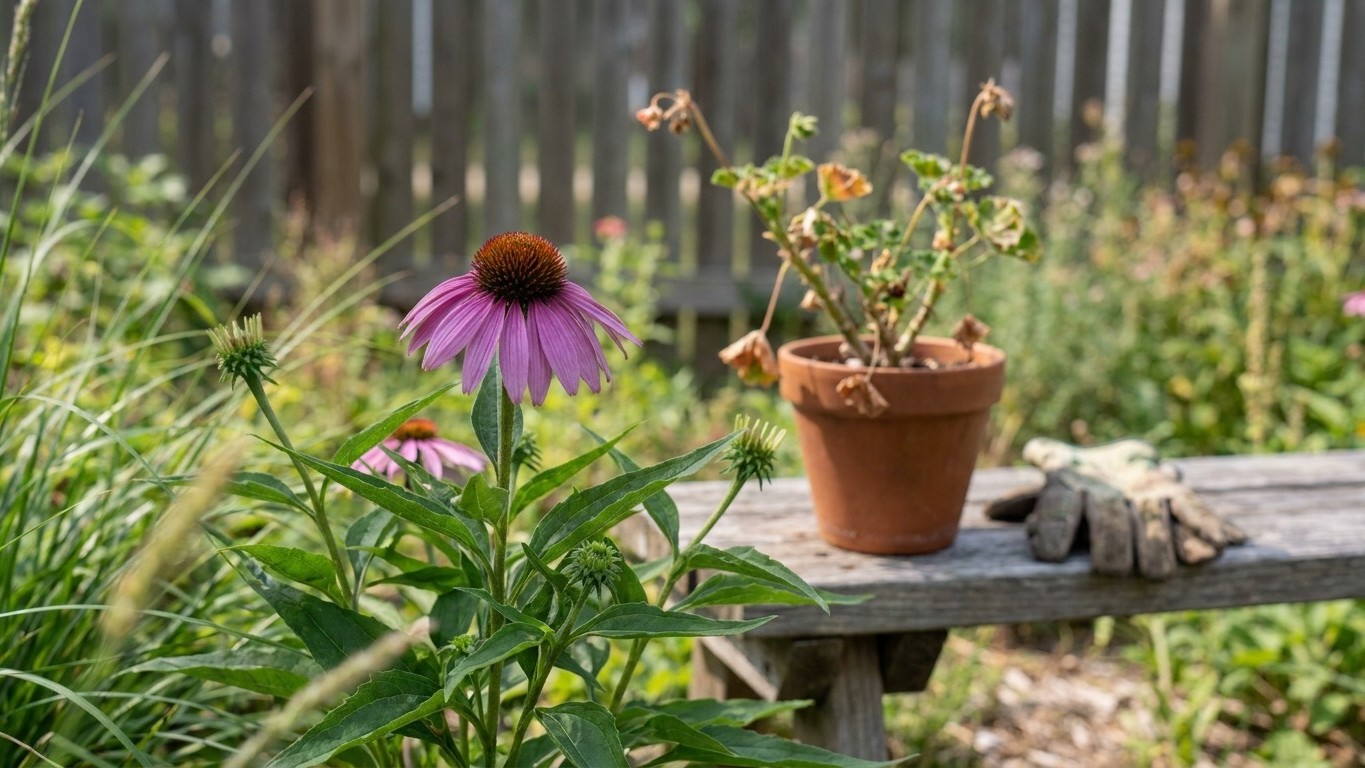
- Purple coneflower (Echinacea purpurea): upright, drought-tolerant, blooms through the hottest stretch of summer
- Black-eyed Susan (Rudbeckia hirta): self-seeds readily and holds up in poor, unamended soil
- Wild bergamot (Monarda fistulosa): lavender blooms that draw bumblebees and hummingbird moths
- Butterfly milkweed (Asclepias tuberosa): the only host plant monarch caterpillars will eat, with a deep taproot that shrugs off dry spells
- Prairie blazing star (Liatris pycnostachya): tall purple flower spikes, useful as a cut flower
- New England aster (Symphyotrichum novae-angliae): one of the last natives to bloom, feeding pollinators into fall
Beyond the marquee bloom, these plants build soil structure that ornamental hybrids rarely match. Deep, fibrous root systems break up compacted clay over several years and reduce erosion on slopes, and the extended bloom sequence across the group, from early summer bergamot through fall asters, keeps native bees and butterflies fed for months rather than a few weeks.
Skipping natives for an all-hybrid border isn’t a mistake exactly, but it trades away free pollinator traffic and lower long-term maintenance for a longer bloom window on a few showpiece flowers. A mixed approach usually works best: anchor a border with three or four natives for the bees and monarchs, then fill in with peonies or daylilies where you want a specific color at a specific week of the calendar.
Perennials that come back

At Wisconsin’s USDA zone range of 3b to 6a, a genuine perennial has to survive a mean minimum of 17.2°F in the coldest month, per NOAA’s Milwaukee normals, and colder than that farther north and inland from the lake. Read the hardiness zone on a plant tag against your own county, not against Milwaukee. A tag rated hardy to zone 5 will winter over fine near the lakeshore and die in a zone 4 or 3b county without extra protection.
Reliable across most of the state
Peonies, daylilies, hostas, purple coneflower, black-eyed Susan, Siberian iris and most sedums are rated hardy well into zone 3, so they return in nearly every Wisconsin yard without winter mulching. Bearded iris and garden phlox generally hold to zone 4, which covers most of the state but can be marginal in the coldest northern counties without a layer of winter mulch over the crown.
Grown as annuals here, hardy further south
Some of the most popular garden-center flowers are perennial only in much warmer climates and get treated as annuals in Wisconsin, replanted every spring. Lantana, verbena bonariensis and most mandevilla are commonly rated hardy only to about zone 8 or 9, conditions closer to those in Louisiana than to Milwaukee, so Wisconsin gardeners buy them fresh each year rather than expect them to overwinter outdoors. Dahlias are genuinely perennial in mild climates but need their tubers dug and stored indoors over a Wisconsin winter if you want the same plant back next year.
| Plant | Typical catalogue hardiness | Status in Wisconsin |
|---|---|---|
| Peony | Zone 3-8 | Reliable perennial statewide |
| Daylily | Zone 3-9 | Reliable perennial statewide |
| Garden phlox | Zone 4-8 | Perennial, marginal in far north |
| Dahlia | Zone 8-11 | Grown as annual, or tubers lifted and stored |
| Lantana | Zone 9-11 | Grown as annual |
The zone number on a tag is a floor, not a guarantee of survival. A plant rated hardy for your zone still needs reasonable drainage, since wet feet in a cold winter kill more marginal perennials than the cold itself. Amending heavy clay soil before planting, or choosing a raised bed for anything borderline, does more for winter survival than an extra layer of mulch.
Putting a border together
A border reads as one design instead of a row of unrelated plants when it’s built in layers, timed to bloom in sequence, and planted with room to fill in rather than to look finished on day one.
Layer by height
Put the tallest flowers, prairie blazing star, garden phlox, tall sedums like ‘Autumn Joy’, at the back of a bed viewed from one side, or in the center of an island bed viewed from all around. Mid-height plants such as coneflower, black-eyed Susan and daylilies fill the middle ground, and low edging plants, creeping phlox, dwarf sedum, or annual alyssum, hide the bare soil at the front until everything else fills in over the following seasons.
Plan bloom in sequence
Wisconsin’s growing season runs from the last spring frost to the first fall freeze. NOAA’s 1991-2020 normals put both as a range at the Milwaukee reference station: the last spring freeze falls between April 16 and April 29, and the first fall freeze falls between October 17 and October 29. Gardeners farther from the lake should expect an earlier freeze in fall, and can check their own county’s dates through their local extension office rather than assume Milwaukee’s window applies to them. Inside that season, stagger bloom time on purpose: peonies and iris open in late spring, coneflower and daylilies carry midsummer, and asters and sedum finish the display into fall. A border planted entirely with midsummer bloomers looks bare for the weeks on either side of that peak, which is the single most common design mistake in a first-year bed.
Repeat color, and leave room
Three plants of one color scattered once through a border reads as chaos. The same three plants repeated in clusters of three at intervals down the bed reads as a plan, even with no other design skill involved. Space new perennials at their mature spread, not their nursery-pot size: a coneflower that looks lonely with two feet of bare mulch around it in May will fill that gap by its second summer, and crowding it now just means digging and dividing sooner than you’d like. In the first year, before perennials reach full size, tuck in inexpensive annuals like marigolds, zinnias or cosmos to fill the gaps without permanently crowding the bed. Pull them at the end of the season and the perennials take over the space they were always meant to have.
Local help
The University of Wisconsin-Madison Division of Extension runs a Master Gardener Volunteer program through county-level offices that keep plant lists suited to their own soil and microclimate, which matters more than any statewide guide once you’re picking exact cultivars. Call or visit your county extension office before buying anything borderline for your zone, since they know which side of the 3b-6a divide you’re actually gardening on. Our broader Wisconsin guides cover related timing questions, from vegetable planting dates to frost protection.
Common questions
Can I grow hydrangeas in Wisconsin?
Panicle hydrangea (Hydrangea paniculata) and smooth hydrangea (Hydrangea arborescens) are the safe choices, both commonly rated hardy to zone 3 or 4 on the plant tag, which covers essentially all of Wisconsin. Bigleaf hydrangea (Hydrangea macrophylla), the kind with the big blue or pink mophead blooms, is usually rated only to zone 6 and will struggle or die back to the ground most winters outside the warmest strip near Lake Michigan.
Why do my perennials that are supposed to be hardy keep dying?
Wet soil in winter kills more marginal perennials than cold air does. A plant rated hardy for your zone still needs drainage that lets water move away from the crown, because saturated soil that freezes and thaws repeatedly damages roots even on a plant that could otherwise handle the temperature. Raised beds, or amending heavy clay with compost before planting, solves this for most borderline perennials.
When is it too late to plant perennials in fall?
Aim to get perennials in the ground at least six weeks before your area’s first fall freeze so roots have time to establish before the soil locks up. Near Milwaukee, where NOAA’s 1991-2020 normals put the first fall freeze between October 17 and October 29, that generally means finishing fall planting well before the end of September. Gardeners farther north or inland should count back from their own local freeze date instead, since it arrives earlier than Milwaukee’s.
Do Wisconsin flowers need full sun?
Most of the reliable perennials named here, coneflower, black-eyed Susan, daylily, and peony, want six or more hours of direct sun a day to bloom well. Hostas and astilbe are the shade exceptions and actually do better with protection from the hottest afternoon sun, which matters more on one of Milwaukee’s rare 90°F days than on an average Wisconsin summer afternoon.
Related guides
- Flowers That Actually Thrive in Michigan, and the Ones That Struggle
- Flowers That Actually Thrive in Minnesota, and the Ones That Struggle
- Flowers That Actually Thrive in Connecticut, and the Ones That Struggle