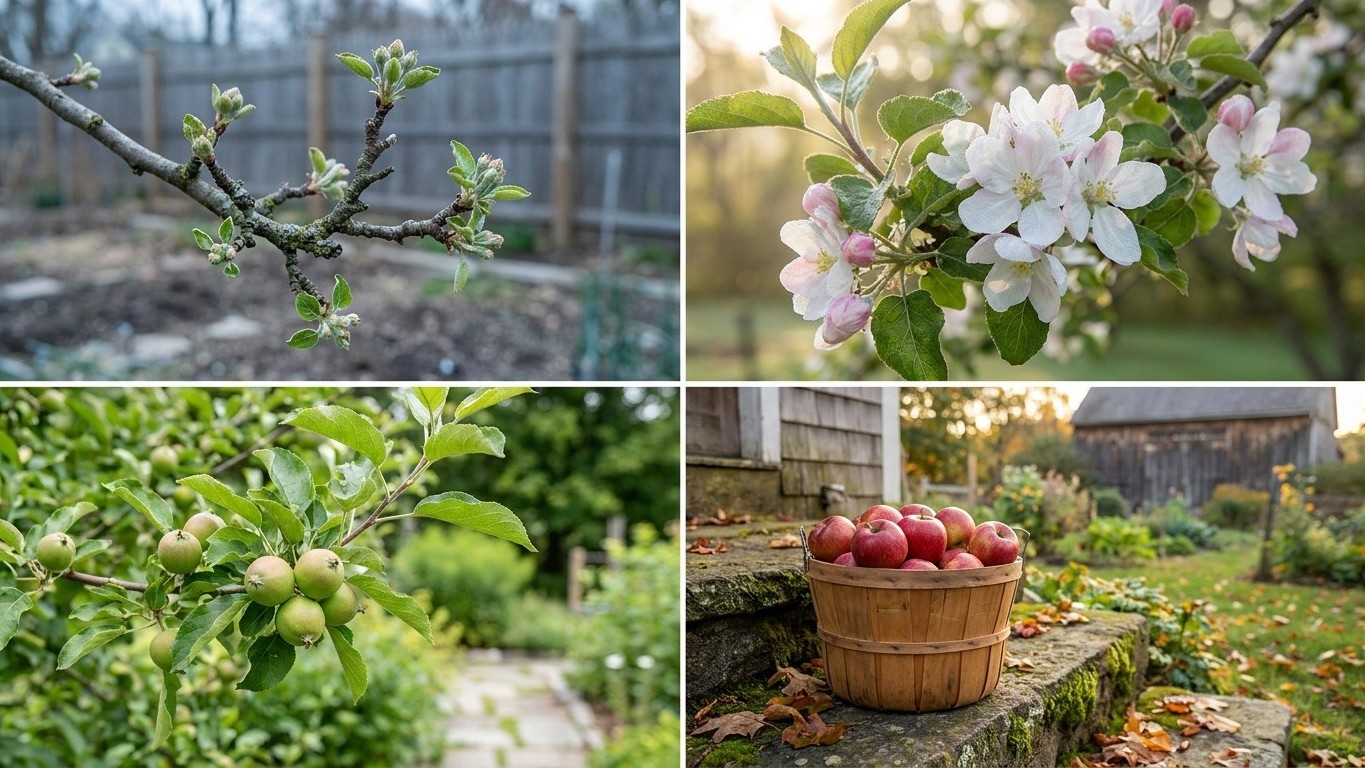

Connecticut’s apple stages run on two fixed points: NOAA’s 1991-2020 climate normals put the last spring frost at Bridgeport between April 2 and April 12, and the first fall frost between October 28 and November 10, at the same coastal reference station. Everything else on the tree, from bud break to harvest, is timed against those two windows rather than against a date on the wall. The single thing to check before you do anything else this season: what stage your buds are actually at, because a warm week can push a tree ahead of the frost window fast.
The short answer for Connecticut
Connecticut’s apple trees don’t care what the calendar says this week, they care what stage their buds are in, and that’s the only question worth answering before the next cold night rolls in. Pink buds and open blossoms take frost completely differently, so a stage that’s harmless on Tuesday can be crop-ending by Friday if the tree has moved on and you haven’t checked. So walk out today and look, green tip, pink, or open bloom, because that’s what tells you how much danger is actually sitting in the forecast for your trees right now.
What the answer depends on is not the month but three things: how early a given cultivar blooms, how high or how inland the site sits relative to the Long Island Sound coast, and whether the rootstock and cultivar are hardy enough for the site’s winter minimum. If you have not yet picked a site, a rootstock, or a cultivar list, that groundwork is covered in Growing Apples in Connecticut, and this calendar assumes it is already done. An orchard planted on a hillside above a river valley will move through these stages differently than one in a low frost pocket a mile away, even though both sites are nominally in the same county.
Working through it

The calendar below moves stage by stage rather than month by month, because the stage is what decides risk. A tree can sit at green tip for two weeks in a cold spring or ten days in a warm one. What matters is where the tree is when a frost arrives, not what the date says.
Dormancy

From leaf drop in fall, typically not long after the first fall frost window closes at Bridgeport (NOAA, October 28 to November 10), through late winter, the tree is fully dormant. This is when structural pruning, dormant oil applications, and any trunk protection against rodents or sun scald get done. The tree is at its most cold-tolerant during this stage, which is why the coldest-month minimum matters here more than at any other point in the year.
Green tip

Buds swell and show a thin line of green at the tip as the tree resumes growth after accumulated warmth. This usually happens before the last spring frost window closes, and the buds at this stage still tolerate a fair amount of cold, so a frost here is rarely a crop-ending event on its own.
Pink

Flower buds swell further and turn visibly pink, still closed. This stage is markedly more frost-sensitive than green tip, and it often lands close to or inside the last spring frost window of April 2 to April 12 at Bridgeport, which is exactly why growers watch that window rather than a fixed date. A pink-stage frost is where a poorly sited early cultivar starts to lose flowers.
Bloom and petal fall


Open blossoms are the most frost-vulnerable stage of the whole year. For most sites, full bloom lands after the worst of the spring frost risk has passed, but a late frost inside or even just after the April 2 to April 12 window can still catch an early-blooming cultivar in flower. Petal fall follows within days and is only slightly less risky, since the young fruitlet forming underneath the spent petals is still tender.
Fruit set through harvest

Fruitlets that survive petal fall thicken and green up over the following weeks, and by then frost risk has generally dropped off for the season. Harvest timing from here is a cultivar question more than a climate one. Catalogue figures for apples are usually given as days from full bloom to harvest, and they run a week or two either way depending on the season and site, so treat them as a range to plan around rather than a fixed date.
| Variety | Days from bloom to harvest | Typical harvest timing | Note |
|---|---|---|---|
| ‘Zestar!’ | 100-110 | Early to mid August | Earliest of the common home-orchard picks, so also earliest-blooming and most exposed to a late spring frost |
| ‘Liberty’ | around 135 | Late September | Scab-resistant, useful where spray schedules are kept light |
| ‘Honeycrisp’ | 135-145 | Mid to late September | Needs consistent care through summer to size well |
| ‘GoldRush’ | 165-175 | Mid to late October | Long season, harvest pushes close to the first fall frost window in cooler inland sites |
| ‘Northern Spy’ | 170-180 | Mid to late October | Very cold-hardy tree, but needs the longest season of this group to finish |
A cultivar like ‘GoldRush’, at 165 to 175 days from full bloom, and with bloom typically landing several weeks after the region’s last spring frost window, can push its harvest right up against the first fall frost window of October 28 to November 10 at Bridgeport, and later still inland. That is the calculation to run yourself with a specific cultivar’s published figure and your own site’s frost pattern, not a date to take from any single source. A fuller ranking of cultivars against the state’s frost and chill patterns is in The Best Apple Varieties for Connecticut.
What changes across Connecticut
The Bridgeport station NOAA uses for these normals sits on the Long Island Sound coast, which is the mildest, most frost-buffered ground in the state. Every stage above runs later in spring and earlier in fall the further you move from that coastline, and NOAA’s own caution on this data says inland and northwest Connecticut freeze noticeably earlier in fall and later in spring than Bridgeport does.
The northwest highlands
The Litchfield Hills sit at meaningfully higher elevation than the shoreline, and elevation alone pushes bud break, pink, and bloom later in spring, and pushes the first fall frost earlier. An orchard here should expect its whole calendar to run later than the Bridgeport windows above, not earlier.
River valleys and frost pockets
Cold air drains downhill and pools in low ground overnight, so a site at the bottom of a valley, along the Housatonic or the upper Connecticut River lowlands for instance, can see a harder, later spring frost and an earlier fall frost than a slope just above it. This is a site-level effect as much as a regional one, which is why two orchards a short drive apart can bloom and finish harvest days apart.
The shoreline
The immediate coast, where Bridgeport’s own data comes from, keeps the mildest and most frost-buffered conditions in the state through both spring and fall. If your orchard sits within a mile or two of Long Island Sound, the Bridgeport windows are a reasonably close fit. Move a few miles inland from that shoreline strip and the gap starts to widen.
The mistakes this climate punishes
Most crop failures on a home apple tree in Connecticut trace back to one of three timing mistakes, and each shows up at a different point in the season.
An early cultivar in a late-frost year
Planting a cultivar that blooms early, like ‘Zestar!’, on a site where spring frost tends to run late, sets the tree up to flower right into risk every few years. This shows up as a thin or absent crop the spring after an otherwise normal-looking bloom, and it is the most common reason a tree that fruited well for years suddenly does not.
Feeding or pruning too late in the season
Nitrogen applied in mid to late summer, or pruning cuts made after midsummer, push soft new growth that has not hardened off by the time the first fall frost window arrives. That tissue is the first thing damaged, and dieback from it becomes obvious the following spring rather than immediately.
A rootstock or cultivar that is not hardy enough for the site
NOAA’s 1991-2020 normals put Bridgeport’s coldest-month mean minimum at 23°F, and that figure alone rules out tender rootstocks and marginally hardy cultivars on any site colder than the coast, which is most of the state. A tree that looked fine its first two winters can still take serious trunk and root damage the first genuinely hard winter it sees, and by then it is too late to change the rootstock. Get the hardiness right at planting, since it is not a mistake you can correct later without starting over.
Checking this against your county
Bridgeport’s frost windows are a coastal figure, and the further your orchard sits from that reference point, the more your actual dates will drift from them. UConn Extension is the land-grant service for the state and the right place to check local frost data, cultivar recommendations, and pest and disease timing specific to your county. Their site is at extension.uconn.edu, and it is worth a call or a look before you commit to a cultivar list based on the general figures above.
Common questions
How many chill hours does an apple tree need in Connecticut?
No figure for local winter chill accumulation is included in this article’s sourcing, so do not treat any number you see elsewhere as fixed for your county. Most apple cultivars sold for the Northeast are bred for chill requirements well within what a Connecticut winter provides, but check with UConn Extension for cultivar-specific guidance for your area.
Can frost still hurt my apple trees in May?
It is possible, though NOAA’s Bridgeport normals put the last spring frost window at April 2 to April 12, meaning frost risk is dropping sharply by then on the coast. Inland and higher-elevation sites run later than that window, so a May frost is more plausible away from the shoreline, and it would most likely catch a tree still at bloom or petal fall rather than one already past fruit set.
Do I need two apple trees to get fruit?
Most apple cultivars need pollen from a different, compatible cultivar to set fruit reliably, so a single isolated tree often blooms well but sets little fruit. A neighbor’s tree or a nearby crabapple can sometimes cover this, but it is worth checking bloom overlap with the specific cultivars involved.
Why did my tree bloom fine but drop most of its fruit afterward?
Heavy fruit drop shortly after petal fall is often the tree thinning itself, which is normal and not a sign of frost damage if the fruitlets look otherwise healthy. If the drop happens right after a cold night during bloom or petal fall, frost damage to the young fruit is the more likely explanation.