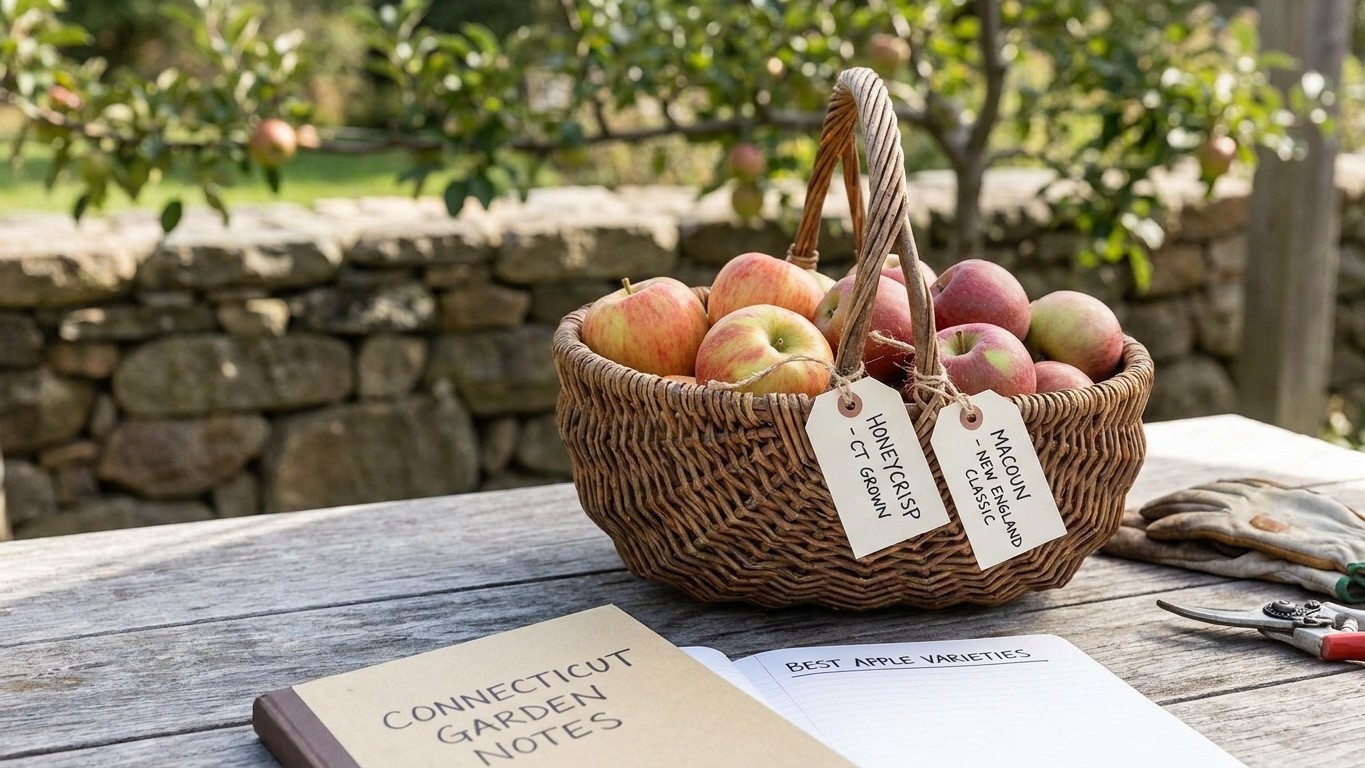

Connecticut’s apple problem isn’t which variety tastes best — it’s whether the tree you plant can clear your last frost before it blooms and shrug off the winter after. That’s the whole game here: rootstock hardiness and bloom timing beat flavor preference every time, because a beautiful cultivar that flowers into an April frost gives you nothing to taste at all. So before you fall for a name on a nursery tag, find your site’s typical last-frost date and match rootstock and bloom group to it — that single number rules out half the list before you ever get to pick a favorite.
The short answer for Connecticut
No single apple variety is the universal answer for the whole state, and that’s not a dodge, it’s the actual constraint. Winter hardiness and bloom timing against the last frost decide more than flavor preference does. NOAA’s 1991-2020 climate normals for Bridgeport (station USW00094702) put the coldest month’s average daily low at 23°F, mild by Connecticut standards since Bridgeport sits on Long Island Sound. The same station’s freeze records put the last spring frost between April 2 and April 12, and the first fall frost between October 28 and November 10. Every apple choice you make gets measured against that window, and against a later, colder version of it if your site is inland.
If you haven’t already worked through site selection and planting basics, Growing Apples in Connecticut is the place to start before you get into variety choice.
What decides the outcome is not the tree’s name but three things: whether its rootstock survives your winter, whether it flowers late enough to dodge the April frost window, and whether its resistance to scab, cedar apple rust or fire blight matches your site’s disease pressure. Full-size and semi-dwarf trees on rootstocks such as MM111 or M7 tolerate cold better at the root than dwarfing stock like M9 or M26, which is the trade you’re making for a smaller, earlier-bearing tree.
Ask your nursery or the extension office which named cultivars they carry on which rootstock before you plant, and check the bloom group against your own local last-frost pattern rather than the Bridgeport figure if your site is inland or upland.
Working through it

Ranking apple choices for Connecticut means ranking the traits that survive here, not the names on a nursery tag. Four filters decide whether a tree thrives: rootstock hardiness, bloom timing relative to the last frost, winter chill, and disease pressure.
Rootstock decides whether the tree survives the winter at all
The scion, the named variety grafted onto the top, controls fruit flavor and disease resistance. The rootstock underneath controls whether the root system survives a hard winter and how big the tree grows. Full-size seedling rootstock and semi-dwarfing types such as MM111 or M7 root deeper and tolerate cold better than dwarfing rootstocks like M9, M26 or Bud.9, which sit closer to the surface and are more exposed to freeze-thaw damage. A dwarf tree that would be perfectly hardy on a warmer rootstock can still lose its root system in a cold pocket if the graft union sits too high or the mulch is thin going into winter. NOAA’s Bridgeport normals put the coldest month’s average low at 23°F, which most apple rootstocks handle without trouble, but that figure comes from the mildest station in the state, and inland sites run colder.
Bloom timing has to clear the last frost, not just survive winter
Apples bloom in spring, and an open flower killed by frost doesn’t set fruit even if the tree itself is perfectly hardy. NOAA and NCEI’s 1991-2020 freeze normals put Bridgeport’s last spring frost between April 2 and April 12. Apple bloom generally follows green tip and pink bud by two to four weeks depending on the spring, which puts many trees flowering into or just past that window on the coast, and later than that inland. A cultivar bred to flower early gets no benefit from otherwise suiting Connecticut if a late frost inside that window catches it in bloom. This is the trade a mid- or late-blooming type buys: less risk of a wasted crop, at the cost of ripening later in the fall.
Chill and disease pressure fine-tune the choice
Winter chill, the accumulated cold hours a tree needs before it flowers normally, is rarely the limiting factor in Connecticut the way it is in the mid-Atlantic or the South. The state’s winters supply chill well in excess of what almost any apple cultivar needs, so this filter mostly rules out varieties bred for warm-winter climates, not the other way around. Disease resistance to apple scab, cedar apple rust and fire blight matters more locally than chill does, because humid Northeast summers keep fungal pressure high on unsprayed trees. Ask the extension office or nursery which named cultivars on offer carry documented resistance to these three before you commit to a low-spray planting.
- Rootstock: sets winter survival and mature tree size
- Bloom timing: sets frost risk during flowering
- Chill requirement: rarely limiting in Connecticut winters
- Disease resistance: sets how much spraying the tree needs each summer
What changes across Connecticut
The Bridgeport figures above come from a coastal station on Long Island Sound, and NOAA’s own data notes that Bridgeport is the mildest reference point in the state. Move inland or uphill and both frost dates shift: spring frost lingers later, and fall frost arrives earlier, which shortens the season a variety has to ripen in.
Litchfield County, in the state’s northwest hills, sits at higher elevation than the coast and holds cold air longer into spring. A bloom group that clears Bridgeport’s April 2-12 frost window with room to spare may still be flowering when a Litchfield County frost arrives, because that window shifts later the farther you get from the Sound. The Connecticut River Valley has its own local risk: cold air drains downhill overnight and pools in the low ground near the river, so a site at the bottom of a slope can frost on a night when a hillside orchard fifty feet higher stays clear. That’s a site issue as much as a regional one, and it’s worth walking your own ground before you plant a low spot.
The coastal strip from Bridgeport east through New Haven benefits from the Sound’s moderating effect on both ends of the frost season, the same effect that makes Bridgeport’s own normals the mildest in the state. None of this changes what a tree needs, only when it needs it, so the fixes are timing choices, not different varieties: a later-blooming cultivar or a warmer microsite buys the same safety margin an early frost would otherwise cost you. If you’re weighing whether your county behaves more like the coast or the hills, the full Connecticut Apple Calendar, Stage by Stage walks through how to read your own site against these stages.
The mistakes this climate punishes
Three mistakes account for most of the failed crops and dead trees in this climate, and each shows up at a specific point in the season rather than as a vague bad year.
Planting an early-blooming type and trusting the coast’s frost dates inland
An early-flowering cultivar chosen because it looked good on a nursery chart can bloom right into a frost that arrives on schedule for an inland county but has already passed on the coast. This shows up in late April, when a grower who treated Bridgeport’s April 2-12 window as if it applied everywhere finds a full bloom blackened overnight. The fix is checking your own local last-frost tendency, not the coastal figure, before choosing a bloom group.
Choosing a dwarfing rootstock for a cold, exposed site without protection
Dwarfing rootstocks like M9 or M26 bear earlier and keep the tree small, which is exactly why they get planted on tight suburban lots, but their shallower root systems are the first thing to suffer in a freeze-thaw winter. This shows up two or three years in, as a tree that leafs out weakly in spring or dies back at the graft union after a cold winter with little snow cover for insulation. Mulching the root zone before the ground freezes for good, not right after planting in fall, is the cheap fix most people skip.
Feeding or pruning late enough that new growth is still soft at first frost
Nitrogen applied in mid or late summer pushes soft new growth that hasn’t hardened off by the time NOAA’s normals put the first fall frost at Bridgeport, October 28 to November 10, and earlier than that inland. That soft growth is what a frost damages first, and it weakens the tree heading into winter rather than just costing a few leaves. The same applies to pruning cuts made too late in the season, which invite dieback at the cut rather than clean healing. Stop feeding by mid-summer and finish major pruning while the tree is still dormant, before green tip, and this risk mostly goes away.
Checking this against your county
The frost windows and hardiness figures above all come from NOAA’s Bridgeport station, the mildest spot in Connecticut, and every inland or upland county will differ from it by days to weeks in both directions. UConn Extension is the state’s land-grant extension service and the right place to ask for county-level frost data, local disease pressure, and which named apple cultivars growers in your area have actually had luck with on which rootstock. Find your county office through the UConn Extension directory before you commit to a variety or a planting site.
Common questions
Do I need two apple trees to get fruit?
Most apple varieties need a different variety blooming at the same time nearby for pollination, since a single tree usually won’t set a full crop on its own. A neighbor’s tree or a nearby crabapple within bloom range can do the job, so you don’t necessarily need a second tree on your own property, but you do need one somewhere close by that overlaps in bloom timing.
What USDA hardiness zone is Connecticut for apples?
Apples are hardy across the range of zones found in Connecticut, so zone alone rarely rules a variety out here the way it might for a more marginal fruit. The bigger local filter is the rootstock’s cold tolerance and the bloom timing against your area’s last frost, both covered above, rather than a single statewide zone number.
How long before a new apple tree bears fruit?
This depends on rootstock more than on variety. Dwarfing rootstocks like M9 or M26 can bear a light crop in three to four years, while semi-dwarf or standard trees on rootstock such as MM111 typically take longer to reach full production. Check the rootstock listed on the nursery tag, not just the variety name, since that’s the bigger factor in when you’ll see fruit.
Can I grow apples right on the Connecticut shoreline?
Yes, and the shoreline is actually the easier end of the state for apples, since the Sound’s moderating effect gives a later effective frost risk in fall and an earlier close to the frost window in spring than inland sites get, based on NOAA’s Bridgeport normals. The trade-off is that shoreline summers can run more humid, which raises fungal disease pressure, so scab and rust resistance matter more there than the frost dates do.