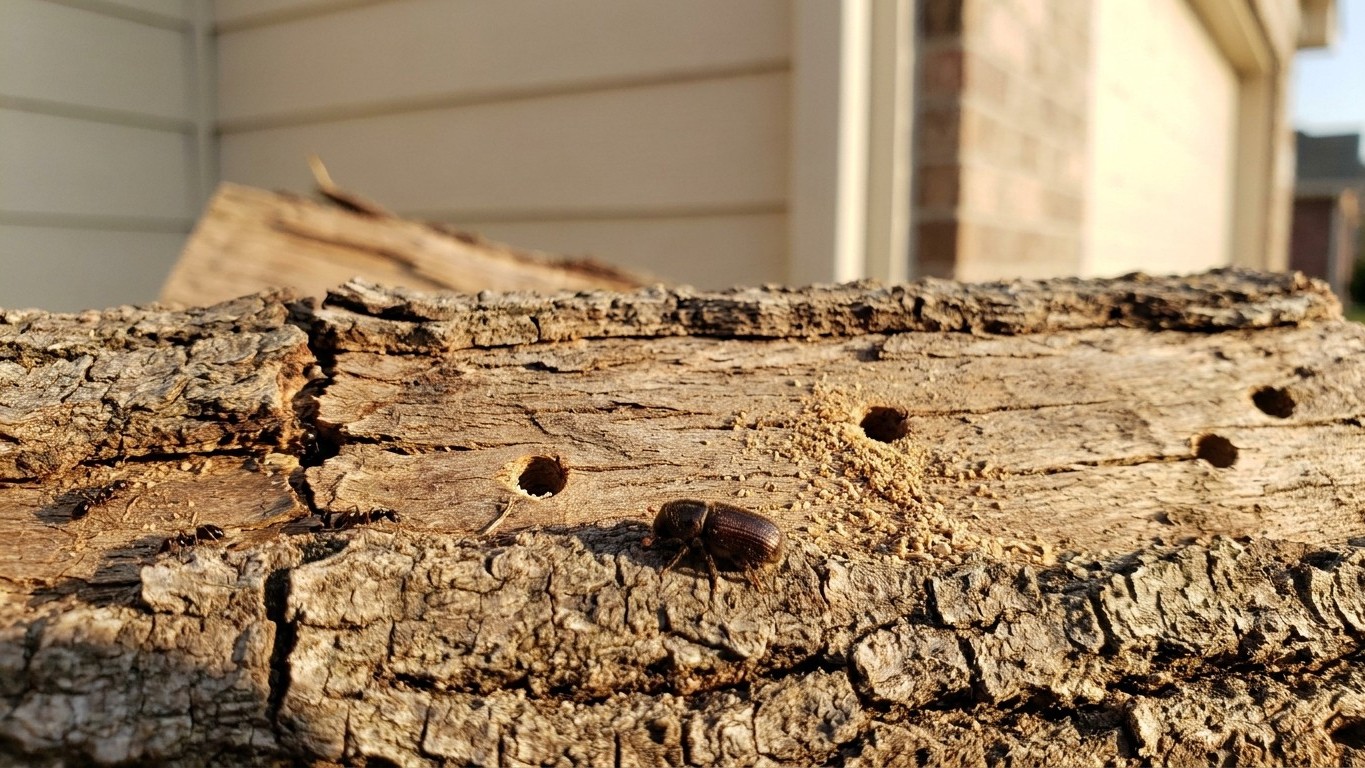

Bark beetles crawling across a log, small holes in the wood, maybe a few ants scurrying when you pick up a piece. It looks alarming stacked by your back door, but here is the direct answer: almost nothing living in firewood wants anything to do with your house. It bores into wood, not walls. The real risk isn’t in your woodshed at all.
What you are seeing

You split a log or grab an armful from the stack and something moves. Maybe it’s a beetle the size of a grain of rice, maybe a cluster of ants, maybe just sawdust-like frass falling out of a hole that wasn’t there last month. Your first reaction is probably to wonder if you just brought termites into your living room.
Slow down. In the overwhelming majority of cases, what you’re looking at is a wood-boring insect that spent its whole life cycle inside that specific piece of wood and has zero interest in your drywall, your floor joists, or anything else in your house. These insects target dead or dying wood fiber. A framed house, with its dry lumber and finished surfaces, isn’t food to them. It’s not even shelter they’d choose.
That said, two things are worth naming specifically, because they’re the exceptions that actually matter: carpenter ants and termites. Both can appear in firewood, and both are signals worth paying attention to, not because they’re common, but because their presence tells you something about the wood itself. Wood that attracts carpenter ants or termites was damp, sometimes for a long stretch, before it ever made it to your stack.
So is this urgent? Almost never. Most of what you’re seeing is annoying, not dangerous. A few beetles on the porch is not a home infestation. But it’s worth knowing which insects fall into which category, because that distinction changes what you should actually do next, and it’s the difference between sweeping bugs off your boot and calling someone about your foundation.
Why it happens
The mechanism is simpler than most people assume, and understanding it in the right order clears up almost all of the anxiety around bugs in a wood stack.
- Wood-boring insects living out their life cycle in the log itself. This is by far the most common source of anything you’ll find crawling on or in firewood. Beetles, borers, and similar insects lay eggs in bark or in cut ends of wood while a tree is dying or shortly after it’s felled. The larvae feed on the wood fiber for months, sometimes years, then emerge as adults, often right around the time that log ends up in your stack or in your house waiting to be burned. None of this has anything to do with your home’s structure. These insects are wood specialists, and once that particular log is gone, so are they.
- Carpenter ants nesting in wood that stayed damp too long. Unlike the borers above, carpenter ants don’t eat wood. They excavate it to build nests, and they strongly prefer wood that’s already soft from moisture. If you find carpenter ants in a stack, the real story isn’t the ants, it’s the fact that piece of wood held water long enough to soften. That’s a seasoning and storage problem as much as a bug problem.
- Termites, which are rare in cut and split firewood but not impossible. Termites need sustained moisture and, usually, ground contact to establish a colony. Firewood that touched soil for a long stretch, or sat stacked directly on damp ground, is the kind of wood that can pick up a termite presence. It’s the least common of the three, but it’s also the one people worry about most, largely because termites carry an outsized reputation.
Here’s the part that surprises most people: the obvious fear, that stacking wood near your house invites termites into your walls, usually isn’t how it plays out. Termites already established in a wood pile are focused on that wood. The bigger and much more overlooked issue isn’t what’s living in the stack sitting in your yard right now. It’s what gets carried in on wood that traveled a long distance before it ever reached you, which is a separate problem worth understanding on its own (see why you should not move firewood).
What to do about it
Once you know what you’re dealing with, the response is straightforward and doesn’t require chemicals, calls to an exterminator, or tossing your whole stack.
- Bring in only one or two days’ worth of wood at a time, not a full week’s supply. This alone solves most of the “bugs in the house” complaint, because insects that emerge from a log do so on their own schedule, and a smaller indoor stash simply gives fewer of them the chance to show up in your living room before that wood gets burned.
- Never spray firewood with insecticide. It’s tempting when you see something crawling, but that log is going into a fire in a room where people are breathing the smoke. Whatever you spray on doesn’t disappear when the wood burns. Skip it entirely.
- Sweep or vacuum up stray insects and move on. A few beetles or ants on the floor near your wood stack are a cleanup task, not a pest emergency. Burn the wood as planned.
- Check that specific piece of wood for softness or dampness if you spot carpenter ants. Softness under a thumbnail, dark staining, or a musty smell all point to moisture, which is the actual condition you’re managing, not the ants themselves.
- Call a pest professional only if you find an active nest or colony inside your house structure itself, not in the wood pile. Ants or termites working inside a wall stud, a windowsill, or framing lumber is a different situation entirely from insects riding in on a log destined for the fire. That distinction is the line between a stack you keep managing yourself and a problem that needs a licensed inspection.
None of this requires a sweep or chimney professional. Their expertise is in flue safety and creosote, not insects. Where they do become relevant is if you start burning wet, insect-affected wood regularly and it’s contributing to a heavier creosote buildup, but that’s a seasoning conversation, not a pest one.
How to keep it from coming back
The upstream fix here is the same one that solves half the other firewood headaches: seasoning and storage. Wood that’s properly split, stacked off the ground, covered on top but open on the sides, and given months to dry out simply doesn’t hold the moisture that carpenter ants and termites are drawn to in the first place. Dry wood is far less hospitable to almost every insect that causes concern.
Stack size and airflow matter more than people expect. A stack packed too tight, sitting directly on soil, or shoved against a damp foundation wall creates exactly the conditions that invite moisture-loving insects and slow the drying process at the same time. Elevating your stack even a few inches off the ground and leaving gaps for air movement addresses both problems with one change.
But the habit that actually matters most, more than seasoning technique or stack shape, is where your wood comes from. Wood cut, split, and stored locally rarely carries anything you need to worry about. The insects it does have are already adapted to that wood and that region, and they pose no threat to your house or the surrounding trees. Wood hauled in from far away is a different story, and it’s the single biggest reason state agriculture departments and forestry services actively discourage moving firewood across regions.
That’s really the core lesson buried in all of this. The bugs sitting in your stack tonight aren’t the issue. It’s the ones that hitch a ride when firewood crosses county or state lines, carrying species that have no natural predators in a new area. That’s covered in detail in why you should not move firewood, and it’s the one habit, more than seasoning or stacking, that keeps a genuinely new problem from ever showing up in your yard.