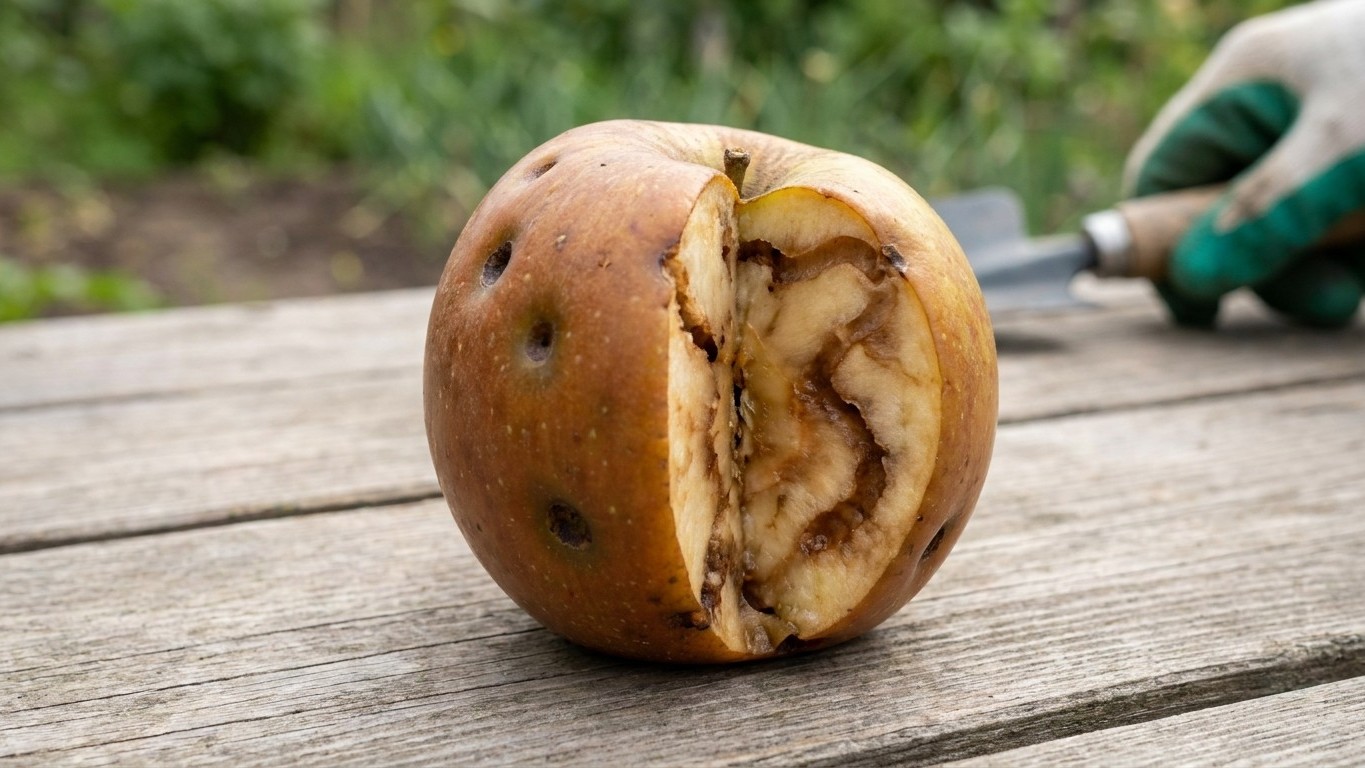

Those small dimples sinking into your apple’s skin, with thin brown trails winding through the flesh when you cut it open — that’s apple maggot. The dimples alone can fool you; some of the worst tunneling hides under skin that barely looks marked. So don’t judge by the surface: slice open a handful of the mildest-looking apples on the tree right now, today, before you decide anything’s clean. What you find inside tells you far more than what you see outside, and it’s the only way to catch this before the fruit starts dropping early.
The damage it leaves

The first sign most growers notice is on the fruit surface itself: a scattering of small, water-soaked looking dimples that sink slightly below the smooth skin around them. On some varieties these marks stay pale, almost translucent. On others they darken to a faint brown blush that spreads as the apple ripens further. From the outside alone, the damage can look like hail scarring or a mild case of skin russeting, which is why growers often dismiss it until they cut the fruit open.
Inside is where the pest gives itself away. A knife slice through an infested apple reveals thread-thin brown tunnels winding through the flesh, sometimes just under the skin and sometimes reaching close to the core. The tunnels don’t follow a straight line the way some borer damage does. They wander, branch, and often connect to small pockets of brown, mealy tissue where the flesh has started to break down around the feeding site.
Heavily infested fruit tends to drop early, often weeks before it would normally be picked, and a tree carrying a bad infestation can lose a noticeable share of its crop to premature fruit fall before harvest even starts. This is a fruit-only problem. Unlike spider mites, which leave bronzed, stippled leaves across the canopy in a hot dry stretch, apple maggot leaves the foliage alone and does all of its damage inside the developing fruit.
One detail worth flagging early: the outer dimpling can look worse than the internal damage on lightly infested fruit, while a fruit with almost invisible surface marks can already be riddled with tunnels inside. Surface appearance alone is not a reliable gauge of how far the infestation has progressed, which is why the next check matters more than a glance at the skin.
Making sure it is this one
Cut the fruit open
The single most reliable check is a knife. Slice the suspect apple in half through the widest point and look for the winding brown tunnels described above. Fresh tunnels near the surface are thin and pale tan. Older ones, closer to the point where a larva has been feeding for a while, turn darker brown and start to collapse into soft, rotten-smelling pockets.
Compare the scar shape on the skin before you cut. Apple maggot dimpling is scattered and irregular, spread across the whole surface rather than concentrated near the stem end. That distinguishes it from plum curculio, which leaves a distinct crescent-shaped scar near the stem on young, still-developing fruit, usually well before the apple maggot’s marks would appear on ripening fruit later in the season.
Hang a trap
If the fruit damage is ambiguous, a red sphere sticky trap hung in the canopy is the standard way growers and extension scouts confirm adult flies are active in an orchard. The trap mimics a ripening apple, and adult flies land on it and get stuck to the coating. Catching flies on the trap, combined with dimpled fruit and internal tunneling on the cut sample, is as close to a confirmed diagnosis as a home grower gets without sending a sample to an extension lab.
Physiological disorders like cork spot or bitter pit can also leave brown flecking inside the flesh, but those show up as firm, corky lesions rather than winding tunnels, and they don’t correspond to any external dimpling pattern. If the internal marks are lines rather than spots, the pest is the more likely explanation.
When it attacks
Apple maggot activity tracks the tree’s own stages rather than a date on the calendar. Adult flies begin laying eggs under the skin of developing fruit somewhere around petal fall and early fruit set, once the young apples are large enough to sting but still weeks from ripening. Egg-laying continues through the summer as the fruit sizes up, which is why an orchard can show fresh damage on fruit that looked clean just a few weeks earlier.
Larvae feed inside the fruit while it stays on the tree, tunneling as the apple grows around them, and the damage becomes visible from the outside only as the fruit nears its ripening window, when the skin dimples and the internal tunnels darken. How many generations complete in a season depends heavily on the local climate, so rather than pinning that to a fixed number, use your own region’s extension monitoring calendar alongside the fruit’s own stage: green, then coloring, then ripe, each carrying a different level of risk.
Variety timing matters here too. Early-ripening apples in Clemson HGIC’s bloom group A, Anna and Dorsett Golden, often finish and get picked before fly pressure builds to its peak in a given season. Late-hanging varieties in bloom group C, among them Arkansas Black, Golden Delicious, Jonagold, Ozark Gold, Priscilla, Rome Beauty and Stayman, stay on the tree longer and accumulate more weeks of exposure to egg-laying females, which is part of why late-season varieties tend to show heavier maggot damage at harvest than early ones in the same orchard.
What to do about it
Traps and monitoring
Red sphere sticky traps hung at fruit level starting around petal fall give the earliest warning that flies are active, well before any damage shows on the fruit itself. Check traps regularly through the summer rather than hanging them once and forgetting them, since a trap that fills up with debris and other insects stops catching flies effectively.
Barriers
Bagging individual fruit clusters with lightweight mesh or paper bags once the fruit has set physically blocks the adult female from reaching the skin to lay eggs. It is labor-intensive on a full-size tree but manageable on dwarfing rootstock, where every branch is within reach from the ground or a short stepladder.
How practical that is depends heavily on rootstock, which is what fixes a tree’s mature height, not the variety grafted onto it. USU Extension’s figures for common apple rootstocks make the tradeoff clear:
| Rootstock | Mature height (USU Extension) | Trap and barrier reach |
|---|---|---|
| M.9 | 8-12 feet | Whole canopy reachable from the ground |
| M.26 / G.11 | 12-15 feet | Reachable with a short stepladder |
| M.7 / G.30 | 18-20 feet | Upper third needs a taller ladder or pole tools |
| MM.111 | 30-35 feet | Full-canopy monitoring impractical without equipment |
| Seedling | 35-40 feet | Rely on sanitation over canopy-wide traps or bagging |
On a seedling rootstock reaching 35 to 40 feet, hand-bagging and full-canopy trap coverage stop being realistic, and sanitation on the ground becomes the main tool available.
Sanitation steps
- Walk the drip line and pick up dropped fruit at every check, not just at cleanup time
- Cull and discard, rather than compost, any fruit already showing dimpling
- Thin heavily set clusters early so remaining fruit isn’t crowded against bark or other apples where flies can move between them easily
Any control decision that involves a spray belongs to your local extension service, since registered materials and timing windows differ by state and the FACTS available here don’t cover that ground safely.
Keeping it out next year
Apple maggot larvae that finish feeding inside a fruit drop to the ground still inside it, then leave the fruit to pupate in the soil beneath the tree, where they overwinter and emerge as adults the following season. That single detail is why fallen fruit left on the ground all summer, rather than dimpled fruit still hanging on the tree, does the most to build up next year’s population.
Picking up drops promptly, rather than letting them sit, is the single most effective habit for breaking that cycle, since every fruit removed before the larvae exit is one less fly next season. This matters more in an orchard with a history of infestation than in a first-year planting, where the ground hasn’t yet built up a reservoir of overwintering pupae.
Ground management
Keeping the area under the canopy mowed short and free of thick mulch makes it harder for dropped fruit to hide from a daily sweep, and it keeps the ground surface more exposed rather than insulated. Removing fruit mummies left hanging from the previous season, along with any fruit that rotted on the branch, closes off another spot where larvae can complete their cycle undisturbed.
None of this replaces the traps and barriers discussed above, but sanitation is the piece that works on every rootstock and every tree size, including the full-size seedling trees where trapping and bagging the whole canopy simply isn’t practical. For growers dealing with more than one apple pest in the same season, the drop-and-cleanup habit built for apple maggot tends to help with several others at once, since fallen, rotting fruit is a shared breeding ground.
Common questions
Can I still eat an apple with a few dimples on it?
You can cut around the tunnels and eat the rest, but check the flesh carefully first. If the tunnels have reached deep into the core or the flesh around them has started to break down and smell fermented, it’s better to discard that fruit rather than trim around it.
Does apple maggot spread from one tree to the whole orchard?
Adult flies can move between nearby trees over a season, so a single infested tree left unmanaged can become a source for others planted close by. Distance and windbreaks slow that spread but don’t stop it completely, which is why sanitation across the whole planting matters, not just around the worst tree.
Is this the same thing as a worm in the apple?
Not usually. What most people picture as “a worm in the apple” is often codling moth, which leaves a single wide tunnel straight to the core with visible frass, rather than the scattered, thread-thin winding trails apple maggot leaves closer to the surface. A cut fruit usually settles which one you’re dealing with.
Will removing one infested tree solve the problem?
It helps but rarely solves it on its own, since adult flies can fly in from wild or abandoned apple and hawthorn trees nearby that aren’t under anyone’s management. Sanitation on your own trees combined with trapping gives you a realistic level of control even when the surrounding area isn’t fully clean.