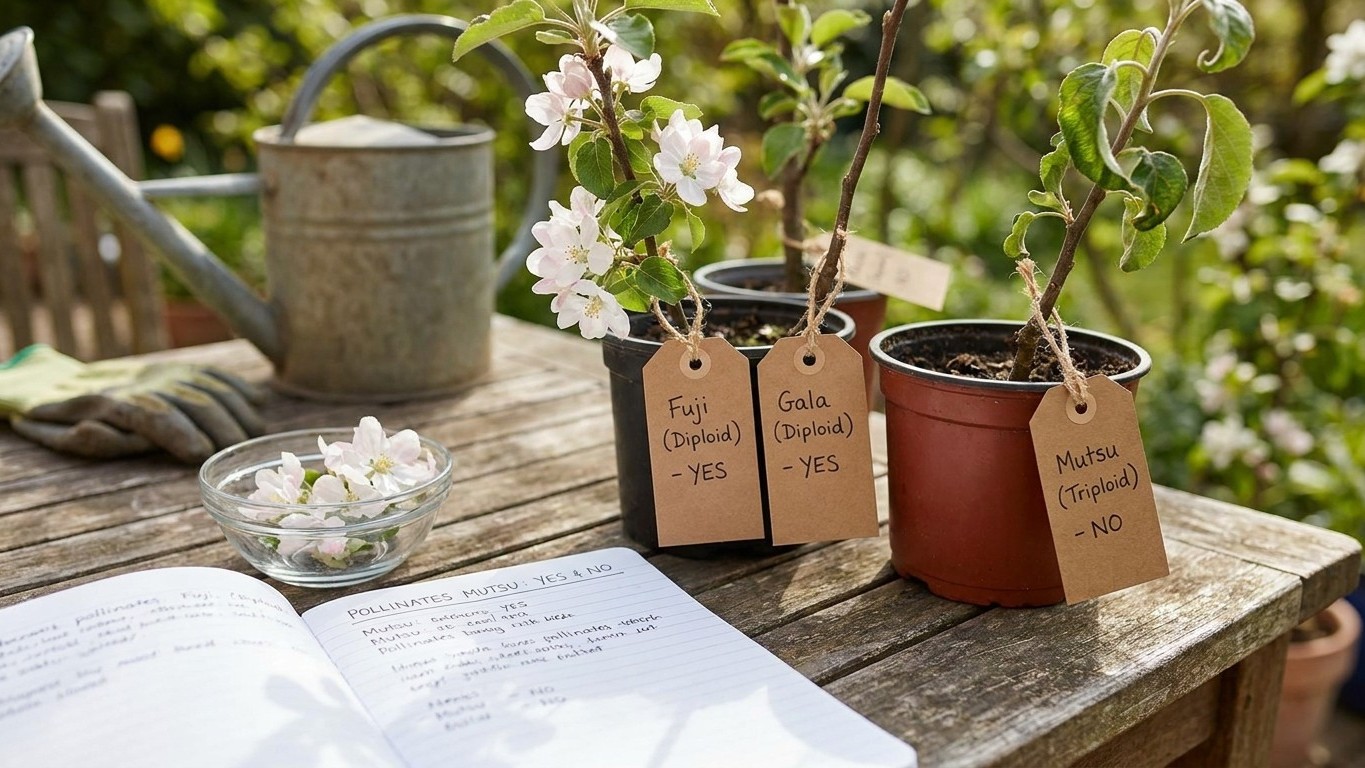

Mutsu’s own pollen is a dead end—sterile, incapable of fertilizing anything, including itself. Every apple that hangs from a Mutsu limb got its start from pollen borrowed off a neighbor: Gala, Fuji, Yates, Red Delicious, Granny Smith, Jerseymac, Ginger Gold, or Mollie’s Delicious. That much solves the mystery of the empty tree standing alone in a yard. What it doesn’t solve is the two-tree orchard, where the borrowed pollinator, having given everything to Mutsu, gets nothing back and starts failing too.
The short answer
Mutsu sets fruit when a compatible variety is blooming nearby. The Clemson HGIC 1350 and UGA C740 compatibility lists name eight partners:
- Fuji
- Gala
- Ginger Gold
- Granny Smith
- Jerseymac
- Mollie’s Delicious
- Red Delicious
- Yates
Any one of those eight supplies pollen Mutsu’s flowers can use. The catch is that Mutsu’s own pollen is sterile, per the same Clemson and UGA sources. A sterile-pollen tree accepts pollen from a compatible neighbor and sets a full crop, but it hands nothing back. Mutsu is a one-way taker in any two-tree planting.
That’s why a Mutsu garden needs three varieties, not two. Plant Mutsu with only one of its eight partners, and that partner still needs its own pollen source. If Mutsu is the only other tree in range, the partner gets nothing in return and its own crop suffers along with Mutsu’s. Add a third variety, either another name from the list above or any other apple that overlaps Mutsu’s bloom window and carries fertile pollen, so the two donor trees fertilize each other and both keep feeding Mutsu. For the mechanics of how apple flowers get fertilized in the first place, see Apple Pollination.
Why these varieties and not others

Every apple variety flowers in a sequence tied to its own genetics. Clemson Cooperative Extension groups that sequence into bloom groups, roughly earliest to latest, and Mutsu falls into bloom group B. That letter is a ranking, not a calendar date. In a cool spring, group B might open in the third week of April somewhere, and in a mild one it might open two weeks earlier, but it still opens before group C and after group A wherever the orchard sits. Utah State University Extension separately describes Mutsu’s bloom timing as mid-season, which fits a variety sitting toward the middle of that ranking rather than at either end.
Compatible pollinizers have to open their own flowers during that same window. A bee moving pollen from a Gala blossom to a Mutsu blossom that opened three weeks later accomplishes nothing. That overlap is the whole reason Fuji, Gala, Ginger Gold, Granny Smith, Jerseymac, Mollie’s Delicious, Red Delicious, and Yates work as partners: each blooms close enough to Mutsu’s mid-season window to have viable pollen in the air while Mutsu’s flowers are still receptive.
What bloom overlap does not promise
Sharing a bloom period is necessary, but it is not the whole story. Overlap says nothing about whether a variety’s pollen is actually fertile. Mutsu itself blooms in group B and produces pollen right on schedule, but that pollen is sterile, so bloom timing alone would wrongly suggest Mutsu could pollinate its own neighbors. Overlap also says nothing about parentage. Two varieties that flower together are not necessarily related, and the reverse holds too: even when two trees do share a parent-offspring relationship, a shared bloom window does not override that biology. A parent variety cannot fertilize its own seedling no matter how closely their flowering times line up.
What cannot pollinate it
The clearest case is Mutsu itself. Because its pollen is sterile per Clemson HGIC and UGA Extension, two Mutsu trees planted side by side will bloom heavily and set little or no fruit between them. The same goes for Mutsu paired with any other sterile-pollen variety. A grower who plants only two trees and happens to pick a sterile pair gets flowers and no apples, which is the exact trap this variety sets for anyone who assumes any two apple trees will do.
Beyond Mutsu’s own sterility, no parentage exclusion has been published for this variety in the sources behind this page. That does not mean none exists; it means a grower should not assume compatibility beyond the eight varieties Clemson HGIC and UGA Extension actually list. Also sold under the name Crispin, per Utah State University Extension, Mutsu is common enough in nursery catalogs that gardeners sometimes assume any mid-season apple nearby will finish the job. It won’t reliably, unless that variety’s own bloom timing and pollen fertility have been checked against Mutsu’s.
The safest move for a variety not on the list is to ask a local extension office, the same kind of body that published the figures above, before betting a season’s crop on an untested pairing. Fire blight susceptibility is another reason to be deliberate about the mix: USU Extension rates Mutsu as susceptible to fire blight, and a pollinizer chosen without regard to disease pressure can bring the bacterium into bloom-time range at the worst possible moment, when open flowers are its easiest entry point. The same question comes up with other widely grown apples, and readers can compare notes at What Pollinates Northern Spy, and What Cannot for that variety’s own list of partners.
How close the second tree has to be

Pollen doesn’t travel on the wind the way it does in corn or pine. Apple pollen moves on the bodies of bees and other pollinating insects, so the real question is how far a bee is willing to fly between blossoms, not how far pollen can drift on a breeze.
Same garden beats same street
A pollinizer growing in the same yard, close enough that a bee can visit both trees on a single foraging trip, does the most reliable work. A tree at the far end of the same block still helps if bees are working both properties, but the odds drop the farther apart the trees stand, especially in windy or exposed sites where bees forage less to begin with.
What else can carry pollen
Mutsu doesn’t require a tree the grower planted and paid for. A neighbor’s compatible apple tree counts, provided it’s one of the eight varieties above or another that overlaps Mutsu’s mid-season bloom and carries fertile pollen. An ornamental crabapple flowering at the same time works too. So does a single pollinizer branch grafted onto an existing tree, which puts a second variety’s flowers close enough to matter without planting a whole extra tree.
What stops it regardless of distance
None of that matters if bees aren’t flying. Cold, wet, or windy weather during the bloom window keeps pollinators grounded, and no amount of proximity or partner variety fixes a week when bees simply didn’t work the flowers. That’s a season-to-season risk every grower faces, not a flaw in the choice of pollinizer.
If there is no room for a second tree
A small garden can still get a crop from Mutsu without planting two extra trees, but each workaround trades some effort for the space it saves.
Multi-grafted trees
A single trunk carrying three or more grafted varieties, sometimes sold as a family tree, puts a compatible pollinizer and Mutsu on one root system. It solves the space problem outright, but each variety needs pruning on its own schedule since they don’t grow at the same rate, and a vigorous graft can shade out a weaker one over a few seasons if left unchecked.
A grafted pollinizer branch
Topworking a single branch of an existing apple tree to one of Mutsu’s eight compatible partners is cheaper and faster than planting a new tree, and it puts pollen exactly where it’s needed. It takes a season or two before that branch blooms reliably, and it calls for basic grafting skill or the patience to learn it.
Columnar varieties and a crabapple as insurance
Columnar apple trees, bred to grow as a narrow upright column rather than a spreading canopy, let a grower fit two or three varieties in the footprint of one standard tree. They still need a true pollinizer among them. A columnar Mutsu next to a columnar tree of the wrong variety solves nothing. An ornamental crabapple that flowers during Mutsu’s mid-season window takes almost no extra space if one is already planted as a landscape tree, and it doesn’t need to bear eating apples, only to bloom at the right time with fertile pollen. Gardeners weighing these same space trade-offs for other late-keeping apples can compare notes at What Pollinates Arkansas Black, and What Cannot.
Common questions
Will one Mutsu tree ever produce apples on its own?
Not reliably. Nearly all varieties crop better with a compatible partner, and Mutsu’s sterile pollen makes it entirely dependent on outside pollen, so a lone Mutsu tree typically blooms heavily and sets very little fruit.
Can two Mutsu trees pollinate each other?
No. Mutsu’s pollen is sterile in both directions, so two Mutsu trees planted together behave the same as one: flowers, but no fertilization between them.
Is Crispin a different apple than Mutsu?
No, it’s the same variety. Utah State University Extension lists Crispin as another name Mutsu is sold under, so a “Crispin” tree from a nursery is Mutsu with a different label.
Does Golden Delicious count as a pollinizer for Mutsu?
It isn’t on the published list. The Clemson HGIC 1350 and UGA C740 compatibility lists name Fuji, Gala, Ginger Gold, Granny Smith, Jerseymac, Mollie’s Delicious, Red Delicious, and Yates specifically, and compatibility beyond those eight isn’t documented in those sources. Check with a local extension office before relying on a variety that isn’t on the list.
What growing zone and harvest window does Mutsu need?
Utah State University Extension places Mutsu in hardiness zones 5 to 9, with harvest running from late October into early November. Timing within that window shifts with local weather each year, and growers in other parts of any given state should expect some variation from a single reference orchard.