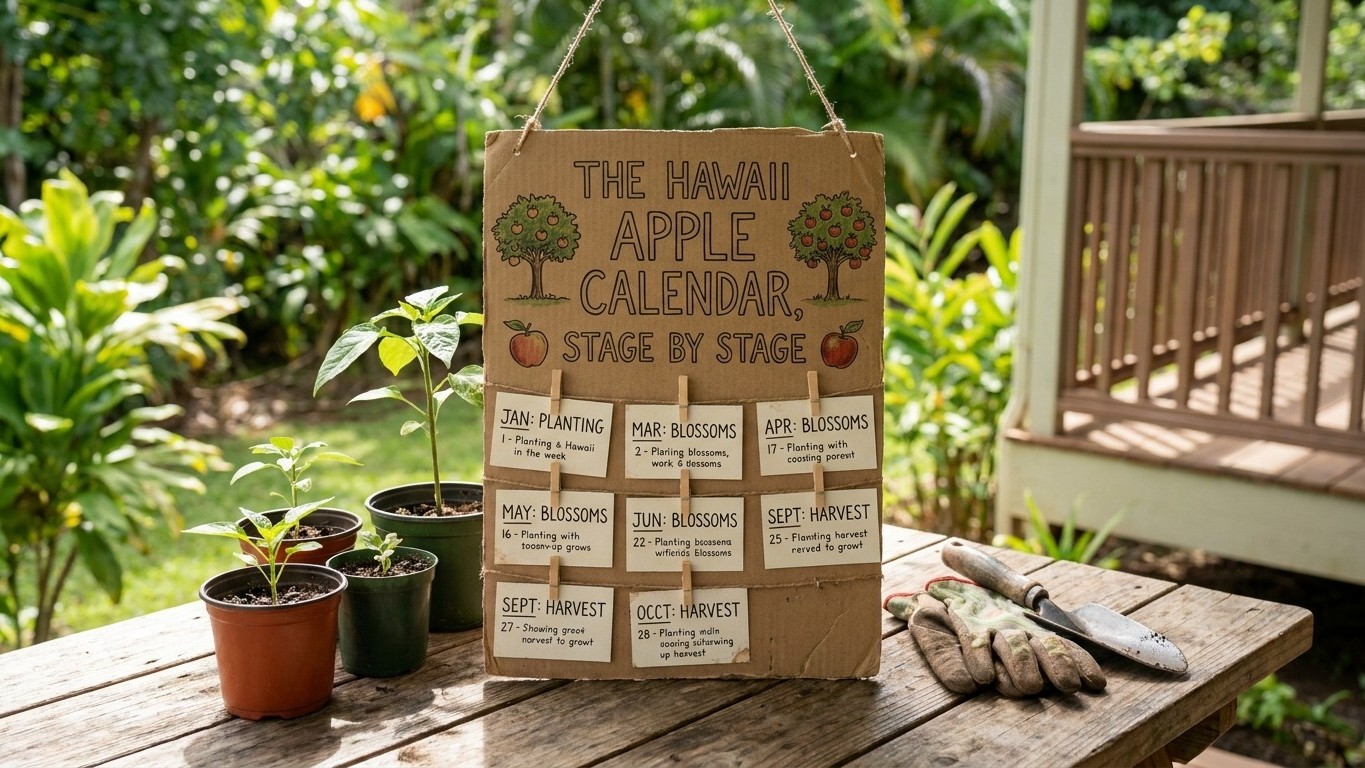

Hawaii has no true apple calendar in the sense mainland growers use, because the state has no frost season to anchor one. NOAA’s 1991-2020 climate normals show zero days per year at or below 32°F at the Honolulu-area station, and Honolulu’s coldest month has a mean daily minimum of 66.1°F, too warm to trigger the dormancy an apple tree needs. Pick a site by elevation and exposure, not by calendar date, and choose an ultra-low-chill cultivar such as ‘Anna’ or ‘Dorsett Golden’ before you plant anything else.
The short answer for Hawaii
There’s no true apple calendar here, because Hawaii never delivers the freeze a tree needs to shut down for winter on its own, so the whole idea of circling a date on the wall doesn’t apply. What matters instead is which stage your tree is actually in, and that stage starts the moment you hand-strip its leaves to force the dormancy the weather won’t give it. So before you watch for green tip or bloom, go check your site’s elevation and pick a real ultra-low-chill cultivar like ‘Anna’ or ‘Dorsett Golden’ — that choice, not the season, decides whether any of the later stages happen at all.
That single fact rewrites the whole idea of a calendar. Rather than watching for green tip after the last frost, a Hawaii grower has to manufacture the dormancy a mainland tree gets for free, by hand-stripping leaves, and then time everything that follows off that artificial reset rather than off a date on the wall. The stage the tree is in, not the week of the year, is what tells you when to feed, thin or spray. Working through the basics of site and soil first, as covered in Growing Apples in Hawaii, matters more here than it does anywhere with a real winter.
What the answer depends on: the site’s elevation, since cooler nights help a tree hold what little chill Hawaii offers, whether the site sits windward or leeward, since rainfall and fungal pressure differ sharply between the two, and the cultivar itself. Only a handful of apple varieties have been bred with a chill requirement low enough to break dormancy reliably in a climate this warm, and picking the wrong one is the single most common way this crop fails here.
Working through it

Dormancy: a manufactured stage, not a season
On the mainland, dormancy arrives with the first hard freeze and holds until the last one passes months later. In Hawaii it never arrives on its own. NOAA’s NCEI normals for the Honolulu-area station read zero freeze days for the entire year, so the tree gets no weather cue to drop its leaves. Growers who want a real crop strip the leaves off by hand, working through the whole canopy in one sitting once the tree has had time to rest after the previous harvest. This forced defoliation is what starts the clock. Skip it, or do it halfway, and the tree just keeps limping along in partial leaf, flowering weakly and out of sync from branch to branch.
Green tip through bloom
Once the tree is bare, bud swell and green tip follow within a few weeks on the cultivars actually bred for this climate, because their chill requirement is low enough that Hawaii’s mild nights, with no help from frost, can satisfy it. This is where variety choice decides the whole season. ‘Anna’, ‘Dorsett Golden’ and ‘Ein Shemer’ are the three ultra-low-chill apples with the longest track record outside their original breeding zones of Israel and Florida, and their published chill needs sit low enough to break dormancy on Hawaiian nights that never come close to freezing. The Best Apple Varieties for Hawaii lays out how those three, and the handful of others sometimes tried, compare on chill and fruit quality.
| Cultivar | Chill need | Pollination |
|---|---|---|
| ‘Anna’ | Ultra-low | Needs a compatible partner nearby |
| ‘Dorsett Golden’ | Ultra-low | Self-fruitful, sets heavier with a partner |
| ‘Ein Shemer’ | Ultra-low | Self-fruitful, sets heavier with a partner |
Bloom on a forced-dormant tree in this climate can be uneven, with some spurs opening while others are still swelling, because the “winter” it just went through was manufactured by hand rather than delivered by weather. Thorough, even stripping and a consistent rest period between defoliation and the next flush smooth that out over a season or two. Petal fall follows bloom by roughly the same span it would anywhere else, since that stage is driven by the flower’s own biology rather than by temperature.
Fruit set to harvest
Fruit set depends on cross-pollination between compatible cultivars landing while both are in bloom at the same time, so a lone ‘Anna’ tree with no partner nearby will drop most of its flowers unset. Once fruit is set, sizing runs on the same rough logic it would in any warm climate: heat speeds sugar accumulation, and Hawaii’s lowland heat can finish a size class earlier than a books-based mainland harvest date would suggest. Watch the fruit itself, not the calendar. Firmness at the stem, background color moving off deep green, and a clean snap off the spur tell you more than any date on a wall planner ever will.
What changes across Hawaii
Every figure in this calendar is tied to the Honolulu-area station in NOAA’s 1991-2020 normals, and Honolulu sits at low elevation on Oahu’s leeward side. Move to a different part of the state and the picture changes fast, mostly because of two things: how high above sea level the site sits, and whether it faces windward or leeward.
Elevation matters most. Higher ground runs cooler at night than the coast, and that handful of extra cool-night hours is exactly what a low-chill apple is trying to bank before it can break dormancy on its own. Growers on Maui’s upcountry slopes around Kula and on the Big Island around Waimea have both reported success with apples where nearby lowland sites have not, because both areas sit high enough above the coast to run cooler after dark. NOAA does not maintain a climate-normals station at either location, so there’s no equivalent official figure for how much cooler they actually run. Treat elevation as a real advantage, but confirm what a specific site does over a season of your own observation rather than assuming it matches Honolulu’s numbers or anyone else’s.
Windward versus leeward changes the disease side of the calendar more than the temperature side. Windward slopes catch the trade winds and the rain that rides in with them, which keeps foliage wetter for longer stretches and raises pressure from fungal disease on a tree that’s already stressed by an unnatural dormancy cycle. Leeward sites stay drier, which suits the manufactured-dormancy approach better, since a defoliated tree recovering from hand-stripping does not need extra moisture stress on top of it. A grower choosing between two otherwise similar sites should weigh the drier leeward option ahead of a wetter windward one, all else being equal.
The mistakes this climate punishes
Bringing over a mainland-bred cultivar because it’s cheap or familiar is the costliest mistake made here. A tree such as ‘Fuji’ or ‘Gala’ needs several hundred hours of real winter chill to break dormancy properly, chill that Honolulu’s coldest month, with NOAA’s normals putting its mean daily minimum at 66.1°F, simply never delivers. The tree survives fine. It just never flowers well, and a grower can spend years blaming soil or fertilizer for a problem decided at the nursery counter.
Skipping the hand defoliation, or doing it halfway, is the second. A tree left with even a partial canopy reads that as continued growing season rather than rest, and bloom comes weak, late, and scattered across the tree instead of arriving together. This shows up about a season after planting, once the novelty of a young tree’s first flush wears off and the grower expects a normal bloom that never quite comes.
Planting a single self-only tree and expecting a full crop is the third. ‘Anna’ in particular sets far better fruit with a compatible partner such as ‘Dorsett Golden’ or ‘Ein Shemer’ blooming nearby at the same time, and a lone tree in a small yard often ends up light on fruit for no reason the grower can diagnose from the leaves or the soil.
- Mainland high-chill cultivar planted without checking chill need
- Hand defoliation skipped or done partway through the canopy
- Single tree with no compatible bloom partner
- Low-chill apple sited on a wet windward slope
- Heavy feeding right up to the point of forced dormancy
Choosing a wet windward site for a low-chill apple stacks two stresses on top of each other: the tree is already working through an artificial dormancy cycle, and constant leaf moisture adds fungal disease pressure it doesn’t need. This tends to show up as leaf spot or blight symptoms within the first wet season or two on the property, well before the tree is old enough to prove whether the chill and pollination side of things would even have worked.
Feeding heavily right up to the point of hand-stripping the leaves is the last one. Fresh, soft growth right before a forced dormancy period wastes the nitrogen and slows the tree’s recovery once it’s stripped. Growers get better results holding off on feeding until new growth actually appears after defoliation, then feeding into that flush instead of ahead of it.
Checking this against your county
Every number in this calendar comes from one NOAA station near Honolulu, and Oahu’s leeward coast is only one of dozens of microclimates across the state. Before committing a season to any of this, check current guidance with the University of Hawaii’s College of Tropical Agriculture and Human Resources (CTAHR), the state’s land-grant extension service, at ctahr.hawaii.edu. CTAHR’s county extension offices can speak to elevation and rainfall patterns specific to your address in a way a single climate-normals station never can, and they track which low-chill cultivars are actually fruiting well on the ground in your part of the state right now.
Common questions
Do I need to strip the leaves every year, or just the first time?
Every year. Hand defoliation isn’t a one-time trick to get a young tree started, it’s the substitute for winter that this climate never provides on its own, so a tree left with its leaves after the previous crop just keeps growing without ever resetting, and bloom the following season comes weaker each cycle it’s skipped.
Will a Honeycrisp or Gala tree from a big-box store grow in Hawaii?
It will likely stay alive, since Honolulu’s warmth is well above what would ever kill an apple tree outright, but it won’t flower or fruit reliably. Cultivars bred for temperate winters need far more accumulated chill than a Honolulu-area winter, with a coldest-month mean minimum of 66.1°F by NOAA’s normals, ever supplies.
Can I put the tree in a refrigerated room to fake a winter?
Some growers in warm climates do chill potted trees artificially for a period before bud break, and it can work for a small container tree. It’s a labor-intensive workaround rather than a normal step in a Hawaii apple calendar, and hand defoliation followed by a natural rest is the more common approach among growers who’ve made this work outdoors.
Can an apple tree in Hawaii fruit more than once a year?
Some growers do get two lighter bloom-and-fruit cycles from an ultra-low-chill tree in a single year by forcing dormancy twice, once after each harvest, instead of once annually. The tradeoff is smaller fruit and a harder toll on the tree, so a single well-managed annual cycle usually produces a better crop than two rushed ones.