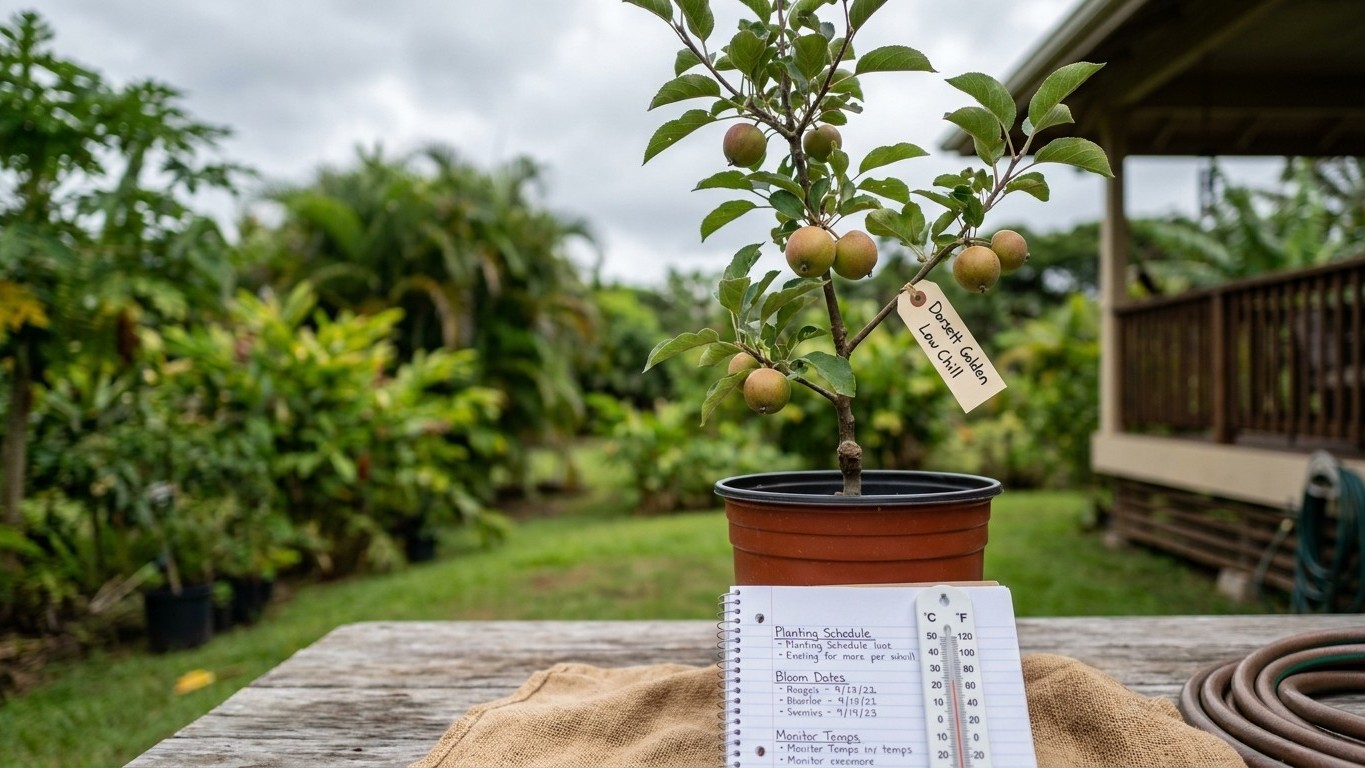

Sea level in Honolulu never gets cold enough to matter, and that’s the whole story with apples here. Elsewhere, growers worry about frost killing buds. In Hawaii, the trouble runs the other way: nights stay so mild that a tree never fully shuts down, so it leafs and flowers in a ragged, drawn-out mess instead of one clean spring burst. The tree lives fine. It just won’t crop reliably — unless you leave the coast behind and climb toward cooler ground.
Can you grow apples in Hawaii
Apple trees have no trouble surviving in Hawaii. The problem is getting them to flower and set fruit the way an orchard tree should. NOAA NCEI’s 1991-2020 climate normals put Honolulu’s coldest month at an average nightly minimum of 66.1°F, which is warmer than many mainland summers, let alone a winter. The USDA’s 2023 Plant Hardiness Zone Map spans the state from zone 9a up to zone 13a, and Honolulu itself sits toward the hot end of that range. Other parts of the state, especially at elevation, run several zones cooler, and that difference is what makes an apple crop possible at all.
Where elevation changes the picture
At sea level near Honolulu, an apple tree behaves oddly. It rarely loses all its leaves at once, and without a real cold season to trigger dormancy, its buds break on their own schedule instead of in one clean spring flush. Flowering turns sparse and stretched out over weeks rather than a tight burst, and fruit set follows the same ragged pattern. None of that kills the tree. It just makes it an unreliable cropper at low elevation.
Move up the mountain and the picture improves. Growers on Maui around Kula, and on Hawaii Island around Waimea and Volcano, garden at elevations with cooler nights, enough to give a low-chill apple something closer to the rest period it needs. Yields still run smaller and less predictable than a mainland orchard’s, but a dooryard tree at these upland elevations is a realistic project in a way a coastal Honolulu tree is not. For a month-by-month look at what to expect from bud break to harvest, see The Hawaii Apple Calendar, Stage by Stage.
It helps to know what the USDA zone map is actually measuring. It ranks a location by its coldest expected winter night, not by how much cool weather it accumulates over a season. A high-elevation Hawaii site can register as USDA zone 9a while never approaching freezing, because Hawaii’s entire hardiness range sits warm on the national scale. That number tells you an apple tree will not freeze here. It says nothing about whether the tree will flower, which is a separate question answered by winter chill.
Which varieties suit this climate

Every named apple variety carries a published chill requirement, and matching that number to your elevation is the whole game — see this Hawaii apple Best varieties guide for a rundown of the cultivars that actually fruit here, the number of hours it needs below roughly 45°F before it will break dormancy and flower cleanly. Hawaii sits at the extreme low end of that scale, so the varieties that make sense here are the ones bred for the Deep South and the Gulf Coast, not the ones bred for New England.
‘Anna’ is the variety most often planted in warm, low-chill climates worldwide. It needs somewhere in the range of 100 to 300 hours of chill, among the lowest of any apple in cultivation, and produces a red-blushed, green-fleshed fruit. ‘Dorsett Golden’ carries a similarly low chill requirement and a flavor close to ‘Golden Delicious’, and it is commonly sold specifically as a pollinizer for ‘Anna’. ‘Ein Shemer’ is another low-chill option, self-fertile on its own, with pale yellow-green fruit and a mild, sweet flavor.
| Variety | Approx. chill requirement | Fruit | Self-fertile |
|---|---|---|---|
| ‘Anna’ | 100-300 hours | Red-blushed, green-fleshed | Partial, benefits from a pollinizer |
| ‘Dorsett Golden’ | 100-250 hours | Yellow, similar to ‘Golden Delicious’ | Yes |
| ‘Ein Shemer’ | 100-200 hours | Pale yellow-green | Yes |
| ‘Tropic Sweet’ | Roughly 250 hours | Yellow with a red stripe | Yes |
None of these figures come from a Hawaii-specific trial. They are the chill ratings published by the breeding programs that developed the varieties, mostly for Florida and the Gulf Coast. Hawaii’s state extension service, the University of Hawaii’s College of Tropical Agriculture and Human Resources, does not publish a dedicated apple variety trial list for the state, so a grower here is working from mainland catalog data crossed against local elevation rather than a locally tested recommendation.
This is also where Hawaii sits at the opposite end of the spectrum from a place like Growing Apples in Manitoba: Varieties, Timing and Frost Risk, where the entire variety list is built around surviving deep winter cold rather than escaping the lack of it. A high-chill variety bred for a place like that, planted in Hawaii, would not die. It would simply refuse to bloom in any organized way, giving the same thin, staggered flowering described above, only worse.
Planting a pair that works here
Every apple needs a second tree nearby with fertile pollen blooming at the same time, and Hawaii’s short list of workable varieties narrows the choice further. ‘Anna’ paired with ‘Dorsett Golden’ is the combination most often recommended in warm-climate growing guides, because the two bloom close together and ‘Dorsett Golden’ carries fertile pollen even though ‘Anna’ can set some fruit alone. ‘Ein Shemer’ is self-fertile on its own but crops more heavily with a second low-chill variety nearby, and it blooms early enough to overlap with either of the other two.
Skip triploid varieties entirely when picking a partner. Varieties such as ‘Jonagold’ and ‘Stayman’ carry sterile pollen, so even a tree that survived and flowered here would contribute nothing to a neighbor’s fruit set. None of the common triploids are low-chill selections anyway, so this rarely comes up in practice, but it is worth checking before ordering from a mainland nursery that stocks a wider list than the handful that actually suit this climate.
Because bloom in this climate often stretches out over weeks instead of arriving in one clean flush, pairing two varieties that can each self-pollinate to some degree, rather than relying on one fully self-sterile variety and a single partner, gives a better chance that at least some flowers overlap in any given week. Planting the two trees close enough for bees to pass between them daily matters more here than in a climate with one tight bloom window, simply because there is more time for pollen to go stale or for one tree’s flush to miss the other’s entirely.
The frost that costs a crop here

In most apple country, the date of the last spring frost decides the whole season, because a frost that hits after the buds show pink kills the flowers even though the tree itself comes through fine. Hawaii breaks that rule almost entirely. NOAA NCEI’s 1991-2020 climate normals for the Honolulu-area station report zero freeze days in an average year, and every freeze percentile at 32°F and 36°F comes back not computable, meaning frost essentially does not occur where people live and garden. The only frost in the state falls on the high volcanic summits, Mauna Kea, Mauna Loa and Haleakala, thousands of feet above any orchard.
That is a real advantage over a state like Growing Apples in Idaho: Varieties, Timing and Frost Risk, where growers track a specific spring frost window every year and can lose whole blocks of bloom to a late cold snap. A Hawaii grower never has to watch a forecast for that reason. But the flip side of never getting frost is never getting the cold that triggers a clean, synchronized bloom in the first place, which is the actual limiting factor described above.
What costs a Hawaii apple grower a crop is not a freeze. It is a bloom that never lines up between two trees, a wet spell that knocks pollen off before bees can move it, or a tree that skips a proper rest period after a mild winter and flowers weakly. None of that shows up on a frost map, so a grower planning a Hawaii apple planting should stop watching for a frost date entirely and instead track chill accumulation and bloom overlap between the two trees in the ground.
In a frost-prone state, the standard advice is to lean on a late-blooming variety so its flowers open after the risk has passed. Hawaii does not need that particular fix, but the same logic applies in a different form. Choosing a variety with a naturally longer, looser bloom period, rather than a tight two-week bloomer, spreads the risk of a bad pollination week over more days instead of concentrating it. ‘Anna’ does this by nature, since its bloom in a low-chill climate already tends to straggle rather than flush, and a grower can use that trait deliberately instead of fighting it.
The apple year in Hawaii
A mainland apple calendar runs off a known last-frost date. Hawaii’s growers have no such date to anchor on, since NOAA’s Honolulu-area normals confirm freeze risk is not a factor at all in inhabited elevations, so the stages below are read off the tree itself rather than off a month on the wall.
Start the year by tracking whichever tree is further along, rather than assuming both move together. At low elevation, expect a wider spread between the earliest bud movement and full bloom than a catalog description would suggest, and expect some seasons where the tree barely rests before pushing new growth.
- Dormancy: rarely complete at low elevation. Upland growers sometimes strip leaves by hand in late fall to force a rest period the climate will not provide on its own.
- Green tip: can appear after any stretch of cooler nights, not on a fixed date, so check the tree weekly rather than by calendar.
- Pink: buds show color just before opening. This is the point to confirm the pollinizer tree is tracking at a similar stage.
- Bloom: often stretched over several weeks instead of one flush. Move bees or hand-pollinate on the days both trees have open flowers.
- Petal fall: watch for wet weather knocking pollen loose before it has finished its job.
- Fruit set: expect a lighter, patchier set than a catalog description promises, since that description was written for a climate with a real winter.
- Harvest: goes by fruit size, color and ease of separating from the branch, not by the days-to-maturity figure on the tag, which was counted in a climate with a fixed bloom date to count from.
Because none of these stages line up with a spring or fall date the way they would in a frost-driven climate, the most useful record a Hawaii grower can keep is a log of which stage each tree hit and when, year over year, on that particular site. Two trees a mile apart at different elevations on the same island can run weeks out of sync with each other, which is common enough that pairing two self-fertile, low-chill varieties, as covered above, is worth the extra insurance.
Local help
For anything specific to your part of the state, the University of Hawaii’s CTAHR extension service is the right first call, since spray timing, pest pressure and soil questions all shift with elevation and rainfall in ways a national guide cannot cover. CTAHR does not maintain a dedicated apple variety list, but its county offices can speak to local growing conditions and connect a grower with anyone else in the area who has tried it.
Common questions
Can I grow a Honeycrisp or Gala apple tree in Hawaii?
Not successfully as a fruiting tree. Both are high-chill varieties bred for a real winter, and in Hawaii’s climate they will survive but flower so weakly and unevenly that a crop is unlikely. Stick to a named low-chill variety such as ‘Anna’, ‘Dorsett Golden’ or ‘Ein Shemer’ instead.
Do I need to protect my apple tree from frost in Hawaii?
No. NOAA NCEI’s 1991-2020 climate normals for the Honolulu-area station show zero freeze days in an average year, and frost in the state occurs only on the high summits of Mauna Kea, Mauna Loa and Haleakala, far above any garden. Skip frost cloths and put that effort into chill and pollination timing instead.
Why won’t my apple tree drop its leaves in winter?
It’s missing the cold trigger that forces dormancy in a temperate climate. This is normal in Hawaii’s low-chill conditions and does not injure the tree, but it does make bloom ragged. Some upland growers strip leaves by hand in late fall to force a cleaner rest period.
Where in Hawaii do apples actually fruit best?
Cooler upland areas do better than the coast, places like Kula on Maui and Waimea or Volcano on Hawaii Island, where nighttime temperatures run cooler than the lowlands. Even there, expect a smaller and less predictable crop than a mainland orchard, not a full substitute for it.
How many years before a Hawaii apple tree bears fruit?
Grafted low-chill varieties typically start bearing within a few years on the mainland, but Hawaii’s irregular dormancy can push that timeline out further and make it less predictable year to year. There is no local trial data to pin down an exact figure, so treat catalog bearing ages as a starting guess and check with CTAHR for anything documented in your area.