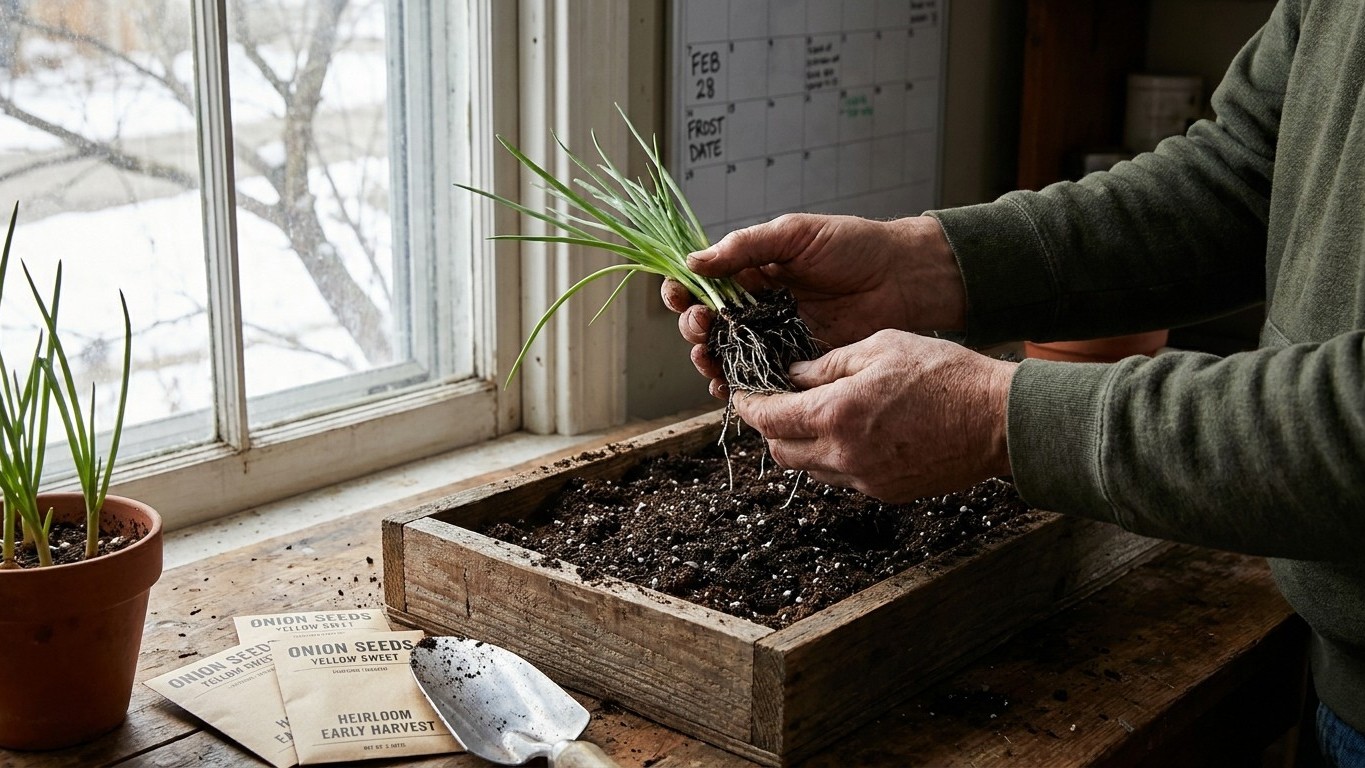

In Iowa, timing depends entirely on where the sun sits in the sky, not on the calendar page. At Des Moines’ latitude, 41.53 degrees north, the longest day of the year brings 15 hours and 1 minute of daylight, well past the 12-hour mark that triggers bulbing in short-day onions. That single number rules out autumn planting and points Iowa gardeners toward late winter and early spring, using long-day and intermediate-day varieties built for northern light.
The short answer for Iowa

Onions bulb when day length crosses a threshold written into their genetics, not when the weather warms up. At 15 hours and 1 minute on the summer solstice, Des Moines sits well above the 12-hour trigger that Clemson Cooperative Extension’s Home & Garden Information Center identifies for short-day onions, and comfortably inside the 14-to-16-hour window that long-day types wait for. That’s why Iowa is long-day and intermediate-day territory, full stop, and why the planting window here looks nothing like the fall-planting schedule used in Georgia or Texas.
The practical answer: start seed indoors in January or February, or set out transplants and sets from mid-March into April, as soon as soil can be worked and the worst hard freezes have passed. Onions tolerate light frost fine once hardened off; what they can’t tolerate is a growing season too short to build enough leaf mass before the long June days flip the switch to bulbing. Planting in autumn, the way a Gulf Coast gardener would, means the plant faces a brutal Iowa winter with no snow cover deep enough to protect it and no payoff on the other side.
Varieties that match this day length
Nineteen of the varieties documented on this site carry a published range that covers 41.53N: Ailsa Craig, Barolo, Blush, Bridger, Cabernet, Calibra, Elsye, Expression, Frontier, Monastrell, New York Early, Patterson, Red Carpet, Red Long of Florence, Red Long of Tropea, Rossa di Milano, Scout, Sierra Blanca, and Walla Walla Sweet. That list mixes long-day and intermediate-day types, which gives an Iowa gardener real room to choose on flavor and storage life rather than fighting the climate first.
What will not work here
Planting the wrong day-length group in Iowa doesn’t produce a smaller onion. It produces no onion at all. A short-day variety sown at 41.53 degrees north spends the whole season making leaves, because the day never drops back to the 12-hour trigger it’s waiting for after transplant, and by the time cold weather arrives the plant simply rots in the ground instead of forming a bulb worth harvesting.
Five varieties in this site’s records are documented for latitudes below Des Moines and have no business in an Iowa garden:
- Candy (intermediate-day, 33-40N): too far south to make sense at this latitude
- Gabriella (short-day, 20-35N): will bulb far too early and stay small
- Madalyn (short-day, 20-35N): same short-day mismatch, tiny bulbs guaranteed
- Red Rock (short-day, 30-36N): triggers bulbing while the plant is still a seedling in Iowa terms
- White Castle (short-day, 30-38N): a Gulf-region onion, wrong tool for this latitude
Four more sit close enough to a published boundary that they belong in a gray zone rather than a flat yes or no: Powell (long-day, 43-47N), Redwing (long-day, 43-65N), Safrane (long-day, 42-50N), and Talon (long-day, 42-50N). All four are rated for latitudes just north of Des Moines, which means they may bulb reliably here, especially in northern Iowa, but a gardener near the reference city is working at the edge of their published range rather than squarely inside it.
The other mistake, separate from picking the wrong variety entirely, is planting the right variety too late. That failure doesn’t just push the harvest back a few weeks the way it would with tomatoes or beans.
What changes across Iowa
Iowa isn’t one latitude, and the advice above bends depending on where in the state a garden actually sits. Des Moines, at 41.53 degrees north, is the reference point behind every figure in this guide, but the state runs from roughly the Missouri border near 40.4 degrees north up to the Minnesota line near 43.5 degrees, better than three full degrees of latitude end to end.
| Location | Approx. latitude | Daylight vs. Des Moines | What it changes |
|---|---|---|---|
| Southern Iowa (near Missouri border) | ~40.4°N | slightly less daylight on the solstice | still solidly long-day territory, but slightly less margin for borderline varieties like Powell or Talon |
| Des Moines (reference city) | 41.53°N | 15 h 01 min | the benchmark used throughout this guide |
| Northern Iowa (near Minnesota border) | ~43.5°N | slightly more daylight on the solstice | more clearance for the borderline group, Powell, Redwing, Safrane, Talon, which is published closer to 43-47N anyway |
The practical takeaway: a gardener in Dubuque or Decorah, up near the Minnesota line, can lean into the borderline long-day varieties with more confidence than one in Keokuk or Fairfield near the Missouri line. The gap is a couple of weeks of daylight accumulation over the season, small on paper, but it’s exactly the margin that decides whether a variety rated 43-47N performs like it’s supposed to.
Sweet now, or onions that last
Every Iowa gardener ends up choosing a side in this trade, whether they realize it or not. University of Missouri Extension states it plainly: as a rule, sweet onions do not store as well as the more pungent types, because pungency comes from volatile sulfur compounds. Those same compounds that make an onion bite back are the ones protecting the bulb through months in a pantry or root cellar.
A variety bred to be mild and sweet, like Walla Walla Sweet from the list above, has fewer of those compounds. It’s excellent sliced raw in July, and it will not make it to Thanksgiving in decent shape. The more pungent long-day and intermediate-day types on the same list, the ones grown for keeping rather than for a summer salad, carry more sulfur and hold up through winter storage precisely because of it.
That means the choice isn’t about which variety is “better.” It’s about what a gardener wants their pantry to look like in March. A garden built entirely around sweet varieties gives a great harvest party in August and an empty onion basket by New Year’s. A garden that leans toward the sharper, more pungent long-day types trades some of that immediate sweetness for onions that are still sound when the snow’s still on the ground.
Checking this against your own garden
Every figure in this guide is anchored to Des Moines, and a garden fifty or a hundred miles away, especially near the state’s northern or southern edge, is working with a slightly different day-length curve. State-wide advice is a starting point, not a guarantee for a specific yard.
- Look up your own latitude if you garden well north or south of Des Moines, since even a degree of difference shifts when bulbing kicks in
- Confirm your local last-frost and first-frost dates rather than relying on a statewide average
- Check whether your chosen variety’s published range still covers your specific location, especially for the borderline four: Powell, Redwing, Safrane, Talon
- Call your county extension office, part of Iowa State University Extension and Outreach, for planting windows calibrated to your county rather than the whole state
- Note your soil’s workability in early spring, since a wet, cold field in April can push planting back even when the calendar says it’s time