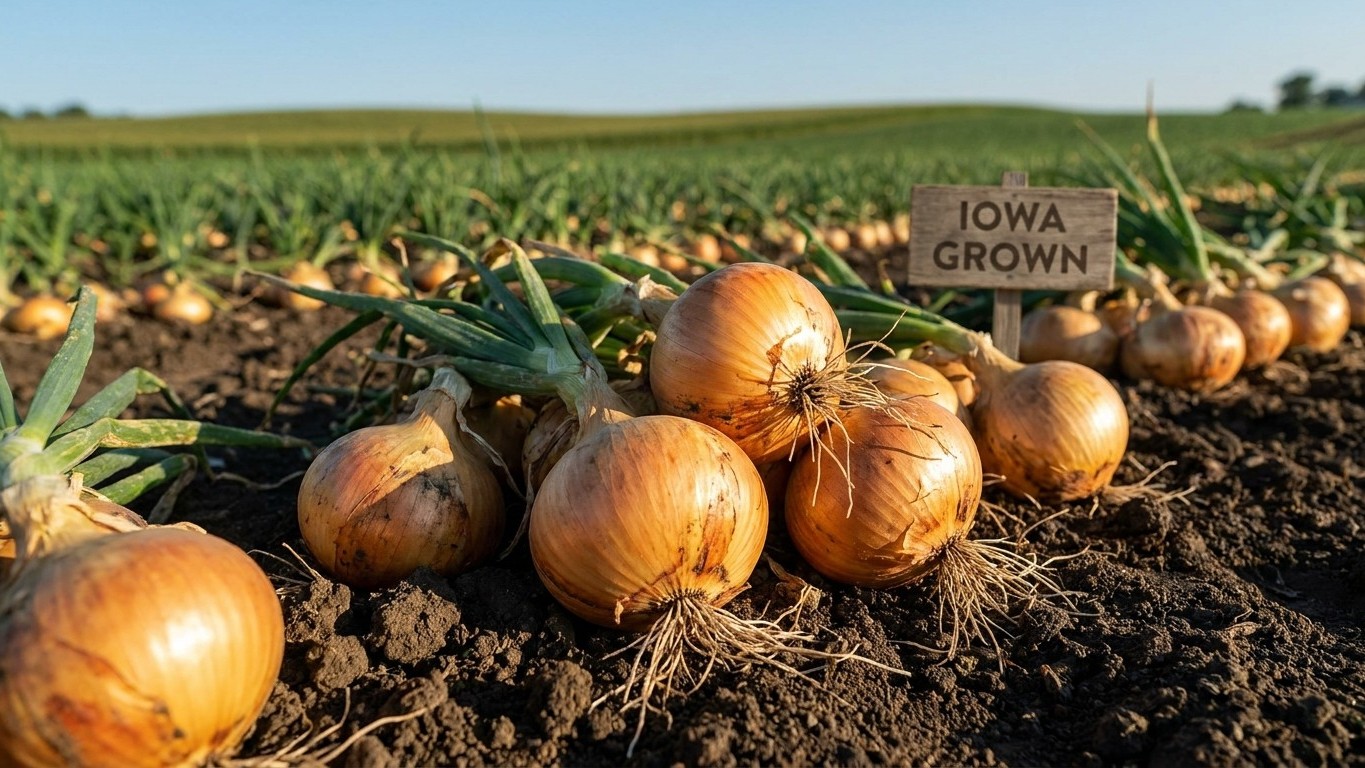

At 41.53 degrees north, the reference station for this territory gets 15 hours and 1 minute of daylight on the longest day of the year. That single number decides almost everything else on this page: it rules out short-day onions entirely, puts intermediate-day types in play, and makes long-day onions the safest bet. Nineteen documented varieties fit this latitude. Twelve others don’t.
How long your longest day is

Everything an onion does with its leaves and its bulb comes down to day length, not temperature. The reference city here sits at 41.53 degrees north (the coordinates of station USW00014933, the same station behind the frost dates below), and on the longest day of the year it gets 15 hours and 1 minute of daylight. That’s the figure the plant actually measures, through a hormonal response to how long the sun stays up, and it’s the number to compare against any variety’s stated requirement before you even look at soil or spacing.
Short-day onions start bulbing once daylight reaches about 12 hours, a threshold reached here by late April or early May. Planted at this latitude, they hit that trigger while the plant is still small, so they form a bulb too early and too small to be worth harvesting. Intermediate-day varieties wait for roughly 13 to 15 hours, which this location reaches comfortably by mid-summer. Long-day varieties hold off until 14 to 16 hours, and a location with a 15-hour-1-minute peak clears that bar too, though it sits closer to the middle of the long-day range than to its upper edge.
Why “Iowa” isn’t one latitude
The 41.53-degree figure belongs to one weather station, not to the whole state. Iowa stretches over several degrees of latitude from its southern edge to its northern one, and daylight length changes with every degree. A gardener near the state’s northern tier gets a longer longest day than 15 hours and 1 minute; a gardener near the southern edge gets a shorter one. Neither difference is dramatic, but it’s enough to shift a variety from a safe long-day choice into the blurred zone, or from the blurred zone into a flat no. If you garden near either edge of the state, it’s worth checking your own latitude rather than assuming the reference figure applies exactly to your yard.
Which varieties bulb in Iowa
Of the varieties documented on this site, 19 have a published latitude range that covers 41.53 degrees north. That’s the largest usable group of any territory in this series, and it includes both long-day and intermediate-day types, which gives a real choice between sharper, long-keeping onions and milder ones that don’t store as long.
- Ailsa Craig (long-day, 38-60N)
- Barolo (long-day, 38-55N)
- Blush (long-day, 38-55N)
- Bridger (long-day, 35-50N)
- Cabernet (intermediate-day, 35-45N)
- Calibra (intermediate-day, 35-45N)
- Elsye (intermediate-day, 32-45N)
- Expression (intermediate-day, 32-45N)
- Frontier (long-day, 40-50N)
- Monastrell (intermediate-day, 35-46N)
- New York Early (long-day, 38-50N)
- Patterson (long-day, 38-55N)
- Red Carpet (long-day, 40-45N)
- Red Long of Florence (intermediate-day, 38-50N)
- Red Long of Tropea (intermediate-day, 35-48N)
- Rossa di Milano (long-day, 38-50N)
- Scout (intermediate-day, 32-46N)
- Sierra Blanca (intermediate-day, 32-45N)
- Walla Walla Sweet (long-day, 35-55N)
Four more sit close enough to a published boundary that they fall in what’s really a continuum, not a hard line: Powell (long-day, 43-47N), Redwing (long-day, 43-65N), Safrane (long-day, 42-50N), and Talon (long-day, 42-50N). These may bulb here, but a gardener planting them is working at the edge of their documented range, not squarely inside it.
The list that matters more, though, is the one that tells you what to avoid. Eight varieties are published for latitudes well below 41.53 degrees north, and planting them here isn’t a minor setback, it’s the wrong plant for the sky above it:
- Candy (intermediate-day, 33-40N)
- Gabriella (short-day, 20-35N)
- Madalyn (short-day, 20-35N)
- Red Rock (short-day, 30-36N)
- Red Sensation (short-day, 25-35N)
- Texas Grano 1015Y (short-day, 25-35N)
- Vidora (short-day, 25-35N)
- White Castle (short-day, 30-38N)
A short-day variety planted this far north hits its 12-hour bulbing trigger while it’s still a young plant with just a few leaves. It doesn’t fail outright. It bulbs, but tiny, then the plant declines because there isn’t enough leaf growth behind it to feed a real bulb, and the small onion that formed too early often starts to rot in the ground before you’d even think to harvest it. If you’ve ever bought a mixed bag of sets from a garden center and ended up with golf-ball onions and soft spots by midsummer, that’s very likely what happened. It’s not a feeding problem or a watering problem. It’s the wrong day-length category for the latitude.
When to plant onions in Iowa
Because this location sits well north of the short-day belt, planting here follows the northern pattern: onions go in during late winter to early spring, not in fall. That’s different from the Gulf Coast and the Southwest, where mild winters let short-day onions overwinter as small transplants and finish bulbing before the summer heat sets in. Here, the growing season runs the other direction, with sets or transplants going into the ground once the soil can be worked and the risk of a hard freeze has eased.
The frost dates from the reference station give the frame. The last spring freeze falls between April 12 and April 24, and the first fall freeze arrives between October 14 and October 25. Onion transplants and sets tolerate a light frost better than most vegetables, so many gardeners get them in a few weeks ahead of the average last frost date rather than waiting for it to pass, giving the plants more time to build leaf growth before the long June days trigger bulbing.
Treat both dates as averages, not guarantees. They come from the 1991-2020 NOAA climate normals for a single airport station, and they mark a 30 to 70 percent probability band for a 32-degree freeze, meaning a freeze is genuinely possible on either side of that window in any given year. County-level data compiled by Iowa State University Extension over a longer period, 1950 to 2021, runs about 4 days later in spring and 10 days earlier in fall than the airport figures. Practically, that means the airport dates are the optimistic end of the range. A gardener planning tight timing around when to set out transplants or when to expect the first fall freeze should build in a few extra days of cushion rather than planting to the exact date.
Sweet onions or onions that keep
What ends up in the pantry here comes down to chemistry, not chance. The compounds that give an onion its sharp bite are volatile sulfur compounds, and those same compounds are what protect the bulb during months of storage. A variety bred to be mild has fewer of them, which makes it better eaten fresh but far less able to survive winter storage without going soft. University of Missouri Extension states the trade-off plainly: sweet onions, as a rule, do not store as well as the more pungent types.
This lines up with the day-length pattern across the country. Southern gardens growing short-day varieties tend to produce sweeter, softer-fleshed onions that are best used within a few weeks of harvest. Northern gardens growing long-day and intermediate-day varieties, like most of what’s viable at 41.53 degrees north, tend to produce sharper onions with tighter, denser layers that can sit in a cool, dry space for months. A pantry stocked from a garden here in September has a real shot at still holding usable onions in March, something a short-day sweet onion from a warmer climate generally can’t do.
There’s one wrinkle worth knowing before you plan around it. Walla Walla Sweet is a long-day variety that fits this latitude, yet it’s known for being mild and short-keeping despite being long-day. That’s a useful reminder that day length determines whether an onion bulbs at all, but sulfur content, not day length, is what determines whether it lasts through winter. Choosing a long-day variety gets you a bulb in the first place here; choosing one described as pungent or firm-fleshed, rather than sweet, is what actually gets it through to spring.