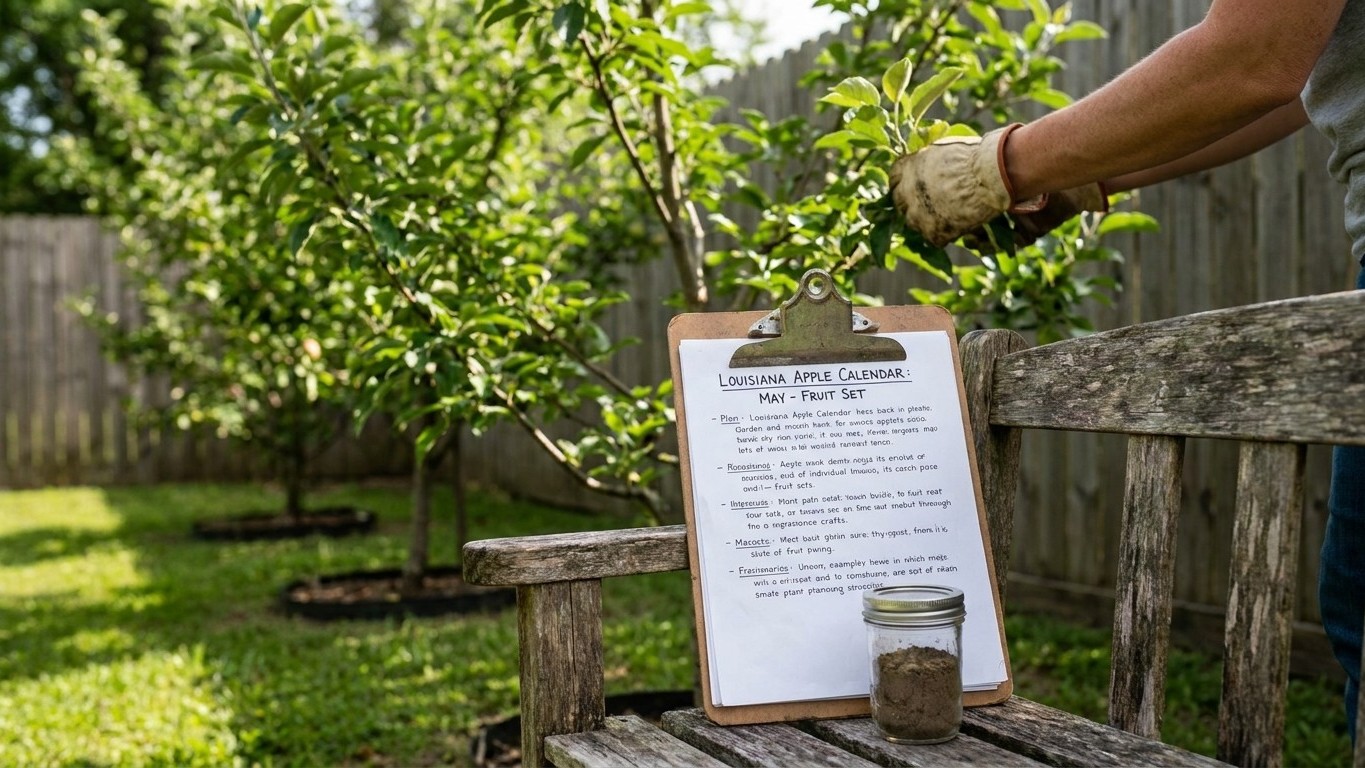

Louisiana’s apple problem isn’t cold, it’s not having enough of it. Your tree wakes up on chill hours, not a date, and this coastal winter barely hands it any — the coldest month averages just 44.7F at night, a hair above the 45F mark that even counts as chill at all. So before anything else, go check which cultivar is in the ground: if it isn’t a low-chill type like ‘Anna’ or ‘Dorsett Golden’, the calendar below won’t save it.
The short answer for Louisiana
The short answer is that Louisiana apple growing works only with low-chill cultivars such as ‘Anna’, ‘Dorsett Golden’ and ‘Ein Shemer’, planted where the winter still drops cool enough, often enough, to break dormancy evenly. At the New Orleans reference station, the coldest month’s average nightly low is just 44.7F, according to NOAA’s 1991-2020 climate normals. That is barely below the roughly 45F threshold most fruit trees use to count a chill hour, which means the accumulated chill season here is thin even by low-chill standards.
That single number decides almost everything else on this page. A cultivar bred for a real winter, one that needs 800 or 1,000 hours below 45F, simply never gets there in south Louisiana and leafs and blooms late, thin, and unevenly no matter how well it is fed or watered. A cultivar bred for something closer to 200 to 300 hours can make do with what the season gives it, though even that is not guaranteed every year.
The other half of the answer is the frost window, and it works differently than you would expect from a standard planting calendar. NOAA’s 1991-2020 normals put the last spring freeze at the New Orleans station between January 18 and February 8, and the first fall freeze between December 17 and January 8, a window that straddles the New Year. A freeze happens in only about 87 percent of years at that station, so roughly one winter in seven brings no freeze at all. Heat, not frost, is the limiting factor for apples here, and the calendar below reads off the tree’s own stage against that freeze window rather than off a fixed date. If you have not yet settled on a site and rootstock, Growing Apples in Louisiana covers that groundwork. This page assumes a tree already in the ground.
Working through it

An apple tree in Louisiana moves through the same stages as anywhere else. What is different is when it moves, how fast it moves, and how much say the calendar actually has over any of it.
Dormancy

Dormancy should run through the coolest stretch of winter, while the tree sits bare and accumulates chill hours below about 45F. At the New Orleans reference station, the coldest month averages a nightly low of only 44.7F, according to NOAA’s 1991-2020 normals, which means many nights barely cross the chilling threshold at all. This is why the cultivar’s published chill requirement, not the calendar date, decides whether the tree wakes evenly. A tree short on chill breaks bud over weeks instead of days, and flowers unevenly as a result.
Green tip and pink bud

Green tip, the first hint of leaf tissue at the bud, arrives once accumulated warmth pushes the tree out of dormancy. In south Louisiana that can start uncomfortably early, sometimes while the last-frost window is still open. NOAA’s 1991-2020 normals put that window at the New Orleans station between January 18 and February 8, and because a freeze somewhere inside it occurs in something between 30 and 70 percent of years, there is no way to call any single day in that stretch safe in advance. Pink bud, when the unopened flower first shows color, is the most cold-tender point in the whole calendar. A freeze here can kill the flower before it ever opens and take the year’s crop with it.
Bloom to fruit set

Bloom itself is short, often just a handful of days from petal opening to petal fall. For most low-chill cultivars grown this far south, bloom lands after the last-frost window has closed, so the bigger threats during bloom are usually rain and humidity rather than cold. Wet, warm bloom weather in a Louisiana spring favors fire blight and scab more than it favors frost damage. Fruit set follows petal fall by roughly two weeks. Fruitlets that fail to size up here almost always point to poor pollination weather or disease pressure during bloom, not to a late cold snap.
Harvest

Because Louisiana pushes heat units fast once bloom is done, the earliest low-chill cultivars ripen correspondingly early. ‘Anna’ and ‘Dorsett Golden’ are among the first apples of any cultivar to color up, typically in early summer, though the exact week shifts by a week or two either way with how warm the spring runs. For the fuller ranked list of cultivars and what each one costs in exchange for surviving here, see The Best Apple Varieties for Louisiana.
What changes across Louisiana
The New Orleans figures above describe the coast, and the coast is the mildest, latest-chilling part of the state. Move north toward Shreveport and the winters run measurably colder and more reliably below freezing, which gives trees there more usable chill and a more predictable, if still short, dormancy. North Louisiana is where a slightly higher-chill cultivar has any real chance, while the far south stays a low-chill-only proposition.
Within south Louisiana itself, the water matters. Lake Pontchartrain and the Gulf both hold heat into the night, which is part of why the New Orleans station records such a mild coldest-month minimum. Move inland, away from that buffering water, and low ground can trap cold air on clear, calm nights even at the same latitude, producing a harder local frost than the coastal average suggests. A tree planted in a low field or a drainage bottom sees a colder night than one on a slope or near open water a few miles away, even in the same parish.
The practical result is that no single frost date or chill figure applies to the whole state, and a grower in Alexandria or Monroe is working with a different winter than one in New Orleans or Houma, even though both lie in the southern half of the state. Treat the figures on this page as a description of the coastal reference station, useful for understanding how the stages line up, and adjust toward more chill and a longer, more reliable freeze window as you move north and away from open water.
The mistakes this climate punishes
Most of the failures in a Louisiana apple planting show up at a predictable stage, and most trace back to the same handful of decisions.
- Planting a high-chill cultivar bred for a real winter. It never fully breaks dormancy in south Louisiana, leafs out patchy over weeks, and blooms too sparse to be worth spraying for.
- Trusting the last-frost window as a hard line. Because a freeze in the New Orleans window (January 18 to February 8, NOAA’s 1991-2020 normals) occurs somewhere between 30 and 70 percent of years depending on where in that window you are, and about one year in seven sees no freeze at all, a warm early spell can pull a low-chill tree into pink bud well before the risk has actually passed.
- Feeding nitrogen late in the season. Growth pushed soft in autumn has not hardened by the first fall freeze, which the New Orleans normals place between December 17 and January 8, and soft wood is what a freeze actually kills.
- Ignoring humidity in favor of watching for cold. Fire blight and scab do more damage in a Louisiana spring than frost does once bloom has actually started, because bloom for most low-chill cultivars here lands after the frost window has closed.
Each of these shows up at a different stage. The high-chill mistake shows at green tip, when the buds should be swelling together and instead trickle out over a month. The frost-timing mistake shows at pink bud, the single most cold-tender point in the calendar. The late-feeding mistake shows at the first hard freeze itself, when soft new tissue blackens while older wood on the same tree survives untouched. The humidity mistake shows a few weeks after bloom, as fruitlets scar or drop for no reason the grower can see from the ground.
Checking this against your county
The figures here describe one station on the coast, and your parish may run a full freeze category warmer or colder depending on distance from water and elevation. The LSU AgCenter is the state’s land-grant extension service and the right place to check local frost records, chill-hour tracking and cultivar performance notes for your specific parish before committing to a planting. Call or visit the parish office rather than relying on a statewide average, since the gap between the coast and the northern parishes is large enough to change which cultivars are worth planting at all.
Common questions
Can I just plant a Honeycrisp or Fuji here?
Not with any reliability in most of Louisiana. Both need far more winter chill than the state’s mild, short winters provide, so they leaf and bloom unevenly and rarely fruit well even where they survive the summer heat.
Do low-chill apples need a second tree to pollinate?
Check the tag on the specific cultivar rather than assuming either way. Some low-chill selections are marketed as partly self-fruitful, but nearly all apples set a heavier, more even crop with a second compatible cultivar blooming nearby.
My tree bloomed in December. Did I do something wrong?
Probably not, and it is a sign of the climate rather than a mistake you made. A run of warm weather during the dormant period can pull a low-chill tree toward bloom early, and since the first fall freeze at the New Orleans station falls between December 17 and January 8 in NOAA’s 1991-2020 normals, an early bloom can still meet a freeze on its way out.
How many chill hours does south Louisiana actually get in a normal winter?
No official chill-hour total for the state appears in the sources behind this page, so treat any specific number you see online with caution. The closest documented figure is the New Orleans station’s 44.7F average nightly low for the coldest month, which signals a thin chill season without giving an exact hour count. Ask the LSU AgCenter whether it tracks chill units for your parish before betting on a specific figure.