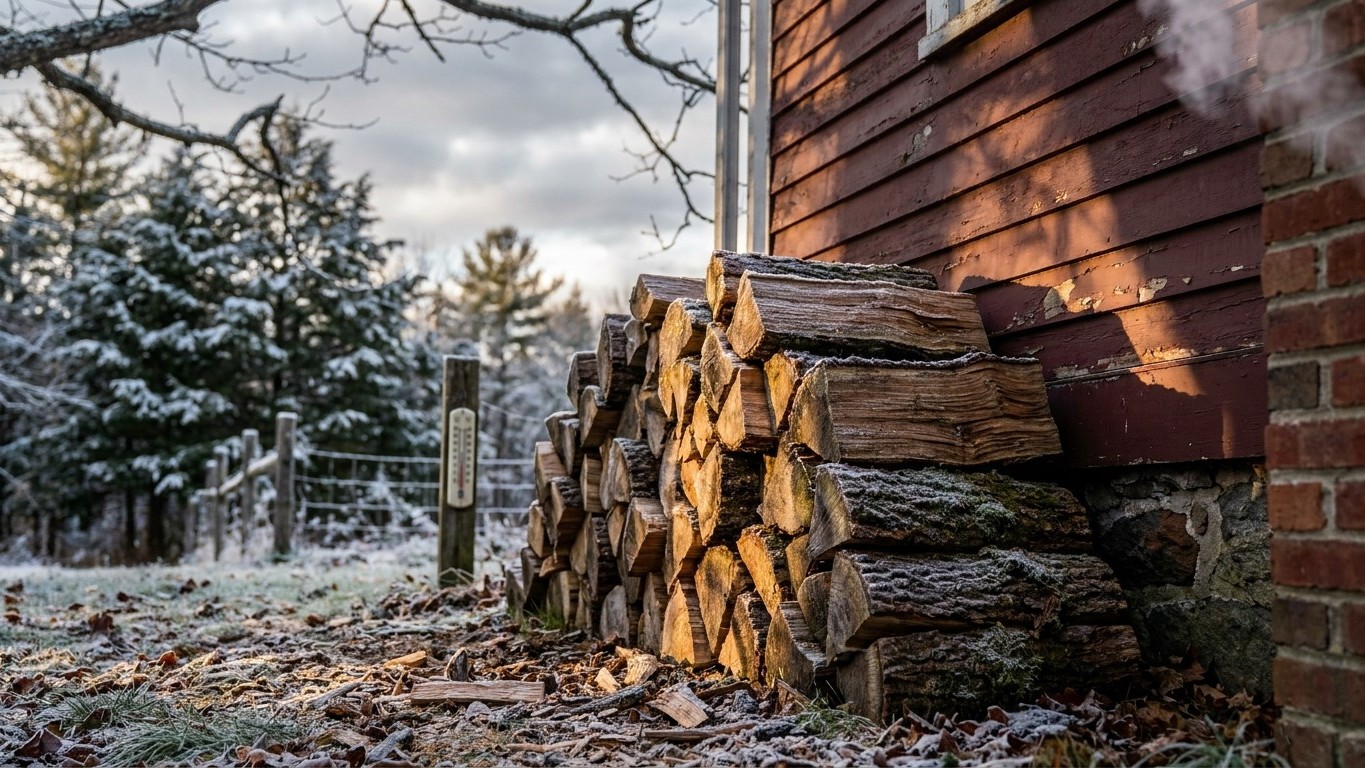

Massachusetts winters bottom out at an average low of 23.1°F in the coldest month, based on the Boston reference station. That single number decides how much wood you need, how dense it should be, and whether a fire is decoration or a real heat source. This guide walks through what that cold means for your woodpile, which woods pull their weight here, how to estimate a winter’s supply, and why so much local firewood never dries properly before it’s burned.
How cold it actually gets here

An average low of 23.1°F in January doesn’t sound brutal on paper. It’s not Minnesota. But “average” is doing a lot of work in that sentence. That figure comes from NOAA’s 1991-2020 Climate Normals for the Boston area, and it’s the mean of the daily lows across the whole month, not the record cold snap. Half the nights in a typical January dip below that mark. Some drop into the teens or single digits when an arctic front sits over New England for a few days. A wood stove or fireplace that’s asked to hold a house through that kind of stretch is doing real structural work, not just adding ambiance.
That distinction matters because it changes what “enough firewood” means. In a climate where winter lows hover in the 40s, a cord or two of whatever’s cheap and local is plenty, because the wood is there for a few chilly evenings a year. Massachusetts isn’t that climate. A house here that leans on wood heat, even as a supplement to an oil or gas furnace, needs to plan for weeks of sustained cold, not isolated cold nights.
What sustained cold does to a burn
A single cold night is easy. You load the stove, it burns down, the house survives on residual heat until morning. A run of nights in the 20s and teens is different. The stove needs to be reloaded overnight or the house loses ground steadily, and by the third or fourth day the difference between a dense, well-seasoned hardwood and a light, quick-burning one becomes obvious in the house’s temperature, not just in the woodpile.
This is also why the coldest-month figure matters more than the average winter temperature most people quote. An average winter temperature in the 30s can hide long stretches near freezing and short ones well below it. Planning firewood around the average alone under-predicts what a real Massachusetts cold snap demands. The 23.1°F figure is a better planning number precisely because it’s already an average of the hardest month, not a cherry-picked record low.
Which woods are worth the effort here
Once you accept that Massachusetts winters ask real work of a woodpile, density becomes the variable that matters most. A cord is a fixed volume, 4 feet by 4 feet by 8 feet, or 128 cubic feet total. That volume doesn’t change based on species. What changes is how much wood fiber is actually packed into it, and denser species pack more fiber, and more fiber means more fuel and a longer, steadier burn from the same stack of wood.
Michigan State University Extension puts the heat content of a cord of well-seasoned hardwood at roughly 20 million BTU on average, which works out to about the same heat as 145 gallons of #2 fuel oil or 215 gallons of LP gas. That’s an average across hardwood species, not a fixed number for any one type. Denser hardwoods run above that average per cord because more wood mass fits into the same 128 cubic feet. Lighter woods, softwoods especially, run below it, both because the wood itself is less dense and because softwoods often carry more resin, which burns fast and hot rather than slow and steady.
Matching wood to the job
Dense hardwoods are the ones you want stacked and ready for the coldest nights, the stretches where the fire needs to hold through eight hours without a reload. Lighter woods and softwoods have their place too. They catch faster, which makes them useful for starting a fire, and they suit the shoulder season, those October evenings or March cold snaps where you want some heat but not an all-night burn.
| Wood type | Relative heat output | Smoke | Sparks |
|---|---|---|---|
| Dense hardwood (oak, hard maple, ash) | Above the 20 million BTU/cord average | Low once seasoned | Few |
| Medium hardwood (birch, soft maple) | Near the average | Moderate | Moderate |
| Softwood (pine, spruce) | Below the average | Higher, more creosote risk | More, due to resin pockets |
A table like this only means anything if you can actually buy or cut the wood it describes. Local availability decides as much as any density chart. A theoretically superior species that you can only find green, unseasoned, and sold by a guy with a truck is worse firewood, practically speaking, than a modest species you can get properly dried and stacked ahead of the season. Ask any seller how long the wood has been split and stacked before you ask what species it is.
How much wood a winter takes
Anyone who tells you “you’ll need three cords” without asking about your house is guessing. The honest answer is that the number depends on three things that vary from house to house, and no published average captures all three at once.
- How cold your winter runs. The 23.1°F average low sets the baseline for Massachusetts, but a run of hard weeks demands more wood than a mild one, even in the same town.
- How well your house holds heat. Insulation, air sealing, window quality, and even how exposed the house is to wind all change how much heat escapes and needs replacing.
- Whether wood is your main heat source or a supplement. A house heated entirely by wood burns through a stack fast. A house with a furnace running in the background and a wood stove for evenings and weekends uses a fraction of that.
The gap between a tight house and a leaky one is not small. A poorly insulated home in a hard winter can burn through roughly double what a well-sealed home uses in the exact same climate, heating the exact same square footage. That’s the mechanism that makes a single “cords per winter” number useless as a rule of thumb: two neighbors on the same street, with the same outdoor temperatures, can have wildly different firewood needs based on how their houses are built.
The practical move is to run your own house down that list. Start with the cold figure for your area, adjust up if your house is drafty or older, adjust down if wood is background heat rather than the main source, and track what you actually burn through one full winter. That real number, from your own stove and your own house, will always beat a generic estimate.
Drying wood in this climate
Species and stove design get a lot of attention, but seasoning outranks both. Michigan State University Extension puts it plainly: firewood should burn at 20 percent moisture or less, while green, freshly cut wood can carry over 60 percent moisture. That water has to boil off before the wood releases usable heat, and boiling it off eats the very energy you were counting on. A “great” species burned green performs worse than a mediocre species burned properly dry.
Getting to that 20 percent mark takes air and time, not sunshine. Wood needs to be split, not left in rounds, and stacked so air actually moves through the pile. Massachusetts summers are humid enough to slow that process compared to a drier climate, which pushes the realistic seasoning window toward a full summer season of stacked, split wood before it’s ready to burn.
The red oak trap
Red oak deserves its own mention, because MSU singles it out as an exception. Its cell structure makes it dry more slowly than other hardwoods, so the usual “one summer and it’s ready” rule doesn’t apply the same way. Red oak often needs more time stacked and exposed to air before it hits that 20 percent target, regardless of how good the stacking job was.
This is also where the most common Massachusetts mistake shows up. Wood cut and split in spring for the coming winter almost never has enough time to season properly by the time the cold arrives in November or December. One summer of drying is the minimum, and species like red oak may need longer. Firewood for this winter should already have been split and stacked last spring or earlier. If it wasn’t, that wood is better saved for next year’s fire than burned green in this one.