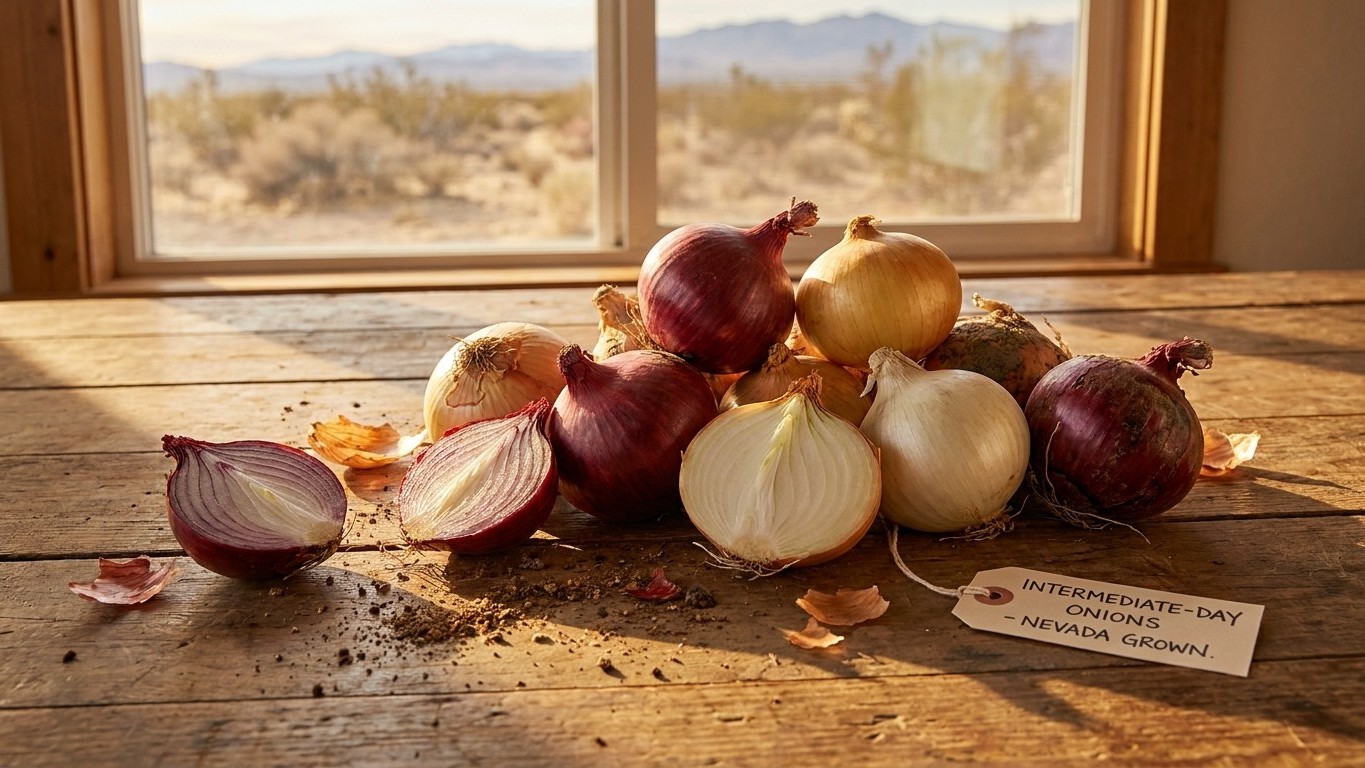

Nevada’s reference station sits at 36.07 degrees north, in Las Vegas, where the longest day of the year delivers 14 hours and 27 minutes of daylight. That figure, not the summer heat, decides which onions actually form a bulb here. It puts most of southern Nevada squarely in intermediate-day territory, with a few long-day and short-day varieties reaching just far enough to work at the margins.
The short answer for Nevada

Onions don’t respond to temperature the way tomatoes or peppers do. They respond to how many hours of light hit their leaves each day, and once that number crosses a variety’s threshold, the plant stops making leaves and starts making a bulb. Short-day types trigger at about 12 hours. Long-day types wait for 14 to 16 hours. At 14 hours and 27 minutes on the solstice, Las Vegas sits in the gap between those two extremes, which is exactly where intermediate-day onions are bred to perform.
That’s the group to plant for most of southern Nevada. Twelve varieties documented on this site have published latitude ranges that stretch across 36.07°N, and the majority of them are intermediate-day:
- Cabernet (intermediate-day, 35-45°N)
- Calibra (intermediate-day, 35-45°N)
- Candy (intermediate-day, 33-40°N)
- Elsye (intermediate-day, 32-45°N)
- Expression (intermediate-day, 32-45°N)
- Monastrell (intermediate-day, 35-46°N)
- Red Long of Tropea (intermediate-day, 35-48°N)
- Scout (intermediate-day, 32-46°N)
- Sierra Blanca (intermediate-day, 32-45°N)
Two long-day varieties also reach far enough south to cover this latitude: Bridger (35-50°N) and Walla Walla Sweet (35-55°N). And one short-day variety, White Castle (30-38°N, no page of its own on this site), sits at its northern edge here rather than its comfortable middle.
A second group deserves a mention rather than a flat recommendation. Gabriella, Madalyn, Red Rock, Red Sensation, Texas Grano 1015Y and Vidora are all short-day types with published ranges that stop just below 36.07°N, within a degree and a half of the boundary. That’s a continuum, not a wall, so these may bulb in a warm, sheltered southern Nevada garden, but a gardener planting them here is working at the edge of what the catalogue data supports, not in the middle of it.
What will not work here
Latitude ranges aren’t marketing copy. They describe where a variety’s genetics line up with the actual daylight the sun provides, and thirteen long-day and intermediate-day onions documented on this site are bred for latitudes that start above 36.07°N. Plant them in Las Vegas or anywhere near it, and the days here simply never get long enough to flip the switch. The plant keeps making leaves all summer because the bulbing signal never arrives, then the top eventually collapses and the bulb, such as it is, rots in the ground before it ever sizes up. That’s not a smaller harvest. It’s no harvest at all.
- Ailsa Craig (long-day, 38-60°N), needs daylight this latitude doesn’t reach
- Barolo (long-day, 38-55°N), bred for northern summers
- Blush (long-day, 38-55°N), same daylight gap
- Frontier (long-day, 40-50°N), requires several more degrees north
- New York Early (long-day, 38-50°N), bulbing trigger never arrives here
- Patterson (long-day, 38-55°N), a northern storage onion, not a southern one
- Powell (long-day, 43-47°N), a narrow, far-northern range
- Red Carpet (long-day, 40-45°N), needs longer summer days than Nevada’s south provides
- Red Long of Florence (intermediate-day, 38-50°N), its low end starts above the reference latitude
- Redwing (long-day, 43-65°N), bred for near-subarctic daylight
- Rossa di Milano (long-day, 38-50°N), another northern-only range
- Safrane (long-day, 42-50°N), requires far more daylight than this latitude provides
- Talon (long-day, 42-50°N), same story, too far north to suit southern Nevada
None of these are borderline the way the short-day edge cases above are. Their ranges start a full one and a half to nearly thirty degrees north of the reference station, which is why the answer for southern Nevada is a plain no rather than a maybe.
What changes across Nevada
All of the above applies to the reference station in Las Vegas, at 36.07°N. Nevada itself runs from around 35°N at its southern tip near Laughlin to roughly 42°N along the Idaho and Oregon border, a spread of about seven degrees of latitude. That’s not a rounding error. It’s the difference between a garden that belongs in the intermediate-day group and one that behaves like the long-day gardens of the Pacific Northwest.
| Location | Approximate latitude | Daylight vs. reference | What changes |
|---|---|---|---|
| Southern tip, near Laughlin | ~35°N | Slightly less | Still intermediate-day, but closer to the short-day edge varieties |
| Las Vegas (reference station) | 36.07°N | 14h27 on the solstice | Baseline for every figure on this page |
| Reno area | ~39.5°N | Noticeably longer | Crosses into long-day territory; several excluded varieties above will bulb here |
| Elko and the northern border | ~42°N | Longest in the state | Full long-day group; plant a couple of weeks earlier than in Las Vegas |
A gardener in Reno or Elko isn’t reading the wrong page by accident, they’re reading a page written for a different climate. The long-day varieties listed as unworkable in southern Nevada, Frontier, Patterson, Redwing, and the rest, are the varieties a northern Nevada garden should actually be planting. Meanwhile a gardener near Laughlin, at the state’s southern edge, sits closer to the short-day varieties that only touch 36.07°N by a degree or so. The safest move for anyone outside the immediate Las Vegas valley is to check their own latitude before assuming the reference figures apply directly.
Sweet now, or onions that last
Southern Nevada’s daylight numbers push growers toward intermediate-day and short-day varieties, and that comes with a flavor trade-off that has nothing to do with luck. University of Missouri Extension puts it plainly: sweet onions do not store as well as pungent ones, because pungency comes from volatile sulfur compounds, and those same compounds are what protect a bulb through months in storage. A sweet onion has fewer of them. That’s why it tastes better raw in July and why it turns soft by January.
Candy, Sierra Blanca, and Walla Walla Sweet, all workable at 36.07°N, lean toward that sweeter, shorter-keeping end of the spectrum. They’re excellent onions to eat within a few weeks or months of harvest, sliced raw on a sandwich or grilled whole, but they are not the onions to count on for a pantry that needs to last through winter. Varieties bred for northern latitudes, the long-day types with more time under summer daylight to build sulfur compounds, tend to run sharper and keep longer, which is exactly why northern Nevada and the Pacific Northwest are known for storage onions rather than sweet ones.
A southern Nevada garden, is set up to feed you generously in late spring and summer and then hand off to the grocery store by late winter. If a full pantry in March matters more than a sweeter onion in July, that’s a reason to grow fewer of the sweet intermediate-day varieties and lean harder on the sharper end of the group, Scout or Monastrell rather than Candy, even though all of them share the same latitude range.
Checking this against your own garden
Every figure above comes from a single weather station in Las Vegas. That’s a solid baseline for the Las Vegas valley itself, but Nevada’s seven degrees of north-south spread mean a garden even a few counties away can behave differently. Before ordering seed based on this page alone, it’s worth confirming a few things specific to the actual plot of ground being planted.
- Look up the latitude of your own town or county, not just the state as a whole, since a few degrees can shift you between day-length groups entirely.
- Check your local average last and first frost dates, since those determine when transplants or sets can safely go in the ground.
- Contact your county’s Cooperative Extension office, part of the University of Nevada system, for planting windows calibrated to your specific elevation and microclimate.
- Note your garden’s elevation, since higher desert valleys and mountain towns can see later frosts and shorter growing seasons than the Las Vegas valley itself.
- If you’re near Laughlin or near Elko, treat this page’s variety list as a starting point rather than a final answer, and lean toward the neighboring day-length group instead.