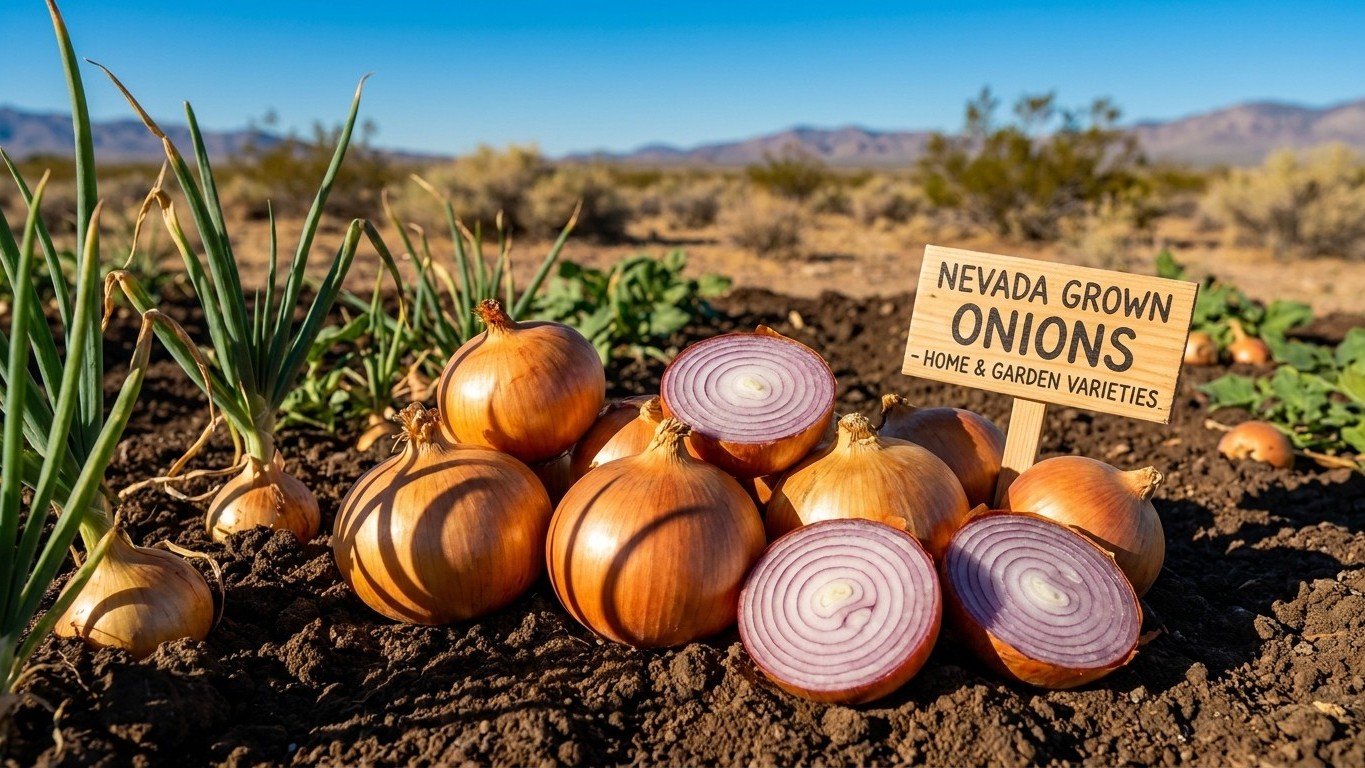

Onions bulb by day length, not by heat — and Nevada’s numbers put most of the state in intermediate-day territory, with a narrow band of short-day varieties possible near Las Vegas and long-day types reserved for the far north. Twelve varieties documented on this site have a published range that covers the 36.07N reference point. Thirteen more simply won’t bulb this far south, no matter how well you feed them.
How long your longest day is

The reference station for this page sits at latitude 36.07 degrees north, the coordinates of the Las Vegas airport station (USW00023169), and on the longest day of the year that location gets 14 hours and 27 minutes of daylight. That single pair of numbers decides almost everything else on this page. An onion doesn’t care how hot your soil gets in July. It counts daylight hours, and once the day length crosses its genetic threshold, it stops building leaves and starts building a bulb.
At 14 hours 27 minutes, Las Vegas comfortably clears the roughly 12-hour trigger that short-day onions need, according to Clemson Cooperative Extension’s guidance on onion bulbing. That’s enough to rule short-day types in, at least at the edge. It’s also enough for intermediate-day varieties, which typically want 13 to 15 hours. What it is not enough for, in most cases, is the long-day varieties that need 14 to 16 hours and often more, consistently, through the growing season. A few long-day varieties whose range starts right around 35N can still work near this latitude, but the further you push into true long-day territory, the more likely the plant just makes leaves.
Nevada is not a small state, and this matters more here than almost anywhere else in the country. The reference latitude of 36.07N describes Las Vegas, in the extreme southern tip of Nevada. Reno sits close to 39.5N. Elko is near 40.8N. Carson City is around 39.2N. That’s a difference of three to four and a half degrees of latitude between the southern corner and the rest of the state, and three to four degrees is enough to add a meaningful chunk of summer daylight, in some cases nearing an extra 30 to 45 minutes on the longest day. A gardener in Las Vegas and a gardener in Elko are, for bulbing purposes, gardening in two different climates wearing the same state name. If you’re anywhere north of the Las Vegas valley, look up your own city’s latitude before trusting a variety list built around 36.07N. The closer you get to 39 or 40 degrees north, the more long-day varieties come into play, and the intermediate-day types that work well in the south may bulb early and stay undersized.
Which varieties bulb in Nevada
Based on published latitude ranges, twelve varieties documented on this site cover the 36.07N reference point outright. That list leans heavily intermediate-day, which fits a state whose most populous corner sits right at the seam between short-day and intermediate-day territory.
- Bridger (long-day, 35-50N)
- Cabernet (intermediate-day, 35-45N)
- Calibra (intermediate-day, 35-45N)
- Candy (intermediate-day, 33-40N)
- Elsye (intermediate-day, 32-45N)
- Expression (intermediate-day, 32-45N)
- Monastrell (intermediate-day, 35-46N)
- Red Long of Tropea (intermediate-day, 35-48N)
- Scout (intermediate-day, 32-46N)
- Sierra Blanca (intermediate-day, 32-45N)
- Walla Walla Sweet (long-day, 35-55N)
- White Castle (short-day, 30-38N)
A handful of others sit within a degree and a half of their published boundary, which puts them in a genuine gray zone rather than a clear yes. Gabriella, Madalyn, Red Rock, Red Sensation, Texas Grano 1015Y, and Vidora are all short-day varieties whose upper range ends between 35N and 36N. They may bulb reasonably well in the Las Vegas valley, and they may come in small. Latitude ranges are a continuum, not a fence, so treat these as worth a trial row rather than a guaranteed crop.
The varieties that will not bulb here
This is the list that saves a season. Thirteen varieties documented on this site have published ranges that start well north of 36.07N, which means the day here never gets long enough to switch them into bulb mode:
- Ailsa Craig (long-day, 38-60N)
- Barolo (long-day, 38-55N)
- Blush (long-day, 38-55N)
- Frontier (long-day, 40-50N)
- New York Early (long-day, 38-50N)
- Patterson (long-day, 38-55N)
- Powell (long-day, 43-47N)
- Red Carpet (long-day, 40-45N)
- Red Long of Florence (intermediate-day, 38-50N)
- Redwing (long-day, 43-65N)
- Rossa di Milano (long-day, 38-50N)
- Safrane (long-day, 42-50N)
- Talon (long-day, 42-50N)
If you’ve ever grown a supermarket onion set from a bag labeled for a northern climate and ended up with a thick green stalk, no bulb, and eventually a mushy base, you’ve already met this list in person. That’s not a soil problem or a watering mistake. The plant simply never received the day length it needed to stop growing leaves. It kept trying until the season ran out, then it rotted. None of these varieties belong south of the mid-30s, and pushing them into Nevada’s southern half won’t change the geometry of the sun.
When to plant onions in Nevada
Onion planting timing follows the day-length group first and the frost calendar second, and Nevada’s frost calendar is genuinely two different stories depending on where you garden. NOAA’s 1991-2020 climate normals for the Las Vegas airport station put the last spring freeze at 32°F between January 7 and February 1, and the first fall freeze between December 8 and December 23. Those are averages drawn from a 30-70 percent freeze probability band, not hard dates, and they describe an unusually mild desert station sitting inside an urban heat island.
Treat those Las Vegas numbers as a floor, not a statewide guide. Reno, Carson City, and any garden at elevation will see frost arrive weeks to months earlier in fall and linger weeks to months later in spring compared to the Las Vegas valley. A gardener in the Truckee Meadows or up in the mountains around Lake Tahoe is often still watching for frost well into May, while a Las Vegas garden may be planting weeks earlier. This is exactly why the state needs to be described as a range rather than a single window, and why your county extension office is the better source than any national dataset for your specific yard.
What the mild band allows
In the mildest, lowest-elevation pockets of southern Nevada, where winter freezes stay light and brief, gardeners can often get away with fall planting of short-day and some intermediate-day onions, letting the bulb develop through the mild winter and early spring before the long summer heat sets in. Further north and at elevation, that approach risks losing the crop to a hard freeze, and the safer play is planting in late winter to early spring instead, timed to the local last-frost window rather than the Las Vegas figures above. Either way, the frost dates here are averages built from three decades of data. Some years run two or three weeks earlier or later than the stated band, so use them to plan a season, not to bet a whole tray of transplants on a single calendar date.
Sweet onions or onions that keep
The onion you can realistically grow in Nevada depends heavily on where in the state your garden sits, and the trade-off underneath it is chemical, not a matter of luck or skill. Pungency in an onion comes from volatile sulfur compounds, and those same compounds double as the bulb’s natural defense in storage. Breed or grow for less bite, and you also grow a bulb with a shorter shelf life. The University of Missouri Extension states it plainly: sweet onions, as a rule, don’t store as well as the more pungent types.
Day length lines up with this trade-off almost exactly. Short-day varieties, the ones best suited to the Las Vegas valley’s latitude, tend to run sweeter and milder, and they tend to fade fastest in the pantry. Intermediate-day varieties, which cover most of the varieties that actually bulb across Nevada’s populated corridor, land in the middle: reasonable flavor, reasonable storage life, rarely exceptional at either. Long-day varieties, the kind better suited to Nevada’s northern counties near or above 39-40N, build up more of those sulfur compounds and keep considerably longer in a cool, dry space.
What that means for your kitchen is straightforward. A garden in the Las Vegas valley, growing short-day or intermediate-day types, will give you onions best eaten within a couple months of harvest: good in salads and on the grill, not built for the long haul. A garden in Reno, Carson City, or Elko, with access to true long-day varieties like Bridger or Walla Walla Sweet, can expect a bulb that holds up in a cool pantry well into winter, sometimes toward spring, though the flavor runs sharper on the plate. Don’t expect a variety to give you both. No onion documented here is bred to be both sweet and a long keeper, and that’s not a gap in the seed catalogs. It’s the sulfur.