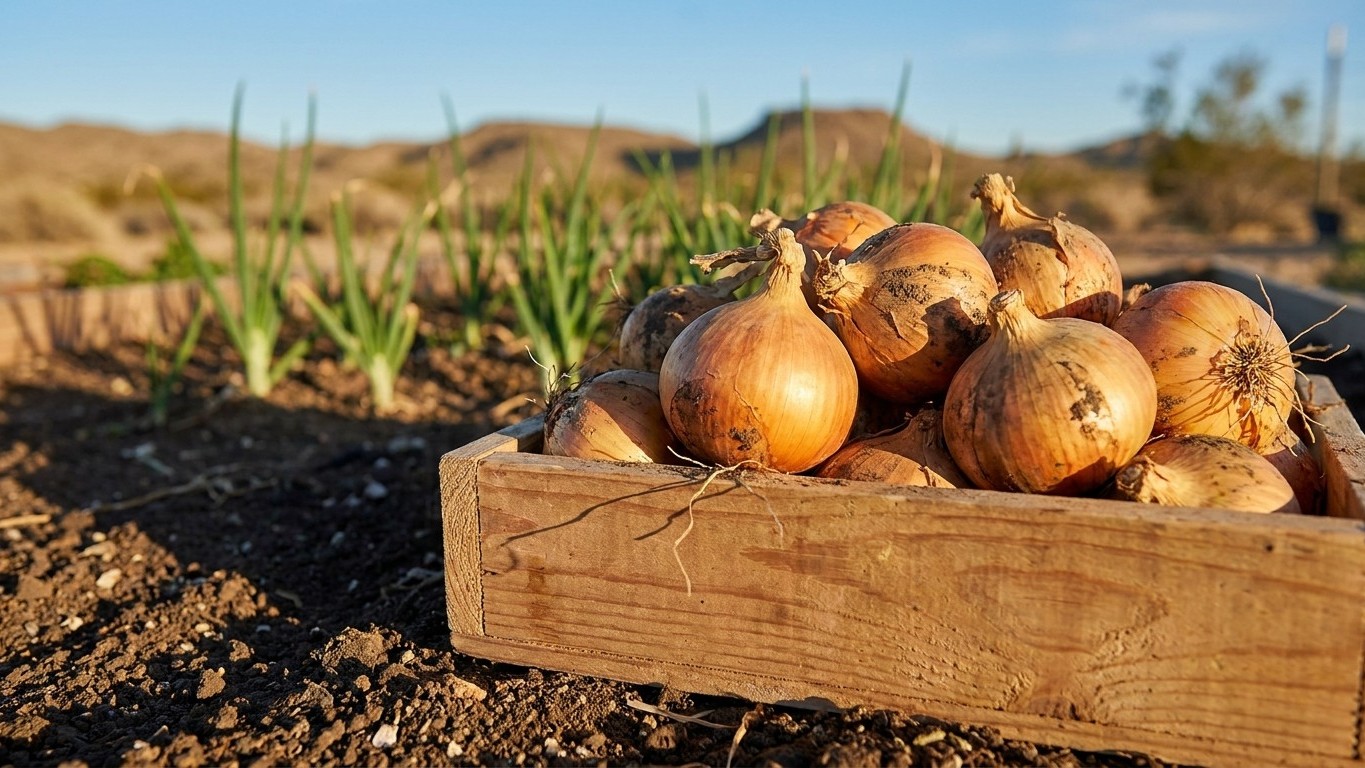

In the low desert around Las Vegas, onions go in the ground in autumn, not spring. Farther north and at elevation, where winters bite harder, the window shifts to late winter through early spring. The difference comes down to two numbers: a reference latitude of 36.07 degrees north and a longest day that tops out at 14 hours and 27 minutes. Those figures, drawn from the Las Vegas weather station, decide when an onion bulbs and how much of the plant it gets to work with.
The short answer for Nevada

An onion doesn’t care how warm it is outside. It cares about how long the sun stays up. Once day length crosses a variety’s threshold, the plant stops building leaves and starts building a bulb, whatever size it happens to be at that moment. At 36.07N, the longest day of the year runs 14 hours and 27 minutes, which lands Las Vegas squarely in intermediate-day territory: varieties that need roughly 13 to 15 hours of daylight to trigger bulbing, rather than the 12 hours short-day types want or the 14 to 16 hours long-day types demand.
That daylight number explains the calendar. In the low desert, winters rarely deliver a hard, sustained freeze, so an onion set or transplant put in the ground in autumn can spend the cool months quietly building roots and leaves. By the time the days lengthen past the intermediate-day threshold the following spring, the plant has months of growth stored up, and it channels that into a full-sized bulb. Push the planting date into spring instead, and the plant only gets a few weeks of leaf growth before the trigger fires, no matter how much water or fertilizer it gets.
Farther north and higher up, that fall strategy stops working. Cold that would barely register in Las Vegas can kill young onion plants outright in Reno or Carson City, where winter lows regularly drop well below freezing. Gardens there have to wait, planting in late winter or early spring once the ground is workable and the worst of the freeze risk has passed. It’s a narrower window than the desert gets, and it’s the reason the same crop follows two different calendars inside one state.
This is also why the advice for Nevada doesn’t transfer to a neighboring state without adjustment. A gardener in Minnesota, sitting at a much higher latitude with far longer summer days, is locked into long-day varieties and a spring-only planting schedule. A gardener in coastal Georgia, at a lower latitude with shorter summer days, plants short-day types in fall as a matter of course. Nevada’s mix of a mid-range latitude and wide climate swings between its low desert and its high desert is what puts it in the intermediate-day, split-calendar category rather than firmly in either camp.
What will not work here
Planting late is the mistake gardeners make without realizing it, because it doesn’t feel like a mistake. The plant looks fine all spring. But bulbing starts on a schedule set by day length, not by the calendar the gardener had in mind, and whatever size the onion has reached by that date is the size it stays. A late planting doesn’t push the harvest back a few weeks with a bigger payoff at the end. It locks in a smaller bulb, permanently, the moment the day-length trigger fires.
The reverse problem is worse: some varieties never reach the trigger at all in Nevada, because the reference latitude’s longest day, 14 hours and 27 minutes, simply doesn’t stretch far enough. These are long-day types bred for latitudes well north of 36.07N. Planted here, they spend the entire season making leaves, wait for a day length that never arrives, and eventually rot in the ground. Not a small onion. No onion.
- Ailsa Craig (long-day, 38-60N), needs longer summer days than Las Vegas provides
- Barolo (long-day, 38-55N), same shortfall, no bulbing trigger reached
- Blush (long-day, 38-55N), day length never crosses its threshold here
- Frontier (long-day, 40-50N), bred for latitudes north of the state’s reference point
- New York Early (long-day, 38-50N), leaves only, then rot
- Patterson (long-day, 38-55N), the trigger day length isn’t available
- Powell (long-day, 43-47N), well outside reach of a 14h27 longest day
- Red Carpet (long-day, 40-45N), the same problem, farther out
- Red Long of Florence (intermediate-day, 38-50N), its lower bound still sits above 36.07N
- Redwing (long-day, 43-65N), a far-northern variety, not a Nevada one
- Rossa di Milano (long-day, 38-50N), no bulb without a longer summer day
- Safrane (long-day, 42-50N), needs several more hours of daylight than Las Vegas gets
- Talon (long-day, 42-50N), same story, no bulbing here
What changes across Nevada
Nevada isn’t one latitude, and the 36.07N figure belongs to one place: Las Vegas, home of the weather station these numbers come from. The state actually stretches from roughly the southern tip near Laughlin up to its northern border with Oregon and Idaho, a span of several degrees of latitude, plus a jump from low desert to high desert elevation that matters just as much as the latitude line does.
| Region | Approximate latitude | What it changes |
|---|---|---|
| Southern Nevada (Las Vegas area) | ~36N | 14h27 longest day; intermediate-day onions bulb reliably; mild winters allow fall planting |
| Northern Nevada (Reno / Carson City area) | ~39-40N | Longer summer days than Las Vegas; long-day types like Bridger and Walla Walla Sweet, whose ranges cover this far north, become an option; cold winters push planting to late winter or early spring |
| Far northern border | ~42N | Longest day noticeably longer still; sits closer to core long-day territory; harsh winters make spring the only realistic planting window |
A gardener near Reno or Elko isn’t reading the same calendar as one near Las Vegas, even though both live in Nevada. The intermediate-day varieties that suit 36.07N, such as Cabernet, Calibra, Candy, Elsye, Expression, Monastrell, Scout, and Sierra Blanca, still work across most of the state’s latitude range, but the far north gains room for genuine long-day types the low desert can’t grow at all. Meanwhile, six short-day varieties, including Red Rock, Red Sensation, Texas Grano 1015Y, and Vidora, sit close enough to the 36.07N boundary that they may bulb in the warmest, southernmost pockets of the state, but they’re at the edge of their published range there, not comfortably inside it.
Sweet now, or onions that last
Every onion garden in Nevada eventually runs into the same trade-off, and it isn’t a matter of variety marketing. It’s chemistry. The volatile sulfur compounds that give an onion its sharp bite are the same compounds that protect the bulb once it’s in storage. A variety bred to be mild has fewer of those compounds, which is exactly why it tastes better raw and exactly why it won’t survive a Nevada winter in the pantry.
This lines up with the day-length split across the state. Short-day and intermediate-day varieties, the ones suited to southern Nevada’s shorter summer days, tend to run sweeter and lighter on sulfur, which means they’re best eaten within weeks of harvest rather than tucked away for later. Long-day types, the ones that only make sense in the state’s far north where the summer day genuinely stretches long enough, carry more of those pungent compounds and hold up in storage for months.
What that means for the kitchen is straightforward. A garden built around the varieties that suit Las Vegas and most of southern Nevada is going to hand over a batch of sweeter onions that are best used up through the fall, not an onion that’s still sitting in good shape in March. A northern Nevada garden growing something like Bridger or Walla Walla Sweet, both of which have long-day ranges wide enough to cover the whole state, gets closer to a bulb that can actually make it through winter storage. There’s no variety that does both. Sweetness and shelf life pull in opposite directions, and the reference latitude a gardener is working from tips the scale one way or the other.
Checking this against your own garden
The 36.07N figure and the 14h27 longest day both describe Las Vegas specifically, not every yard in Nevada. Anyone gardening away from the low desert, especially toward Reno, Carson City, Elko, or the higher elevations in between, is working with a different day length and a very different frost calendar, and it’s worth confirming the local numbers before committing to a planting date.
- Look up your own latitude if you’re more than an hour or two from Las Vegas by driving distance, since a few degrees of difference can shift which day-length group actually suits your yard
- Check your average last spring frost date and first fall frost date locally, rather than assuming the low desert’s mild-winter schedule applies
- Ask your county’s University of Nevada Cooperative Extension office for the planting window and variety recommendations specific to your elevation
- Note whether your site sits in a low desert valley or at higher elevation, since that changes frost risk more than latitude alone does in this state
- Confirm which day-length group your chosen variety is bred for before planting, rather than assuming a variety that worked in another state will bulb the same way here