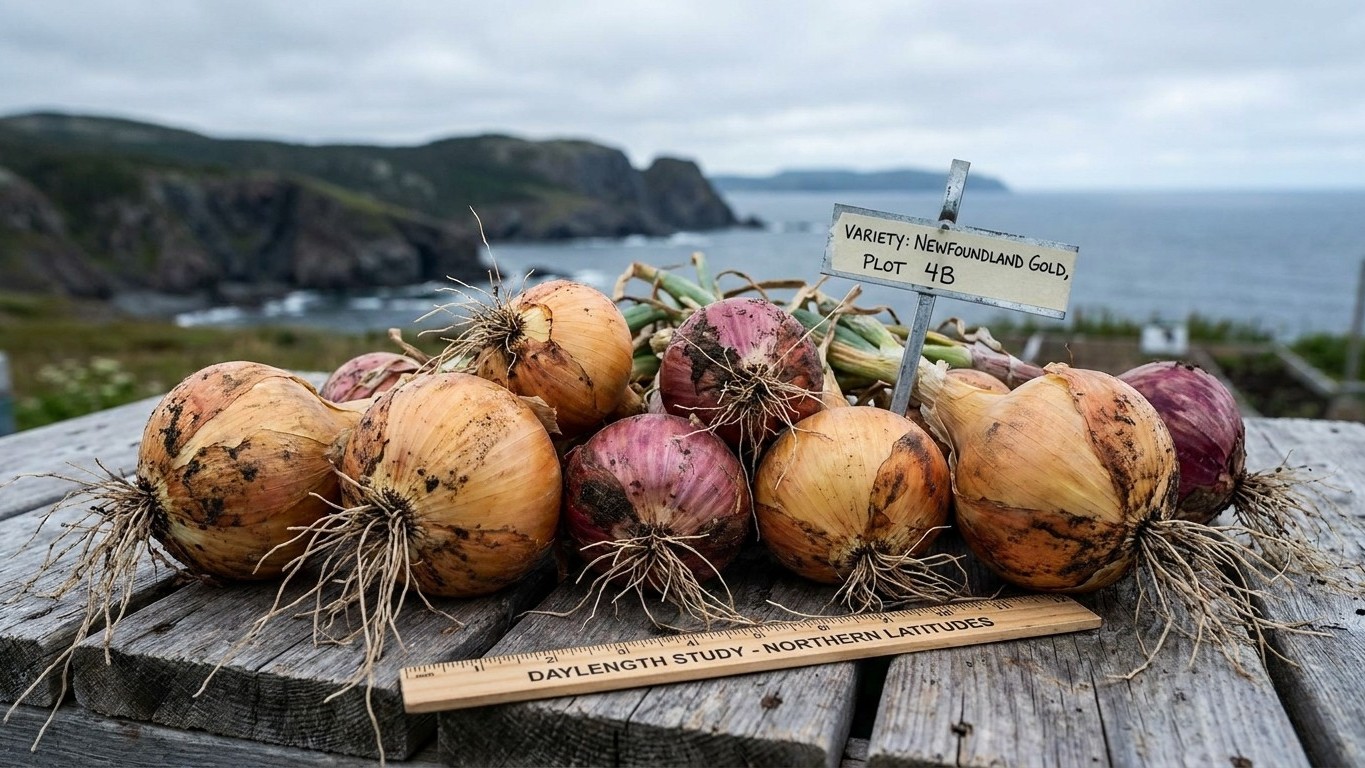

Newfoundland and Labrador sits far enough north that long-day onions are the right choice almost everywhere in the province, and a handful of intermediate-day types can work too. St. John’s, the reference point for this guide, sits at 47.62 degrees north and gets 15 hours and 47 minutes of daylight on the longest day of the year. That’s the number an onion actually cares about.
The short answer for Newfoundland and Labrador

Onions don’t bulb because the weather warms up. They bulb because the day gets long enough, and each variety carries a built-in trigger for that. Short-day types start bulbing once daylight reaches roughly 12 hours, which happens everywhere on Earth by early summer. Long-day types wait for something closer to 14 to 16 hours, a length of day that only shows up at higher latitudes. At 15 hours 47 minutes on the June solstice, St. John’s comfortably clears that threshold, which puts Newfoundland and Labrador squarely in long-day territory.
That threshold comes from Clemson Cooperative Extension’s guidance on onion bulbing, and it holds regardless of how cold or foggy the season has been. A long-day onion planted in St. John’s will start forming a bulb around the solstice whether the spring was mild or miserable, because the plant is reading the clock, not the thermometer.
Fourteen of the thirty-one onion varieties documented on this site carry a published latitude range that covers 47.62N, which means their catalogue data says they’re built for exactly this kind of daylight. That group includes Ailsa Craig, Barolo, Blush, Bridger, Frontier, New York Early, Patterson, Redwing, Rossa di Milano, Safrane, Talon, and Walla Walla Sweet, all long-day types, plus two intermediate-day varieties, Red Long of Florence and Red Long of Tropea, whose ranges also stretch this far north.
One more variety sits right on the edge. Powell, a long-day onion with a published range of 43 to 47 degrees north, has an upper bound just below St. John’s latitude. It falls within the blurred zone rather than a clean yes, and a gardener growing it here should treat it as a variety to watch rather than one to count on without a backup plan.
What will not work here
This is the part of the picture that catalogue lists tend to skip, and it’s the reason a lot of northern gardens end up with a bed of onion leaves and nothing underneath. Short-day and many intermediate-day varieties are built for latitudes well south of Newfoundland and Labrador, where 12 hours of daylight arrives early in the season. Plant one of those here and the trigger for bulbing goes off long before the plant has grown enough leaf mass to build a decent bulb. The result isn’t a smaller onion. It’s leaves all season, a tiny or nonexistent bulb, and rot setting in once the plant tries to go dormant with nothing stored below ground.
Sixteen of the documented varieties fall into this category for St. John’s latitude, either because their published range tops out below 47.62N or because their bulbing trigger simply doesn’t match the daylight this far north:
- Cabernet (intermediate-day, 35-45N), upper range limit sits well south of Newfoundland and Labrador
- Calibra (intermediate-day, 35-45N), same gap, triggers too early for the local daylight curve
- Candy (intermediate-day, 33-40N), built for a much shorter summer day than St. John’s provides
- Elsye (intermediate-day, 32-45N), range ends short of local latitude
- Expression (intermediate-day, 32-45N), same shortfall
- Gabriella (short-day, 20-35N), a short-day variety, bulbs far too early this far north
- Madalyn (short-day, 20-35N), same short-day mismatch
- Monastrell (intermediate-day, 35-46N), narrowly misses St. John’s latitude
- Red Carpet (long-day, 40-45N), a long-day type, but its published range still ends short of 47.62N
- Red Rock (short-day, 30-36N), short-day, wrong trigger entirely
- Red Sensation (short-day, 25-35N), same issue
- Scout (intermediate-day, 32-46N), misses local latitude by a small margin
- Sierra Blanca (intermediate-day, 32-45N), southern range, wrong daylight response
- Texas Grano 1015Y (short-day, 25-35N), a warm-climate short-day classic, not built for this latitude
- Vidora (short-day, 25-35N), same mismatch
- White Castle (short-day, 30-38N), short-day, far outside its intended range here
A short-day variety planted in Newfoundland and Labrador isn’t a matter of a plant that struggles. It’s a variety mistake, and no amount of feeding or watering corrects a bulbing trigger that fires at the wrong moment.
What changes across Newfoundland and Labrador
St. John’s latitude describes the Avalon Peninsula and the southeastern edge of the island, but the province stretches far beyond that. Newfoundland itself runs a few degrees north and west of the capital, and Labrador continues on well past that, reaching toward the sub-arctic. A single latitude figure can’t speak for all of it.
The direction of the shift matters more than the size of it. Moving north in this province means more summer daylight, not less, so the long-day varieties that work in St. John’s tend to work at least as well, and often more comfortably, further into central Newfoundland and up through Labrador. The tradeoff is a shorter frost-free season the farther north a garden sits, which changes when to start seedlings and how much leaf growth the plant can pack on before the trigger fires, even if the daylight math stays favorable.
| Region | Approximate latitude | What it changes |
|---|---|---|
| Avalon Peninsula / St. John’s | ~47.6N (reference) | 15h47m longest day; long-day varieties bulb reliably |
| Central and western Newfoundland | ~48-49N | Slightly longer summer day than St. John’s; long-day varieties remain the safe choice, frost dates shift earlier in fall |
| Labrador coast and interior | ~53-60N | Summer daylight well beyond the long-day threshold; season length becomes the limiting factor rather than day length |
A gardener in Happy Valley-Goose Bay or further up the Labrador coast is working with a summer day considerably longer than St. John’s sees, which means the same long-day varieties still fit the daylight requirement. What tightens instead is the window between last frost and first frost, so timing and seedling size at transplant matter more the farther north the garden sits.
Checking this against your own garden
Every figure in this guide comes from a single station, St. John’s, and a province this size doesn’t behave the same way from one end to the other. Before settling on a variety list, it’s worth confirming a few things specific to the actual garden rather than trusting a province-wide number.
- Look up the latitude of the nearest town or city, especially if the garden sits well north of the Avalon Peninsula or out toward Labrador
- Check local frost-free dates through a provincial agriculture office or county extension service rather than relying on a general provincial average
- Note how much daylight the site actually gets in June, since tree cover, hills, or coastal fog can shave real growing light even where the astronomical day length is generous
- Track whether a borderline variety like Powell actually bulbs in a given season, and keep notes year to year rather than assuming one result predicts the next
- Ask a local extension agent which varieties other gardeners in the area have had success with, since soil and microclimate can shift results even within the same latitude band
A latitude figure and a daylight number are a starting point, not a guarantee. The final answer for any one garden in Newfoundland and Labrador comes from matching those numbers against local frost dates and a season or two of direct observation.