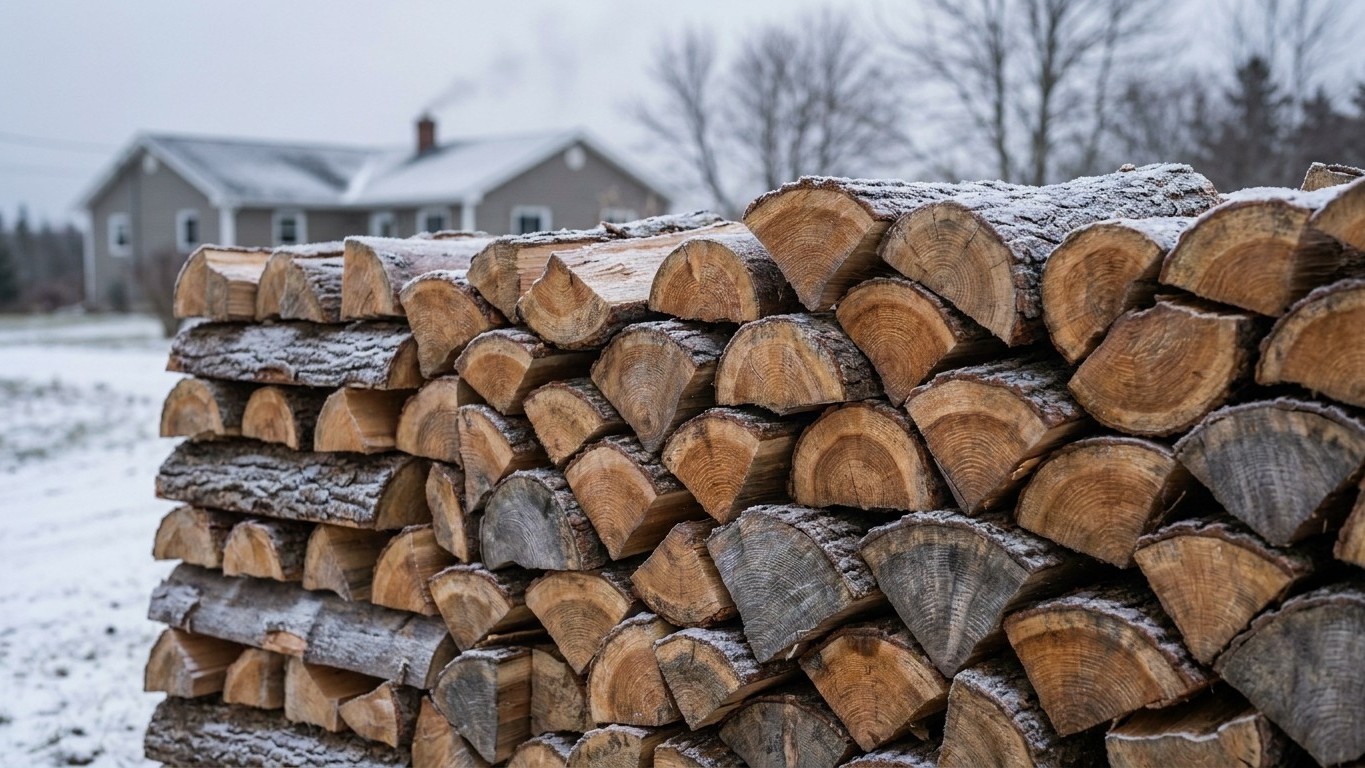

Halifax’s coldest month averages a low of 13.3°F. That single number shapes every firewood decision in Nova Scotia: how many cords you need, how dense your wood should be, and whether burning wood here is a lifestyle choice or a heating necessity. This guide breaks down what that cold means for your woodpile, which species actually earn their keep in a Maritime winter, how to estimate your seasonal need, and why the region’s damp air makes drying wood trickier than the calendar suggests.
How cold it actually gets here

13.3°F. That’s the average daily low for Halifax’s coldest month, according to Environment and Climate Change Canada’s 1981-2010 Climate Normals. Not the record low, not some rare cold snap. The average. Meaning on a typical night in the depth of winter, that’s where the mercury sits before sunrise, night after night, for weeks.
This isn’t a climate where firewood is a nice-to-have. It’s a climate where a poorly heated house gets genuinely dangerous for pipes, for pets, for anyone relying on a single heat source. Wood heat in Nova Scotia has to actually work at 13°F and below, not just look good stacked by the porch.
What that number demands from your setup
A stove or insert burning wood at these temperatures needs fuel that holds heat through a long overnight burn. Softwoods and half-seasoned scraps might get you through a mild October evening. They won’t carry a house through a January night when the outside temperature is sitting well below freezing for eight or ten hours straight.
The practical result: Nova Scotia homeowners who lean on wood heat need to think in terms of density and dryness first, species preference second. A cord of the “right” wood that’s still 40 percent moisture will underperform a cord of a lesser species that’s properly seasoned. Get the fundamentals right before worrying about which tree it came from.
This is also a place where wood heat commonly supplements a furnace or heat pump rather than replacing it outright, particularly in newer construction. But even as a supplement, the numbers below only work if the wood itself is dense and dry enough to matter on the coldest nights, not just on the easy ones.
Which woods are worth the effort here
A cord is a fixed volume, a stack measuring 4 feet by 4 feet by 8 feet, or 128 cubic feet. That volume doesn’t change based on species. What changes is how much wood mass actually fills it, and that’s where density becomes the whole game in a climate like Nova Scotia’s.
According to Michigan State University Extension, a cord of well-seasoned hardwood delivers roughly 20 million BTU, comparable to about 145 gallons of #2 fuel oil or 215 gallons of LP gas. That figure is an average across hardwood species; it moves depending on which hardwood you’re burning and how dry it actually is. A cord of dense hardwood, split and seasoned properly, comes closer to that top-end heat output than a cord of lighter wood ever will, simply because more solid wood fiber is packed into the same 128 cubic feet.
Dense wood for the cold nights, light wood for starting fires
Denser hardwoods are the ones worth seeking out for the coldest stretches of a Nova Scotia winter, the nights near or below that 13.3°F average low. They burn longer, coal better overnight, and get closer to that 20 million BTU ceiling per cord. Red oak deserves a specific mention here, not for its heat output but for a quirk in how it dries: MSU notes it dries slowly because of its cell structure, meaning it needs more time stacked than most other hardwoods before it reaches burnable moisture.
Lighter, softer woods still have a role. They’re the wood you reach for to get a fire going quickly, to bridge a shoulder-season evening that doesn’t call for an overnight burn, or to mix into a firebox alongside denser splits to control burn rate. What they won’t do is hold a bed of coals through a long January night on their own.
Availability matters as much as any table. A species you can’t buy properly seasoned locally is a worse choice than a more modest wood you can actually get dry. Ask any Nova Scotia firewood seller what they stock and how long it’s been split and stacked before assuming a “better” species is worth chasing across the province.
| Wood category | Heat output (per cord) | Smoke | Sparks | Best use |
|---|---|---|---|---|
| Dense, well-seasoned hardwood | Approaches the ~20 million BTU average | Low when properly dried | Low to moderate | Overnight burns, coldest nights |
| Medium-density hardwood | Below the average, still solid | Low to moderate | Moderate | General winter burning, mixed loads |
| Softwood or light hardwood | Well below the average | Higher, more resin-related smoke | Higher, more frequent popping | Kindling, quick starts, shoulder season |
How much wood a winter takes
Anyone hoping for a single “cords per winter” figure for Nova Scotia is asking the wrong question. That number is meaningless without knowing three things about the specific house and household in question.
- How cold the winter runs: a season that regularly dips toward or below that 13.3°F average low burns through wood far faster than a mild one, even in the same town.
- How well the house holds heat: insulation, air sealing, window quality, and even ceiling height change how much of that heat actually stays inside rather than leaking out.
- Whether wood is the primary heat source or a supplement: a household running a wood stove as the sole heat source through the coldest months burns dramatically more than one using it a few evenings a week alongside a furnace.
Here’s the mechanism that makes those variables matter so much: a poorly insulated older house in a hard winter can burn through roughly double what a tightly sealed, well-insulated home uses in that same climate, heating the same square footage. That’s not a rounding error. That’s the difference between ordering three cords and ordering six.
The practical approach is to track your own burning for one season rather than trust a generic estimate pulled from a different climate or a different house. Note how many cords you go through by the end of March, then adjust up or down the following year based on how the winter compared. A milder winter than the 1981-2010 average will need less; a harder one, more. Over two or three seasons, most Nova Scotia households land on a number that’s specific to their house, not to a province-wide guess.
Drying wood in this climate
Seasoning matters more than species selection anywhere wood is burned for heat, and Nova Scotia’s climate makes that timeline less forgiving than drier regions. Per MSU Extension, the target is wood at 20 percent moisture or less; green wood fresh off the tree can sit above 60 percent. That difference isn’t cosmetic. Water inside the wood has to boil off before the wood releases usable heat, and that boiling consumes energy the fire would otherwise be putting into your house.
What actually dries wood is airflow and time, not direct sun exposure. Wood split and stacked loosely, with gaps for air to move through the pile, and ideally covered on top only (not wrapped tight on the sides), will season far faster than wood left in rounds or crammed into a tight, tarped block. Nova Scotia’s humid summers slow this process compared to drier inland climates, so the same split, stacked pile that might reach 20 percent moisture in a hot, dry summer elsewhere can take longer here to hit that same mark.
The most common local mistake
Cutting and splitting wood in spring, then expecting it to be ready by the following winter, is the single most frequent error in this region. A humid Maritime summer typically isn’t enough drying time on its own for wood that’s still green in April or May, especially for red oak, which MSU specifically flags as slow-drying because of its cell structure. That wood needs a full season stacked, sometimes closer to a full year for denser or slower-drying species, before it reaches burnable moisture.
The practical fix is to think two winters ahead rather than one. Wood split and stacked this fall is generally headed toward next winter’s fuel supply, not this one. Buyers relying on wood bought or cut just a few months before the cold sets in are the ones most likely to end up burning wood that’s still too wet, losing heat output to steam instead of warmth, and dealing with more smoke and creosote buildup than a properly seasoned load would ever produce.