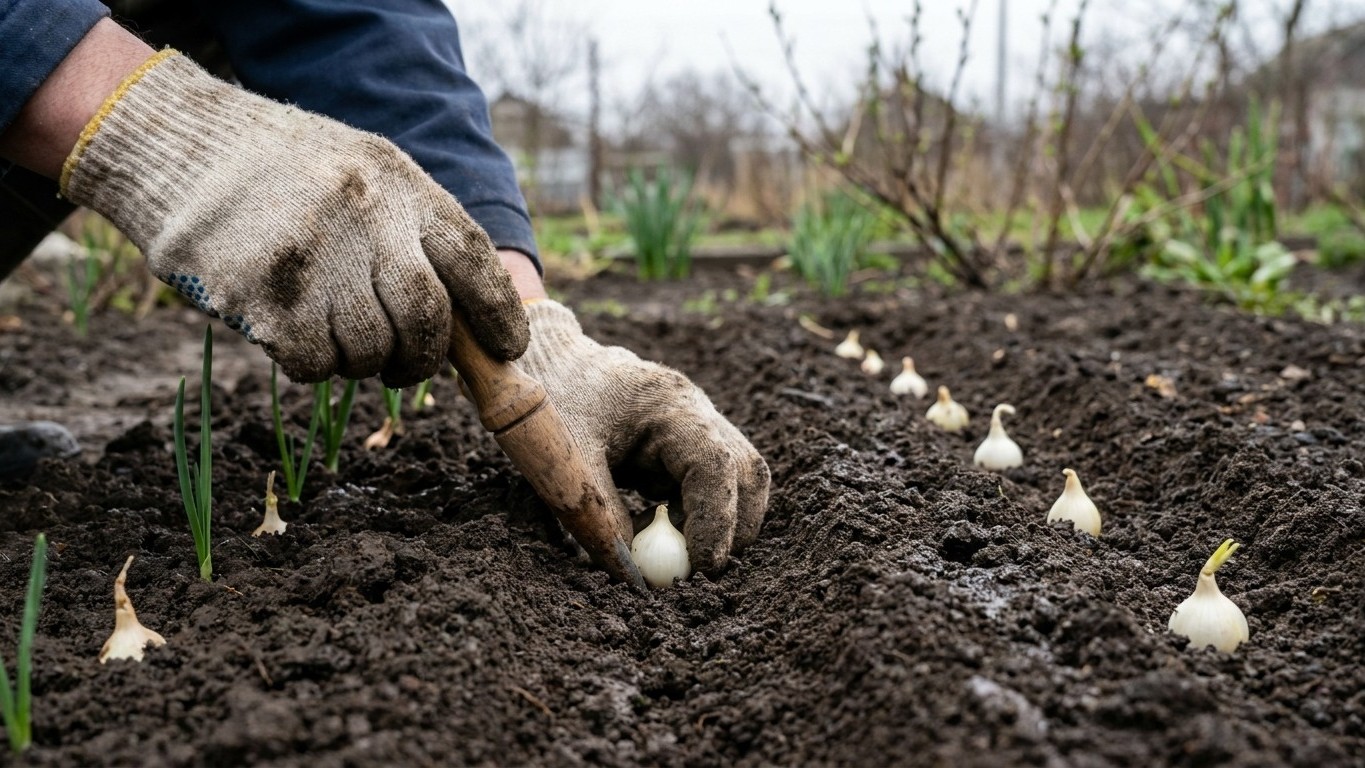

Plant onions in Ohio in late winter to early spring, not fall. Ohio’s winters run too cold for the mild-climate, plant-now-harvest-in-spring approach that works farther south. The target here is getting sets or transplants into the ground early enough that the plants have real size on them before the solstice triggers bulbing, because after that point, size is locked in for the season.
The short answer for Ohio

Columbus sits at 39.99 degrees north latitude, and on the longest day of the year the sun there delivers 14 hours and 51 minutes of daylight. That single figure decides almost everything about onion timing in Ohio, because onions don’t bulb because the weather warms up. They bulb because the day gets long enough to flip a switch in the plant. Short-day onions flip at around 12 hours. Long-day onions wait until 14 to 16 hours. At just under 15 hours of summer daylight, Ohio sits squarely in long-day and intermediate-day territory, which sets the frame for when planting has to happen.
That’s why the calendar in Ohio runs backward from what a Gulf Coast gardener does. In the Deep South, mild winters let growers plant onion sets in fall, let the plants sit through a soft winter, and harvest a fully sized bulb by early summer. Ohio’s ground freezes. Fall-planted onions here don’t survive to spring, so the whole growing window has to be compressed into the frost-free part of the year. That means getting sets or transplants in as soon as the soil can be worked in late winter or early spring, giving the plant every available week to build leaf mass before day length starts pulling energy into the bulb instead.
The gap between Ohio and a state like Georgia or Texas isn’t really about hardiness. It’s about geometry. Farther south, the sun never climbs to 14 hours even at the solstice, so short-day varieties are the only ones that make sense, and planting happens on an entirely different calendar. Ohio’s extra daylight opens the door to long-day and intermediate-day types, but it closes the door on fall planting. Every recommendation that follows on this page traces back to those two numbers: 39.99 degrees north, and 14 hours 51 minutes of daylight at the peak of summer.
What will not work here
Planting the wrong day-length group in Ohio doesn’t produce a smaller crop. It produces no crop, or a crop of onions the size of marbles. Short-day varieties are bred to start bulbing once the day reaches roughly 12 hours, a threshold Ohio’s daylight clears by late April in most years. The plant hasn’t had time to grow much leaf by then, so it bulbs early and stays tiny. Planting a short-day onion in Ohio is a variety mistake, not a feeding or watering mistake, and no amount of fertilizer fixes it.
- Gabriella (short-day, rated for 20-35N): bulbs while the plant is still small at Ohio’s latitude, giving undersized onions
- Madalyn (short-day, rated for 20-35N): same early-bulbing problem this far north
- Red Rock (short-day, rated for 30-36N): triggers well before the plant reaches size
- Red Sensation (short-day, rated for 25-35N): too far north for this variety’s daylight threshold
- Texas Grano 1015Y (short-day, rated for 25-35N): bulbs early and small in Ohio’s daylight
- Vidora (short-day, rated for 25-35N): same early-trigger problem
- White Castle (short-day, rated for 30-38N): bulbs before the leaf canopy has built any size
The opposite failure is quieter and, in a way, worse, because it doesn’t even give you a small onion. Some long-day varieties need more daylight than Ohio’s summer ever provides. Those plants spend the whole season making leaves, wait for a daylight trigger that never arrives, and eventually rot in the ground with nothing to show for it.
- Powell (long-day, rated for 43-47N): needs more daylight than Ohio’s 14 hours 51 minutes ever supplies
- Redwing (long-day, rated for 43-65N): daylight threshold is out of reach this far south
- Safrane (long-day, rated for 42-50N): the day never gets long enough here to trigger bulbing
- Talon (long-day, rated for 42-50N): same problem, leaves all season and no bulb
Timing makes its own version of this mistake. Planting late doesn’t push the harvest back a few weeks the way it does with tomatoes or beans. Whatever size the onion plant has reached when the solstice trips the bulbing switch is the size the bulb will be, permanently. A late-planted onion in Ohio doesn’t ripen late. It ripens small.
What changes across Ohio
Every figure above belongs to Columbus, because that’s where the reference weather station sits. Ohio itself stretches a good distance north to south, from the Ohio River along the southern border up to Lake Erie in the north, and that spread matters more than it looks on a map. A gardener near Cleveland is noticeably farther north than one near Cincinnati, and daylight length shifts with latitude even within a single state.
| Region | Approximate latitude | Longest-day daylight vs. Columbus | What it changes |
|---|---|---|---|
| Northern Ohio (Lake Erie shore) | roughly 41.5N | a few minutes more | edges closer to the range where borderline long-day varieties become viable |
| Columbus (reference city) | 39.99N | 14 h 51 (baseline) | the figures used throughout this page |
| Southern Ohio (Ohio River) | roughly 38.5-39N | a few minutes less | edges closer to the range where short-day mistakes become tempting, and still fail |
The two varieties sitting in the blurred zone illustrate why this matters. Frontier (long-day, rated for 40-50N) and Red Carpet (long-day, rated for 40-45N) both list a lower bound just above Columbus’s latitude. That’s not a hard cutoff. A gardener in far northern Ohio, closer to that 40-degree line, may see these varieties bulb reliably, while the same variety planted in the southern part of the state sits right at the edge and could go either way in a given year. Nothing about a statewide range guarantees a result for every county in it.
Sweet now, or onions that last
Ohio’s position in long-day and intermediate-day territory hands the gardener a real choice, and it comes down to chemistry rather than preference. University of Missouri Extension puts it plainly: sweet onions do not store as well as more pungent types. The bite in a pungent onion comes from volatile sulfur compounds, and those same compounds are what protect the bulb once it’s cured and sitting in a bag on a shelf. A sweeter variety simply has fewer of them. It tastes better raw in July. It won’t make it to January.
That trade-off tracks with day length. Shorter-season, intermediate-day types, several of which grow well at Ohio’s latitude, tend to run sweeter and milder. Longer-day types lean sharper and hold up in storage far longer. Neither is better; they answer different questions. A gardener who wants onions to slice raw on a burger in August is solving a different problem than one who wants a pantry that still has onions in it come March.
Practically, that means an Ohio garden can run both at once. Set aside a bed of a milder, quicker type for summer eating, and plant a sharper, long-day type specifically to cure and store through winter. The onions destined for storage need full curing (necks dried down, skins papery) before they go into mesh bags or braided ropes in a cool, dark spot. Skip that step and even the best keeper won’t make it past the holidays.
Checking this against your own garden
Every figure on this page comes from one weather station near Columbus. That’s a solid starting point for most of Ohio, but not a substitute for checking your own conditions, especially if you garden well north or south of the capital.
- Look up your own latitude if you’re gardening near Lake Erie or along the Ohio River, since a few degrees shifts which variety ranges actually apply to you
- Contact your county extension office for local average last-frost and first-frost dates, since these vary by several weeks across the state
- Check soil temperature before planting sets or transplants; cold, wet soil in early spring can rot onion starts before they establish
- Match any variety you’re considering against its published day-length range before buying, rather than assuming a name you’ve seen elsewhere will perform the same way here
- Ask your extension office whether they track locally-tested onion varieties, since some offices maintain trial data specific to their region