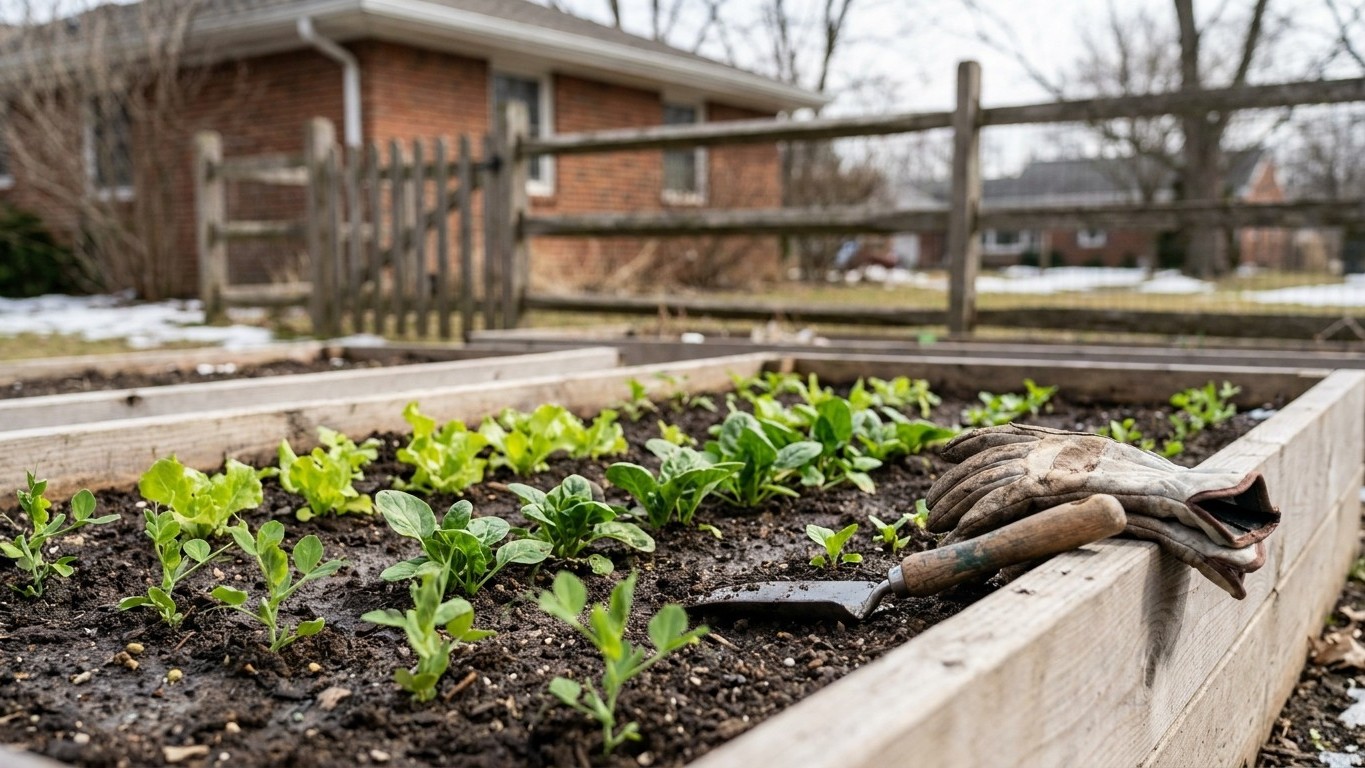

Not much yet — that’s the honest answer, and it’s not a failure on your part. The ground’s still cold, often still frozen underneath, and in most Ohio counties it’s too wet to work. Before you touch a shovel anywhere in the yard, grab a handful of soil from the bed you’re eyeing and squeeze it. If it packs into a tight, wet ball that won’t crumble, leave it alone for now. While you wait for a dry stretch, get garlic in where the ground allows, start tomato seed indoors, and finish any pruning you’ve been putting off.
What goes in the ground in March

Little goes into open ground this month, and that’s the honest starting point rather than a failure of the season. The USDA Plant Hardiness Zone Map, using the 1991-2020 normals, puts Ohio at zones 5b to 6b, and OSU Extension’s last-frost figure of May 5 to May 15 for Columbus means March sits six to ten weeks ahead of that window. Soil across most of the state is still cold and, after snowmelt or spring rain, often saturated.
Test the soil before you plant anything
Squeeze a handful of soil from a bed you plan to use. If it forms a tight, wet ball that won’t crumble when poked, it’s too wet to dig. Working wet soil now costs you structure for the whole season, so wait for a dry stretch even if that means losing a week you’d rather not lose.
What’s actually safe this month
Where the ground is workable, garlic and shallots are the safest bet outdoors. Both are cold-hardy alliums that root before topgrowth takes off, and they shrug off a freeze that would kill anything tender. Missed the fall planting window? A spring planting of sets still produces bulbs, just smaller ones than a fall-planted crop. If those alliums and bare-root plantings were already supposed to be in from What to Plant in Ohio in February, get them in now as a fallback rather than skipping the crop for the year.
Beyond alliums, cold frames and low tunnels let you get a jump on lettuce and spinach seed without risking it to open-ground frost. Bare-root fruit trees, brambles, and roses can go in as soon as the ground is workable and while they’re still dormant, giving roots a head start before leaves start demanding water. Indoors, forcing rhubarb crowns or blanching chicory roots produces edible growth weeks before anything outside is ready. Anything sold as a cold-hardy direct-sow crop for this month is still a gamble north of Columbus or at higher elevation, so treat early pea or greens sowings as a test patch, not the main planting, until the ground proves itself.
What to start under cover
Tomato seed goes indoors well before anything moves outside, and the timing runs backward from transplant date, not forward from a date on a calendar. Every tomato variety here goes out mid-May to late May, matching the frost window OSU Extension gives for the Columbus area. Seed packets typically call for starting six to eight weeks before that transplant date, which puts the indoor sowing window at roughly late March to mid-April for most varieties, regardless of which cultivar you’re growing.
Which variety you start doesn’t change when you sow it, since seed-starting timing tracks the crop, not the cultivar. It does change what you get later. A short-season type like Sakura (55 days from transplant) or Sun Gold (57 days) reaches first ripe fruit by late July, leaving 72 to 74 days of margin before the fall frost OSU Extension puts at October 5 to October 15 for Columbus. A long-season paste type like Amish Paste (85 days) doesn’t ripen until late August, leaving only 44 days of margin. Neither harvest date changes when the seed goes into a tray. Once soil and air both warm enough, the bulk of that transplanting work shifts into What to Plant in Ohio in April.
Two ways to get the timing wrong
- Too early: seed started in early March is often rootbound and leggy long before the ground and air are warm enough to set it out in mid-to-late May, and a stressed transplant rarely outgrows that setback.
- Too late: seed started after mid-April may not reach transplant size before the mid-May window opens, pushing first ripe fruit later and cutting into the fall margin, especially for longer-season pastes and beefsteaks.
The table below shows why the variety matters even though the sowing date doesn’t. All of these transplant in the same mid-May to late-May window, but the margin they leave before frost varies by month.
| Variety | Days from transplant | Transplant window | First ripe | Margin before fall frost |
|---|---|---|---|---|
| Sakura | 55 | mid to late May | late July | 74 days |
| Sun Gold | 57 | mid to late May | late July | 72 days |
| Jasper | 60 | mid to late May | late July | 69 days |
| Cherokee Purple | 72 | mid to late May | early August | 57 days |
| Brandywine | 78 | mid to late May | mid August | 51 days |
| Amish Paste | 85 | mid to late May | late August | 44 days |
What is ready to pick
Outdoors, the answer is close to nothing this early, and that’s normal rather than a sign something went wrong. Kale, leeks, and other crops overwintered in the ground under mulch or snow are the exception. Both survive hard freezes and can be harvested as soon as the ground around them thaws enough to dig, and the cold actually improves their flavor by converting starches to sugars.
Cold frames, sprouts, and stored crops
A cold frame or low tunnel planted with spinach or lettuce back in fall or late winter may already be producing baby leaves. Check under the cover on any sunny day, since heat builds fast under plastic or glass even when outside air is still cold. Harvest a few outer leaves rather than the whole plant so it keeps producing through the rest of spring.
Indoors, sprouts and microgreens fill the gap in a week to ten days from seed, with no soil and no outdoor risk. They’re a reasonable way to keep fresh greens on the table while the garden itself is still weeks from producing anything.
This is also the month to go through the root cellar or basement shelf. Check stored winter squash for soft spots near the stem, potatoes for sprouting eyes or green-tinged skin, and onions for any gone soft at the neck. Pull anything showing rot immediately, since one spoiling squash or onion speeds up decay in everything stored near it.
The jobs that matter this month

This is the month the rest of the season gets decided, even though almost none of the work happens in open ground. Dormant pruning of fruit trees, grapevines, and brambles should wrap up before buds swell and break. Cuts made once leaves emerge cost the plant stored energy it needed for that year’s growth, and open wounds on actively growing wood invite disease in a way dormant wood doesn’t.
Soil, compost, and beds
Pull a soil test now if you haven’t in the last few years. Results take a couple of weeks to come back, and any lime or sulfur it recommends needs time to change soil pH before planting starts. Turn the compost pile while you’re at it. A pile that’s sat all winter is often still cold in the center, and turning it now restarts the breakdown before spring beds need finished compost.
Walk the beds and fix what winter broke: heaved edging, sagging fence panels, raised-bed corners pulled loose by freeze-thaw cycles. Repairs are far easier before anything is growing over them. Order lumber or hardware while it’s still just a repair job, not an emergency once seedlings are ready and the bed isn’t.
Seed and planning
Order any seed you haven’t yet, since popular short-season and disease-resistant varieties sell out earlier every year, and a catalog favorite in stock in January is often gone by April. Sketch out where each crop goes based on what grew where last year. Rotating tomatoes and other nightshades to new ground cuts down on soil-borne disease carrying over, and March is the last easy month to plan it on paper instead of improvising with a trowel in hand.
Clean and sharpen tools before the pace picks up. A dull hoe or pruner does more damage to plant tissue than a sharp one, and a rusted blade carries disease between cuts. None of this takes more than an afternoon, and all of it is harder to catch up on once the frost window opens and outdoor jobs crowd it out.
What not to do in March
The classic mistake is reading a warm afternoon as a sign the season has arrived. Air temperature swings fast in early spring, but soil temperature lags behind it by days or weeks. A warm-season crop set out on the strength of one sunny weekend sits in cold soil that stunts or kills it even if the air felt like May. Wait for the soil, not the thermometer on the porch, before anything tender goes outside.
Two more traps worth naming
Pulling mulch or row cover off too early after a mild stretch is the related error. A hard freeze can follow a warm day within a week this time of year, and anything uncovered in between takes the full hit. Leave winter protection on cold-hardy crops and dormant plantings until mild weather holds for more than a few days running, and keep row cover or an old blanket on hand to throw back over anything you’ve already exposed.
Nitrogen is the other trap. Feeding a high-nitrogen fertilizer to dormant fruit trees or perennial beds this early pushes soft, early growth right before a freeze can still hit it, and that new growth is what gets damaged first. Hold nitrogen feeding until growth is actually underway, and lean on the soil test from the jobs above to decide what the ground actually needs before you add more.
Checking this against your own county
Every figure above comes from OSU Extension’s Ohio Gardening Calendar and the USDA hardiness map, both measured at or near Columbus. Ohio runs from USDA zone 5b to 6b, and a county in the Appalachian foothills, near Lake Erie’s snowbelt, or at higher elevation in the northeast can run two to three weeks behind or ahead of what’s written here. Lake effect alone shifts both the last spring frost and the first fall frost along the northern counties in ways a single statewide date can’t capture.
Treat everything above as a starting point, not an instruction. Check it against OSU Extension‘s county office for your own soil and frost data before committing seed to the ground, and cross-reference the Ohio planting calendar once your county’s actual dates are in hand.
Common questions
Can I plant tomatoes outside in March in Ohio?
No. Every tomato variety needs soil and air warm enough to set out, which OSU Extension’s frost data puts at mid-May to late May for the Columbus area at the earliest. Setting tomatoes out in March means cold soil that stunts or kills them well before a frost even shows up on the forecast.
Is it too late to plant garlic in March if I missed fall?
It’s not too late, but expect smaller bulbs than a fall-planted crop. Garlic planted in spring has less time to establish roots before the days lengthen and bulbing begins, so cloves size up less than they would from an autumn planting, though the crop is still worth putting in.
What USDA zone is Ohio for planting purposes?
The USDA Plant Hardiness Zone Map, using 1991-2020 normals, places Ohio between zones 5b and 6b. That range covers real differences across the state: the Columbus area sits around 6a, while colder pockets near Lake Erie’s snowbelt or at higher elevation run closer to 5b.
How early can I start seeds indoors for a May garden?
Count backward from your transplant date rather than forward from a fixed day. For tomatoes going out mid-May to late May, six to eight weeks earlier lands in late March to mid-April, and starting much before that risks rootbound, leggy seedlings before the ground is ready for them.