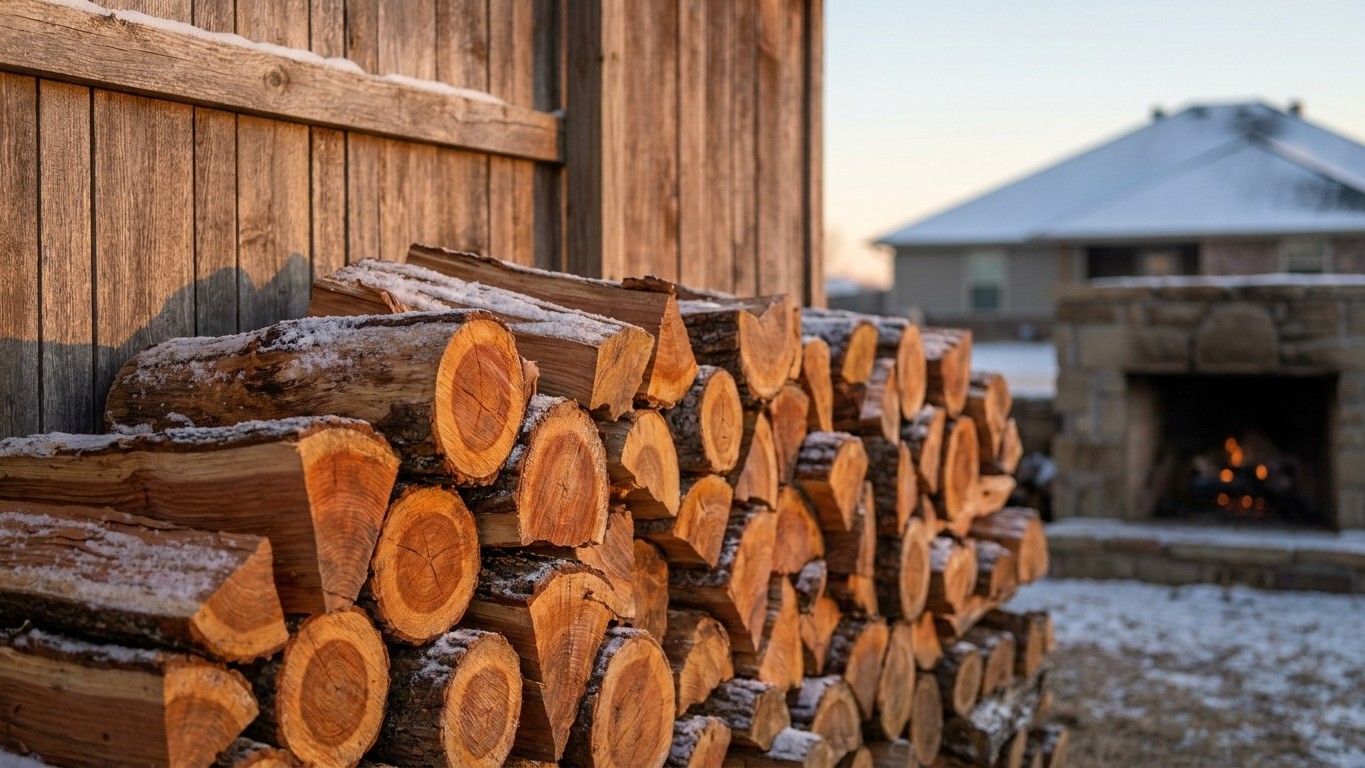

Winter in Oklahoma means burning wood for atmosphere more often than for survival, but the numbers still matter. The reference city, Oklahoma City, sees an average low of 27°F in its coldest month. That’s cold enough to want a solid stack of hardwood on hand, cold enough to make a fire genuinely useful on the worst nights, but not the kind of deep freeze that turns firewood into a life-or-death fuel source. This page breaks down what that 27°F figure means for species choice, quantity, and drying time.
How cold it actually gets here

Twenty-seven degrees is the mean daily minimum for the coldest month at Oklahoma City, according to NOAA’s 1991-2020 Climate Normals. That’s not the record low, and it’s not some rare Arctic blast that shows up once a decade. It’s the average night, the one that repeats itself over and over through January. It tells you how a typical winter behaves here, not how bad the worst one can get.
A 27°F average low puts Oklahoma in a middle zone. It’s colder than the Gulf Coast, where a fireplace is mostly decoration. It’s nowhere near the single-digit lows that force households in the northern Plains or the Rockies to burn wood as a primary heat source for months at a stretch. For most Oklahoma homes, wood heat supplements a furnace or heat pump. It covers the coldest snaps, takes pressure off the electric bill, and turns a living room into the place everyone wants to sit.
That distinction changes how you should think about this whole page. If you’re heating a cabin, a shop, or an older farmhouse where wood is doing real work through January and February, density and BTU output matter more, because you need every cord to carry as much heat as possible. If you’re burning wood a few evenings a week to take the edge off and enjoy the fire, you have more room to burn what’s available and less pressure to chase the densest species on the list.
Either way, 27°F is cold enough that green wood becomes a real problem. Wood that hasn’t dried properly won’t throw much heat no matter how dense the species, and on a night that’s actually pushing your heating system, that shortfall shows up fast. The honest read on Oklahoma winters: comfort-driven burning for most households, with a few genuinely cold stretches each year that reward having good, dry hardwood on hand rather than whatever’s left in the rack.
Which woods are worth the effort here
Once you know the winter is moderate rather than brutal, the next question is what to burn. The rule holds everywhere: a cord is a fixed volume, 4 feet by 4 feet by 8 feet, or 128 cubic feet stacked. A denser species packs more wood fiber into that same volume, which means more pounds of fuel and more heat. According to Michigan State University Extension, a cord of well-seasoned hardwood averages around 20 million BTU, roughly the heat equivalent of 145 gallons of #2 fuel oil or 215 gallons of LP gas. That average is the benchmark, but individual species swing well above or below it depending on density and moisture.
Dense hardwoods for the coldest nights
Species on the denser end of the spectrum, oak and hickory being the two most commonly split and burned across Oklahoma, are what you want stacked closest to the house for the nights that actually dip toward that 27°F average or lower. Dense hardwood burns longer, holds coals better overnight, and gives you a bed of embers still glowing at dawn instead of a cold firebox. The tradeoff is that dense wood takes longer to season and is harder to split, so it needs to be cut, split, and stacked well ahead of the season you plan to burn it.
Lighter woods for starting fires and shoulder season
Lighter, faster-burning species, cottonwood and softer woods like pine, have their place too: they catch quickly, which makes them useful for kindling and for getting a fire established before you add denser splits on top. They’re also fine for the mild evenings of late fall or early spring when you want a fire going but don’t need it to carry the house through the night. What they won’t do is hold a long, steady burn on a genuinely cold night, and pine in particular tends to throw more sparks, which matters if you’re running an open hearth rather than a closed insert.
| Wood category | Heat output vs. average cord | Smoke | Sparks |
|---|---|---|---|
| Dense hardwood (oak, hickory) | At or above the 20 million BTU average | Low once seasoned | Low |
| Medium hardwood (elm, ash-type species) | Near the average | Moderate | Low to moderate |
| Light hardwood/softwood (cottonwood, pine) | Below the average | Higher, especially if not fully seasoned | Higher, especially pine |
None of this matters much if you can’t actually get the wood seasoned and local. A dense species you buy green, or one that’s hard to source in your part of the state, is worse in practice than a lighter wood you can buy already dry and split. Availability at the local firewood dealer or the neighbor selling off a downed tree usually decides more of the equation than the table above.
How much wood a winter takes
Any number you see floating around for “how many cords Oklahoma needs per winter” is close to meaningless without knowing three things about your specific situation. A published average can’t account for your house, your climate exposure, or how you actually use the wood, so treat any flat figure as a rough starting point at best, not a target to buy toward.
- How cold your winter runs. A season that stays close to that 27°F average low burns less wood than one with an unusual stretch of hard freezes, and some winters simply run colder than others even in the same location.
- How well your house holds heat. An older home with drafty windows, minimal attic insulation, and no weatherstripping can lose heat two to three times faster than a tightly sealed, well-insulated house of the same size. That gap alone can double how much wood you burn to hold the same indoor temperature.
- Whether wood is your main heat or a supplement. A household running a wood stove as the primary heat source through winter burns dramatically more than one lighting an occasional evening fire alongside a working furnace.
Run those three variables against each other and you get why a poorly insulated house in a harder-than-usual winter can burn twice what a tight, well-sealed home uses in an ordinary one, even in the same town. The practical approach is to track your own use for one season, note how many times you refilled the rack, and adjust from there rather than buying a fixed number of cords based on a generic guideline. Buying a bit extra the first year and storing it properly costs less in frustration than running out in February.
Drying wood in this climate
Seasoning matters more than species almost everywhere, and Oklahoma is no exception. Green wood can hold moisture above 60 percent, and according to Michigan State University Extension, that water has to boil off before the wood releases usable heat, which eats into the energy you were counting on. The target, regardless of climate, is 20 percent moisture or less by the time you burn it.
What gets wood there is air movement and time, not sunlight sitting on top of a pile. Splitting the wood and stacking it loosely, off the ground, with space for air to move through the rows, is what actually pulls moisture out. A tarp thrown over a dense, unsplit pile traps humidity rather than releasing it and can slow drying instead of helping it.
Oklahoma’s mix of humid summers and hot, dry stretches generally lets split hardwood reach that 20 percent target after one full summer of proper stacking, which lines up with the general rule MSU gives for most species. Red oak is the named exception: its cell structure makes it dry more slowly than other hardwoods, so it typically needs a longer stretch stacked before it’s ready to burn well.
Tie that timeline back to the 27°F winter this page opened with, and the most common local mistake becomes obvious: cutting and splitting wood in spring, expecting it to be ready for the winter that follows a few months later. One summer usually isn’t enough time, especially for red oak. Wood meant for this winter should already be split and stacked from the previous year, and anything cut this spring is really an investment in next winter’s stack, not this one.