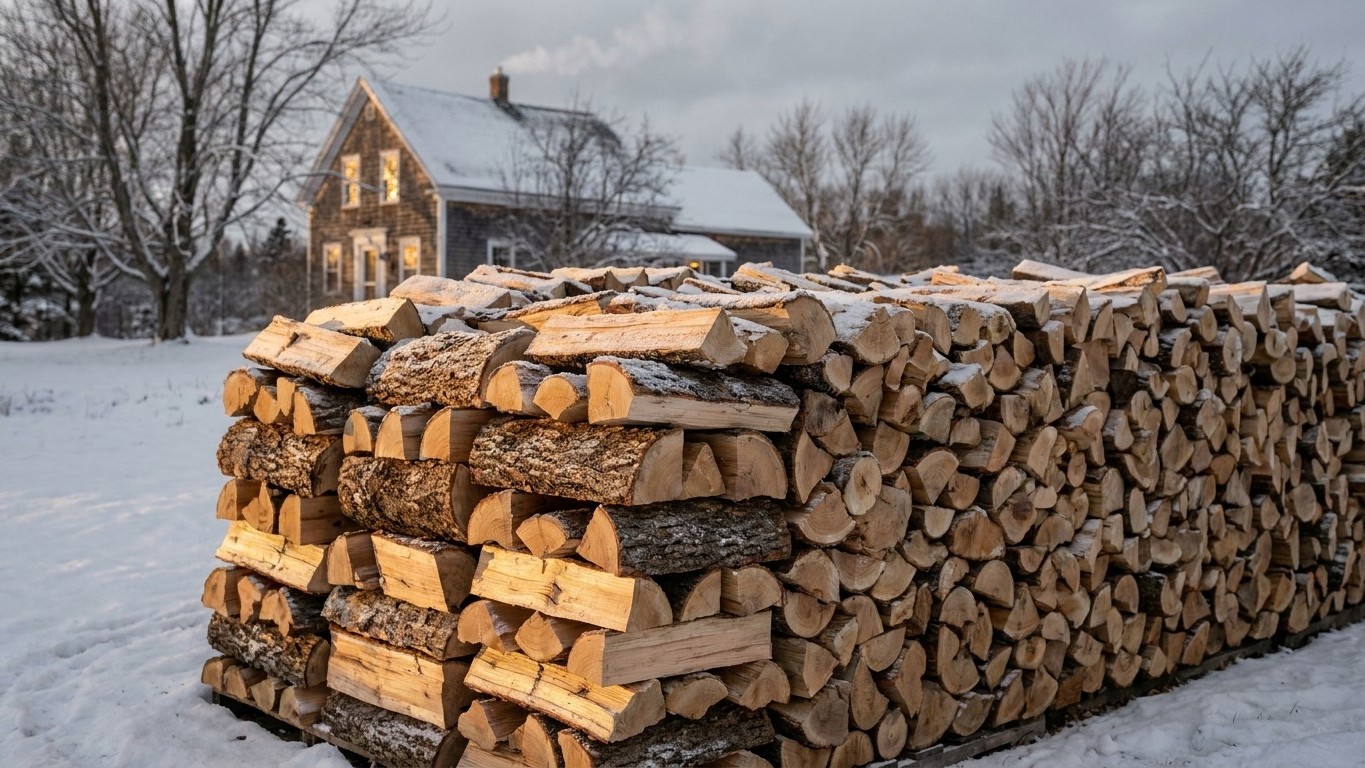

The average low in Charlottetown’s coldest month sits at 10.3°F, cold enough that firewood in Prince Edward Island isn’t a mood, it’s a heating system. That number decides which woods are worth splitting, how much you’ll burn between November and April, and why a stack that looked huge in September can vanish by February. This guide walks through the cold you’re actually fighting, the woods that hold up against it, how much a typical winter demands, and why so much local firewood gets burned before it’s ready.
How cold it actually gets here

Ten point three degrees Fahrenheit. That’s the mean daily minimum for Charlottetown’s coldest month, according to Environment and Climate Change Canada’s 1981-2010 Climate Normals. Not the record low some old-timer remembers from a bad January, and not the average for the whole month, but the number that tells you what a typical overnight low looks like when winter is doing its worst. It’s a figure that puts PEI firmly in “wood as necessity” territory, not “wood as ambiance.”
At that temperature, a poorly heated house loses warmth fast, and a stove or furnace running on wood alone has real work to do overnight. This isn’t the kind of climate where you can toss a couple of logs on for atmosphere and call it done. A fire that dies at 2 a.m. in a Charlottetown January means a cold house by dawn, pipes at risk, and a homeowner shivering into wool socks before the coffee’s even on.
What that overnight low means for a wood-burning household
Ten degrees is well below freezing, and it’s sustained enough over January and February that a home relying on wood heat needs both volume and density behind it. A single cord of soft, low-density wood might get a household through a mild stretch, but it won’t carry the same house through the stretch where the mercury sits near 10°F for days at a time. That’s the gap between having wood and having enough wood.
It also changes how you think about the stove itself. A firebox loaded for a 25°F night burns differently than one loaded for a 10°F night: more wood, packed tighter, and ideally denser species that hold coals longer. Households here that treat wood heat as a side project, rather than a core system, tend to find out the hard way around the third week of January that their stack was never built for this.
Which woods are worth the effort here
Once you know the cold you’re up against, density stops being a nice-to-have and becomes the whole point. A cord is a fixed volume, always 4 feet by 4 feet by 8 feet, or 128 cubic feet stacked. What changes from species to species is how much actual wood, versus air gaps, fits into that volume, and how much of it is water waiting to be boiled off before you get any heat at all. Michigan State University Extension puts well-seasoned hardwood at roughly 20 million BTU per cord, which is the equivalent of about 145 gallons of #2 fuel oil or 215 gallons of LP gas. That’s the benchmark worth measuring everything else against.
Dense hardwoods like red oak, sugar maple, and yellow birch, all reasonably common in Maritime woodlots, sit at or near that 20 million BTU average once properly seasoned. Those are the species you want loaded in the stove at 9 p.m. on a night when the forecast says 10°F, because they burn slower, hold coals longer, and get you to morning without a reload. Red oak carries one caveat worth remembering: MSU notes it dries more slowly than other hardwoods because of its cell structure, so it needs extra time stacked before it earns its place in that overnight slot.
Softer, lighter woods, spruce and fir being the common examples around PEI, fall well below that hardwood average in heat delivered per cord. That doesn’t make them useless. They’re good kindling, good for shoulder-season mornings when you just need to take the chill off, and good for a quick fire that doesn’t need to hold overnight. What they’re not good for is the January stretch where the house depends on the fire lasting eight hours unattended.
None of this matters if you can’t actually get the wood seasoned and stacked before you need it. A supplier who sells you split, dry red oak in October is worth more than one who sells you “premium hardwood” that’s still green in November. Availability and seasoning status should weigh as heavily in your decision as any table.
| Wood type | Heat per cord | Smoke (once seasoned) | Sparks |
|---|---|---|---|
| Dense hardwoods (red oak, maple, birch) | ~20 million BTU, near the seasoned hardwood average | Low | Few |
| Softwoods (spruce, fir) | below the hardwood average | More smoke, faster creosote buildup | More, especially if not fully dry |
How much wood a winter takes
Anyone who tells you a fixed number of cords for a PEI winter is guessing, because the real answer depends on three things about your own house, not the province as a whole. A published average is close to meaningless without knowing how your walls, your windows, and your heating setup actually behave in that 10.3°F cold.
- The cold itself: a winter that lingers near that 10°F overnight low for weeks demands far more wood than one where cold snaps are brief.
- How well the house holds heat: insulation, air sealing, window quality, and even how exposed the house is to wind all change how fast heat escapes.
- Wood’s role in the heating system: whether it’s the sole heat source or a supplement to oil, propane, or electric baseboard changes the volume needed by a large margin.
The mechanism that makes these variables matter so much is simple physics: heat loss scales with the temperature difference between inside and outside, and with how much of that heat the house lets escape. A poorly insulated older farmhouse in a hard winter can burn through double what a tightly sealed, newer-built home uses in that same winter, even sitting in the same county with the same 10.3°F low. That’s not a small rounding error, that’s the difference between three cords and six.
A practical way to build your own estimate: start with how much wood got you through a comparable winter before, adjust up if this winter runs colder or your house has gotten drafty, and adjust down if you’ve since sealed windows or added insulation. Track what’s left in the stack by mid-January, since that midpoint tells you more about your true burn rate than any guess made in October.
Drying wood in this climate
Species matters, but seasoning decides whether any of it burns clean and hot. Michigan State University Extension puts the usable target at 20 percent moisture or less, and notes that green wood can start out over 60 percent water by weight. All that water has to boil off before the wood gives up any heat, and that boiling is exactly why green wood hisses, smokes, and refuses to catch.
PEI’s climate, with its humid summers and a drying season that’s shorter than in drier inland regions, stretches that timeline out compared to what you’d see somewhere arid. Split wood stacked so air moves freely through the pile, not left in rounds, generally reaches that 20 percent mark after one full summer outdoors. Red oak is the named exception in MSU’s research: its cell structure dries more slowly, so it needs more time than a full summer to reach the same moisture level.
What actually dries wood is air movement and time, not direct sun. A stack with good airflow between splits, off the ground, loosely covered on top but open on the sides, will outperform a tightly packed pile baking in full sun with no ventilation. That’s a detail easy to overlook when you’re just trying to get the wood out of the way of the driveway.
Tie this back to the cold figure at the top of this page: wood split in spring for the winter that follows is usually not ready by the time that 10.3°F cold arrives. That gap between “cut in April” and “needed in December” is the single most common mistake reported among PEI households burning wood, and it’s the reason so many stoves choke on smoky, hissing logs in the coldest weeks of the year. The fix isn’t a different species. It’s cutting and splitting a full year ahead, every year, so this winter’s wood was already seasoning last summer.