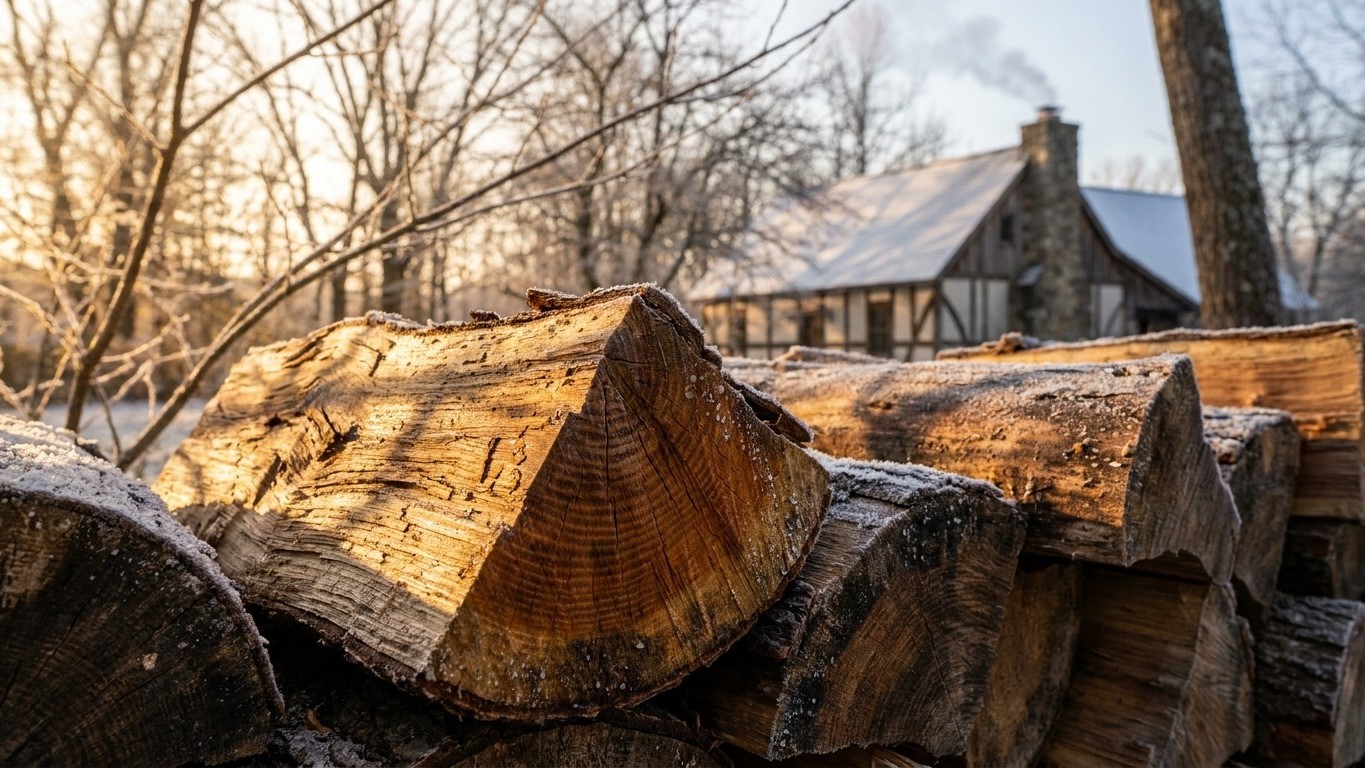

Choosing firewood in New Brunswick comes down to two numbers: how cold your nights actually get, and how much water is still sitting inside the wood you’re about to burn. Get those two right and species choice mostly sorts itself out. Get them wrong and even the densest maple in the province burns cold, smoky, and disappointing.
How cold it actually gets here

The average daily minimum for the coldest month at Moncton, the closest long-term climate reference station for the province, sits at 6.9°F. That’s not the record low some winter delivers once a decade. It’s the typical overnight temperature you can expect through the coldest stretch of a normal January, year after year, according to the Environment and Climate Change Canada 1981-2010 normals. That figure is the one that should shape every firewood decision you make.
A mean low near 7°F means real, sustained cold, not the occasional frosty night. Pipes freeze if a house sits empty. A woodstove left to die out overnight can let indoor temperatures drop enough to be uncomfortable by morning, sometimes dangerous if the house is drafty and heating is not backed up by another source. This is not a climate where firewood is décor for a cozy evening. For a lot of households here, especially in rural parts of the province where oil delivery is expensive and electricity costs climb every winter, wood heat is doing real structural work keeping a house livable.
What that means practically: the margin for error shrinks. A wood that burns fast and bright but doesn’t hold coals is fine for a fire pit in October. It’s a liability at 2 a.m. in January when the stove needs to still be smoldering at sunrise. Anyone heating primarily or heavily with wood in New Brunswick needs to think in terms of overnight burn time, not just flame and warmth in the moment.
It also changes how much wood matters versus how well the wood is seasoned. In a mild climate, a slightly damp log is an inconvenience. Here, burning wood that’s still holding excess moisture at 6.9°F outside means the fire is spending its early energy boiling water out of the log instead of heating the room, right when the room needs heat the most. The cold figure and the seasoning question are connected: the colder it gets, the less forgiving the stove is of wood that wasn’t ready.
None of this means every log needs to be top-shelf hardwood. It means the plan for a New Brunswick winter should be built around having enough properly dried, dense wood on hand for the worst stretches, with lighter wood in reserve for milder days and for starting fires. The next section breaks down which species do which job.
Which woods are worth the effort here
A cord is a fixed volume, a stack measuring 4 feet by 4 feet by 8 feet, or 128 cubic feet, whether it’s packed with dense hardwood or light softwood. That’s exactly why density matters so much once winters get real. According to Michigan State University Extension, a cord of well-seasoned hardwood carries roughly 20 million BTU, the rough equivalent of about 145 gallons of #2 fuel oil or 215 gallons of LP gas. That average hides a wide spread, though, because denser species pack more wood fiber, and therefore more stored energy, into that same 128 cubic feet than lighter species do.
For a winter that bottoms out near 7°F overnight, the densest hardwoods commonly available in New Brunswick, species like sugar maple and yellow birch, are the ones worth seeking out for the coldest nights and for the overnight burn that has to carry a house from bedtime to breakfast. Red oak belongs in that same dense category for heat output, though it comes with a seasoning catch covered in the next section. These are the logs to save for January, not to burn casually in October.
Lighter woods still earn their place in the woodshed. White birch, poplar, and aspen burn fast and catch easily, which makes them good for building a fire quickly or for the shoulder-season days in late fall and early spring when a short, bright burn is all a house needs. They’re poor choices for holding a fire overnight, since they burn through faster and leave fewer coals. Softwoods like spruce and fir have their place too, mainly for kindling and quick starts, but they burn hot and fast with more resin, which means more sparking and a faster buildup of creosote if used as a steady diet in an enclosed stove.
What actually decides the mix in your woodshed
The table below sorts these by general heat output relative to the roughly 20 million BTU per cord average for seasoned hardwood, along with how they behave in a stove.
| Species | Heat output vs. hardwood average | Smoke | Sparks |
|---|---|---|---|
| Sugar maple | Above average | Low | Low |
| Yellow birch | Above average | Low | Low |
| Red oak | Above average | Low | Low |
| White birch | Near average | Medium | Low |
| Aspen / poplar | Below average | Medium | Low |
| Spruce / fir | Below average | Medium-high | High |
Availability matters as much as this table does. A species you can only find green, with no way to season it in time, is a worse choice than a modest wood you can actually get dry and stacked before the cold sets in. Ask any local firewood seller in New Brunswick whether the wood was cut this year or last, because that answer changes everything, regardless of species.
How much wood a winter takes
There’s no honest single number for how many cords a New Brunswick winter requires, and any source that gives you a flat figure without asking about your house is guessing. The real answer depends on three things working together, and running them down for your own home gets you a far more useful estimate than any published average.
- How cold your winter actually runs: a home near the coast may not see the same lows as one farther inland, even within the same province, so local conditions around that 6.9°F average matter more than the provincial figure alone.
- How well the house holds heat: insulation, air sealing, and window quality decide how much of the heat a stove produces actually stays inside rather than leaking out through walls, attic, and drafty doors.
- Whether wood is the main heat source or a backup: a household burning wood exclusively through the coldest months needs a very different supply than one using a stove to supplement oil or electric heat on the coldest nights only.
The mechanism that makes these numbers swing so widely is straightforward: a poorly insulated house in a hard winter can burn through roughly double what a well-sealed, tightly insulated house uses in that same climate, heating to the same comfort level. That’s not a small rounding difference, it’s the gap between running out of wood in February and having a cord left over in April.
A practical way to build an estimate is to track actual usage through one full winter, noting how many cords go through the stove and how the house felt during the coldest stretch, then adjust from there. Anyone new to wood heat in the province is better off buying slightly more than they think they’ll need for the first winter and treating that season as the baseline for every winter after, rather than guessing from a number found online that was calculated for someone else’s house, someone else’s insulation, and someone else’s stove.
Drying wood in this climate
Species choice matters, but it means little if the wood isn’t dry. The target, according to Michigan State University Extension, is 20 percent moisture or less by the time wood goes into the stove. Green wood, freshly cut, can hold over 60 percent moisture, and every bit of that water has to boil off before the wood releases usable heat, which is exactly the energy a cold night can’t afford to waste.
What actually dries wood is airflow and time, not direct sun. Wood that’s split and stacked with gaps for air movement, ideally off the ground and loosely covered on top only, dries far faster than wood left in rounds or piled in a solid heap. Split green hardwood typically reaches that 20 percent target after one full summer of proper stacking, but that timeline assumes the wood was actually split and exposed to moving air the whole time, not left sitting in a damp pile.
New Brunswick’s humid summers stretch that process out somewhat compared to drier inland climates, since damp air slows evaporation from the wood’s surface. Red oak is a named exception even under good conditions: MSU notes its cell structure makes it dry more slowly than other hardwoods, so a single summer often isn’t enough for oak specifically, and it may need a second season stacked before it reaches burnable moisture.
This is where the cold figure from earlier ties directly back in. Wood cut and split this spring for use this coming winter is, in most cases, simply not ready by the time that 6.9°F stretch of January arrives. The most common mistake among people newer to wood heat in the province is buying or cutting wood too close to the season they intend to burn it, then wondering why the stove smokes and struggles to hold a fire on the coldest nights. The fix isn’t a different species. It’s a wood pile that’s already a year ahead of the winter it’s meant to heat.