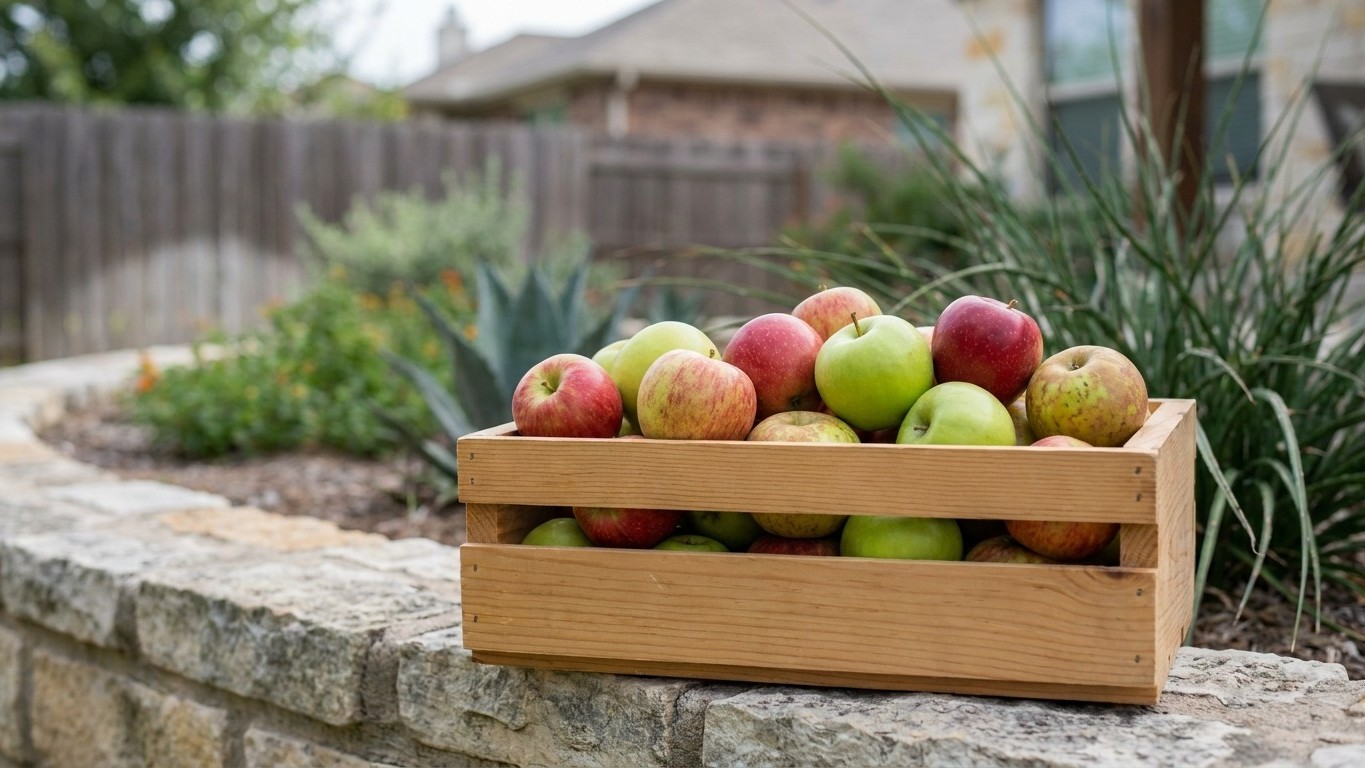

Winter chill hours, not variety fame, decide whether an apple tree ever fruits in your yard. Houston’s coldest month barely dips below freezing on an average day, while the Hill Country and Panhandle see a real winter — so the same tree that sulks near the coast can thrive three hundred miles north. There’s no one “best” apple for Texas, only a match between your chill hours, your last-frost date, and what local growers have actually watched bear fruit nearby.
The short answer for Texas
Winter chill decides it, not fame
There is no single apple variety that works everywhere in this state, and no cultivar recommendation for apples appears in our sourced catalogue for this page. The one number that decides whether a given tree fruits well here is winter chill, the hours a tree spends in the cold each winter, and it swings from almost none on the Gulf Coast to a real winter in the Panhandle. Houston’s coldest month runs a mean daily minimum of just 43.2°F, according to NOAA’s NCEI 1991-2020 Climate Normals, which is a way of saying the coldest part of a Houston-area winter barely dips below freezing on an average day, let alone stays there. That is a Gulf Coast figure only. Push north into the Hill Country or toward the Panhandle and the winter runs both longer and colder, so a tree that never gets enough chill near Houston may do fine three hundred miles north.
Houston’s dates are not a statewide calendar
What the right answer depends on, for any one property, is three things: the chill category the tree needs, whether the local last-frost window lines up with when that variety blooms, and whether the extension office for that county has actually seen the cultivar fruit nearby. Near Houston, NOAA’s 1991-2020 Climate Normals put the last spring freeze at February 4 to March 1 and the first fall freeze at December 1 to December 19, measured at IAH airport, with Hobby airport running about two weeks milder. That window matters more for bloom timing than the calendar month does. Farther from the coast, both dates move, sometimes by months, and no single date serves the whole state.
Working through it

Apple breeding for the South has mostly moved toward extremely low-chill cultivars, precisely because so much of Texas never gets a real winter. Without a sourced list of named cultivars for this page, the honest way to work through the decision is by category rather than by brand name, then hand the category to your county extension office to fill in with a name they’ve actually seen fruit.
Low-chill types
These are bred to break dormancy and flower after a short, mild winter, which makes them the only realistic option anywhere close to the Gulf Coast, where Houston’s coldest month averages a mean minimum of 43.2°F (NOAA NCEI 1991-2020 Climate Normals) and the ground rarely freezes at all. The trade-off is that a low-chill tree planted in a colder inland winter can bloom too early relative to that region’s own last frost date, wasting a flush of blossom to a freeze it wasn’t bred to expect. It also tends to store less well off the tree and needs steady watering through the fruit-set stage described on The Texas Apple Calendar, Stage by Stage, since a hot, dry Gulf Coast spring can abort fruit set faster than cold ever would down there.
Moderate-chill types
This band suits the middle of the state, where winters are cold enough to satisfy dormancy most years but not reliably cold enough for a high-chill tree. The risk here runs the other way from the coast: in an unusually mild winter, a moderate-chill tree can leaf out unevenly or flower thin, because it never fully broke dormancy. An uneven bloom is not a disease and not a pest, it is a chill shortfall, and no spray fixes it. The only real hedge is choosing a category matched to what the local winter usually delivers, not what it delivered last year.
High-chill types
These need the longest, coldest dormancy and belong only where winter genuinely bites, which in this state means well away from the coast. Planted anywhere the coldest month runs mild, a high-chill tree can sit half-dormant for years, flower late and sparse, and never size up a real crop. The payoff for a grower who does have the winter for it is usually better storage life, but that only matters if the local frost window, covered in Growing Apples in Texas, actually gives the crop time to develop between bloom and harvest.
What changes across Texas
The coast
The Gulf Coast, with Houston as the reference point, is the mildest and wettest end of the state’s apple-growing range. NOAA’s 1991-2020 Climate Normals put its coldest month at a mean minimum of 43.2°F and its last spring freeze at February 4 to March 1, which means winter dormancy is short and unreliable most years. Humidity stays high through spring too, and that matters as much as temperature: a wet bloom period favors fungal disease on any apple, regardless of chill category.
The Hill Country
Move inland toward the Hill Country and North Texas, and both the winter and the frost calendar change substantially. Cold air settles into the valleys and low ground on clear nights, so an orchard sited in a low pocket can run several degrees colder at bloom time than one on a nearby ridge just a short drive away. That local frost pooling, not the regional average, is often what decides whether a given year’s bloom survives.
The Panhandle
Farther north, the Panhandle sits at a higher elevation and a higher latitude, so its winter runs longer and colder and its frost-free season is shorter, in a way the Houston figures above say nothing about. None of the Houston dates in this article should be read onto the Panhandle, or onto the Hill Country, since Hobby airport alone runs about two weeks milder than the IAH station NOAA uses for these normals. A grower anywhere outside Houston proper needs that same NOAA data pulled for their own reference station, not this one.
The mistakes this climate punishes
Chill mismatches
The mismatch that costs a crop most often near the coast is buying a moderate or high-chill tree because it’s a familiar name from a catalog, then watching it sit half-dormant through a Houston winter that never delivers the cold hours it needs. That failure shows up as thin, late bloom in the second or third spring, not the first, because a young tree can coast on stored vigor for a season before the chill shortfall catches up with it.
The opposite mistake shows up further inland: a low-chill tree planted where winter still runs cold breaks dormancy on the first mild spell, sometimes in January, and then loses the whole bloom to a freeze that arrives well within NOAA’s freeze-probability window for that region. Near Houston that window runs February 4 to March 1 for the last spring freeze, and a tree blooming ahead of that window is blooming on borrowed time even in a mild coastal winter.
Late-season feeding
Feeding late is a mistake that shows up in fall, not spring. Nitrogen applied into late summer pushes soft new growth that has not hardened off by the time the first freeze arrives, and near Houston NOAA’s normals put that first fall freeze at December 1 to December 19. That soft growth is what a freeze damages first, well before it touches older wood, and the damage often is not obvious until the following spring’s bloom is patchy on just that season’s new wood.
- Buying by variety name alone, without asking the county extension office whether it fruits locally
- Ignoring how a low pocket or valley on the property runs colder at bloom time than the rest of the yard
- Skipping a dormant-season prune and pruning into active growth instead, which invites disease on fresh wounds in a humid spring
- Watering on a fixed schedule through fruit set rather than adjusting for a hot, dry spell that can abort young fruit
Checking this against your county
Nothing in this article substitutes for a call to your county office of Texas A&M AgriLife Extension, which is the extension service USDA NIFA’s land-grant directory lists for this state. Ask specifically which apple cultivars their office has seen fruit within your county, not just within Texas, since the difference between a Gulf Coast county and a Hill Country county a hundred miles away can be the whole difference between a tree that fruits and one that never breaks dormancy. If you haven’t yet walked through site selection and planting for the crop generally, Growing Apples in Texas covers that ground before you get to variety choice at all. Bring your own frost data, pulled for the station nearest your property, rather than reusing the Houston figures in this piece.
Common questions
Can I even grow apples near Houston?
Only with cultivars bred for a very short, mild winter, and no local source in our catalogue names one proven at Houston specifically. Ask the county AgriLife Extension office which low-chill selections they’ve seen fruit nearby before you plant.
How many chill hours does my area actually get?
We don’t have a sourced chill-hour figure for any specific Texas location in this article. Your county extension office or a nearby orchard supplier is the better source, since chill accumulation varies by winter and by exact site, not just by region.
Do I need two apple trees to get any fruit?
Many apple cultivars are not reliably self-fertile and set more fruit with a second variety blooming at the same time nearby. Check the pollination note on the specific cultivar’s tag or catalog listing, since this varies by variety and not by climate.
What’s the difference between hardiness and chill hours?
Hardiness tells you whether the tree survives the cold it experiences. Winter chill tells you whether it flowers properly afterward. A tree can be hardy enough to survive a Panhandle winter and still fail to fruit near the coast, or the other way around, because the two questions are answered by different parts of the tree’s biology.