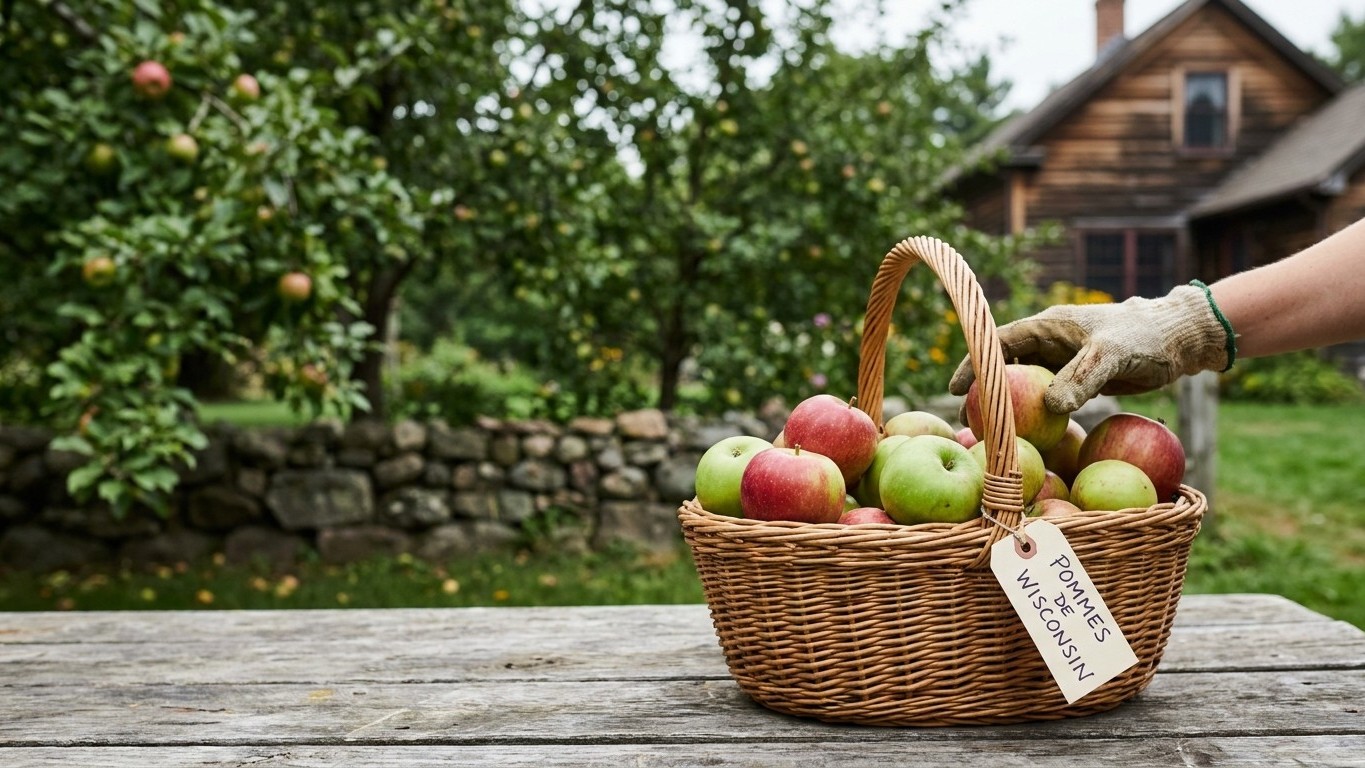

Wisconsin doesn’t have one best apple — it has a test every tree has to pass, and the tree either fits your yard’s cold and your yard’s spring or it doesn’t. What matters is whether the variety’s bloom time clears your last frost and whether its rootstock can actually take your coldest winter nights, not what grows well in Michigan or on a magazine list. So before you buy anything, find the tree’s stated bloom time and hardiness rating on the tag, and hold both up against what your own site actually sees in April and in January.
The short answer for Wisconsin
NOAA’s NCEI 1991-2020 climate normals, measured at the Milwaukee reference station, put the last spring freeze at April 16 to April 29 and the first fall freeze at October 17 to October 29. Any apple tree planted in this state also has to survive winter, and NOAA’s NCEI normals put the mean daily minimum of the coldest month at 15.6°F at Milwaukee. Those two facts, together, are the whole test a cultivar has to pass here.
A tree that blooms while frost is still a live possibility can lose an entire crop to a single cold night, even if the tree itself comes through fine. A tree that needs colder winters than what it actually gets can flower unevenly, or barely at all, because it never banks enough chilling hours to break dormancy properly. Winter hardiness tells you whether the tree lives. Chill requirement tells you whether it flowers. They are separate filters, and a cultivar can pass one and fail the other.
What the right choice depends on, specifically:
- Where in the state you are, since Milwaukee’s frost dates are not everyone’s frost dates
- How exposed the site is, since a hilltop, a lakeshore, and a low field all behave differently on a cold night
- Whether the rootstock, not just the named apple grafted onto it, is rated for winter lows your area actually sees
None of this is answered by a variety’s popularity. A cultivar that thrives in Michigan or New York can still be a poor fit here if its bloom window sits earlier than what Wisconsin’s spring frost pattern allows. Before buying anything, get the tree’s published bloom time (early, mid, or late) and its stated hardiness rating, and hold both against the numbers above.
Working through it

For the day-to-day mechanics of dormancy, bud break, bloom, and fruit set, The Wisconsin Apple Calendar, Stage by Stage walks through each stage in order. This section is only about which cultivar traits actually matter once you’re standing at a nursery bench.
Two filters, checked in order
Check winter hardiness first. A cultivar’s rootstock and scion both carry a hardiness rating, and in a state where Milwaukee’s coldest-month mean daily minimum runs to 15.6°F under NOAA’s NCEI normals, a rootstock that isn’t rated for winters that cold will eventually fail at the graft union or die back after a hard winter, even if it comes through several mild ones first. This is a slow failure, not an obvious one. A marginal rootstock can look fine for three or four winters and then die in the fifth, the one that actually gets cold enough to find its limit.
Check chill requirement second, once hardiness is settled. Chill hours measure the cold a tree needs while dormant in order to flower evenly the following spring. A cultivar bred for a mild climate and given a short chill requirement will often satisfy that requirement early in a Wisconsin winter, then respond to any warm stretch afterward by pushing bloom too soon, right into the April 16 to April 29 frost window NOAA’s normals record at Milwaukee. A cultivar whose chill requirement matches a real Wisconsin winter tends to hold its bloom later, closer to when that frost risk has actually passed.
| Filter | What it tells you | How it fails here |
|---|---|---|
| Winter hardiness (rootstock and scion) | Whether the tree survives the winter at all | Graft union splits or dies back after a hard winter, sometimes years after planting |
| Chill requirement | Whether the tree flowers evenly the following spring | Blooms too early in a mild or warm-swinging winter, exposing blossoms to the April frost window |
| Bloom timing (early, mid, late) | Whether flowering clears the April 16-29 window NOAA records at Milwaukee | Early types lose the crop to a late frost in years spring warms up fast |
What every choice costs
A hardier rootstock is usually a slower, smaller tree, and it can take a season or two longer to bear a real crop. A later-blooming cultivar buys frost safety at the cost of a shorter harvest window before the first fall freeze, which NOAA’s normals put at October 17 to October 29 at Milwaukee, earlier the further north or inland you go. There is no variety that avoids every tradeoff. The choice is which cost you would rather carry: a slower start, a smaller crop in some years, or a tighter harvest window.
Why this page won’t hand you a brand name
We only print a cultivar name once we can source its hardiness rating, chill requirement, and disease resistance from a catalogue or a named extension trial, the same way Growing Apples in Wisconsin lays out the rest of the planting process. No such sourced list for apples was available for this page, so the honest move is to hand you the two filters above and point you toward where a checked list actually lives: a nursery tag that states hardiness and chill hours plainly, or your county extension office, covered further down. Buying on a name alone, without those two numbers on the tag, is how a tree ends up wrong for this state five winters in.
What changes across Wisconsin
Every figure above is measured at the Milwaukee reference station, close to Lake Michigan, and the lake itself is the biggest reason the rest of the state doesn’t match it. Large bodies of water release stored heat slowly through the fall, which is part of why the first fall freeze lands later right along the lakeshore than it does even a short distance inland. Door County, out on the peninsula between Green Bay and Lake Michigan, is the clearest example of this: its orchards lean on that lake effect for a longer, milder fall than the state’s interior gets.
Move inland and south and the pattern flips. Southern Wisconsin away from the lakeshore typically sees its first fall freeze arrive in early October, ahead of the lakeshore dates above, with winters that run a touch milder than the north’s. Push north toward Lake Superior and the growing season compresses at both ends, frost arriving earlier in fall and hanging on later in spring than anything the Milwaukee figures describe.
Elevation and terrain matter on a smaller scale too. A hillside orchard drains cold air downhill on a still night, while an orchard planted in a low field or a valley bottom collects that same cold air and pools it there, which is why frost can hit the bottom of a slope on a night the top of the same slope stays clear. That difference can show up within a single county, not only between one end of the state and the other, and it is worth walking a piece of ground on a cold, calm night before deciding exactly where the trees go.
None of the frost dates above apply unchanged outside the Milwaukee area. Treat them as a starting range, not a fixed date, and adjust for how far your site sits from the lake, how far north it is, and whether it sits high or low on the land.
The mistakes this climate punishes
Planting an early-blooming cultivar in a spot that still gets frost late into the season is the single costliest mistake here. NOAA’s normals put the last spring freeze at Milwaukee anywhere from April 16 to April 29, and a tree in full bloom on the wrong side of that window can lose its whole crop to one cold night, even though the tree itself comes through fine. The damage shows fast: blackened blossom centers within a day or two of the frost, and no fruit set at all in the affected clusters.
Feeding too late
Nitrogen applied in mid to late summer pushes soft new growth right when a tree should be hardening off for winter. That soft growth is the first thing damaged when the first fall freeze arrives, which NOAA’s normals put at October 17 to October 29 at Milwaukee and earlier further north and inland. Stop feeding well before that window opens, not once the leaves start to color, because by then the damage is already set into the wood.
Planting the graft union too low
A graft union buried at or below the soil line is more exposed to cold that settles at ground level overnight, and it is also more vulnerable to collar rot in a wet spring. This shows up as dieback right at the union in late winter or early spring, often mistaken for a general hardiness problem when the real cause was planting depth.
Trusting a chill requirement bred for somewhere milder
A cultivar with a low chill requirement, developed for a warmer state, will often satisfy that requirement early in a Wisconsin winter and then respond to any mild stretch afterward by pushing bloom too soon. That bloom sits exposed for weeks before the last spring freeze actually clears. It is the years with an unusually warm February or March that expose this mistake, not the average year.
Checking this against your county
Every date and figure on this page comes from the Milwaukee reference station, and your county’s actual frost dates and winter lows can run days or weeks different depending on distance from Lake Michigan and how far north you sit. The University of Wisconsin’s extension service, WISC Extension, keeps county-level horticulture staff who can confirm local frost timing and point you toward cultivars actually tested in your part of the state. Call or check with your county office before you plant, especially if your site sits well away from the reference station, or noticeably higher or lower than the land around it.
Common questions
Can I even grow apples in northern Wisconsin?
Yes, but the two filters in this article apply more strictly the further north you go, since winters run colder and the frost-free season runs shorter than anything the Milwaukee figures on this page describe. No sourced list of cultivars specifically trialed in the far north was available for this page, so check with your county’s WISC Extension office for varieties that have actually been tested that far north.
Do I need two apple trees for pollination?
Most apple cultivars need a different cultivar blooming at the same time nearby to set fruit, since very few are reliably self-fertile. If you only have room for one tree, check whether a neighbor within a few hundred feet already has a compatible bloom-time apple, crabapple, or hawthorn, since any of those can do the job.
How do I tell if a nursery tree is actually hardy enough for my winter?
Look for a hardiness rating printed on the tag or in the catalog listing, not just a regional description like “cold-hardy.” Compare that rating against the coldest winters your specific site actually sees, which your county WISC Extension office can help you pin down more precisely than the Milwaukee figures on this page.
Why did my tree bloom and get frosted this year but not last year?
Bloom timing shifts from year to year with how warm the spring runs, and the last frost date is a range, not a fixed day. NOAA’s normals put it anywhere from April 16 to April 29 at Milwaukee. An early warm spell that pushes bloom ahead of schedule, followed by a frost landing on a normal date within that range, is the classic setup for exactly this kind of loss.