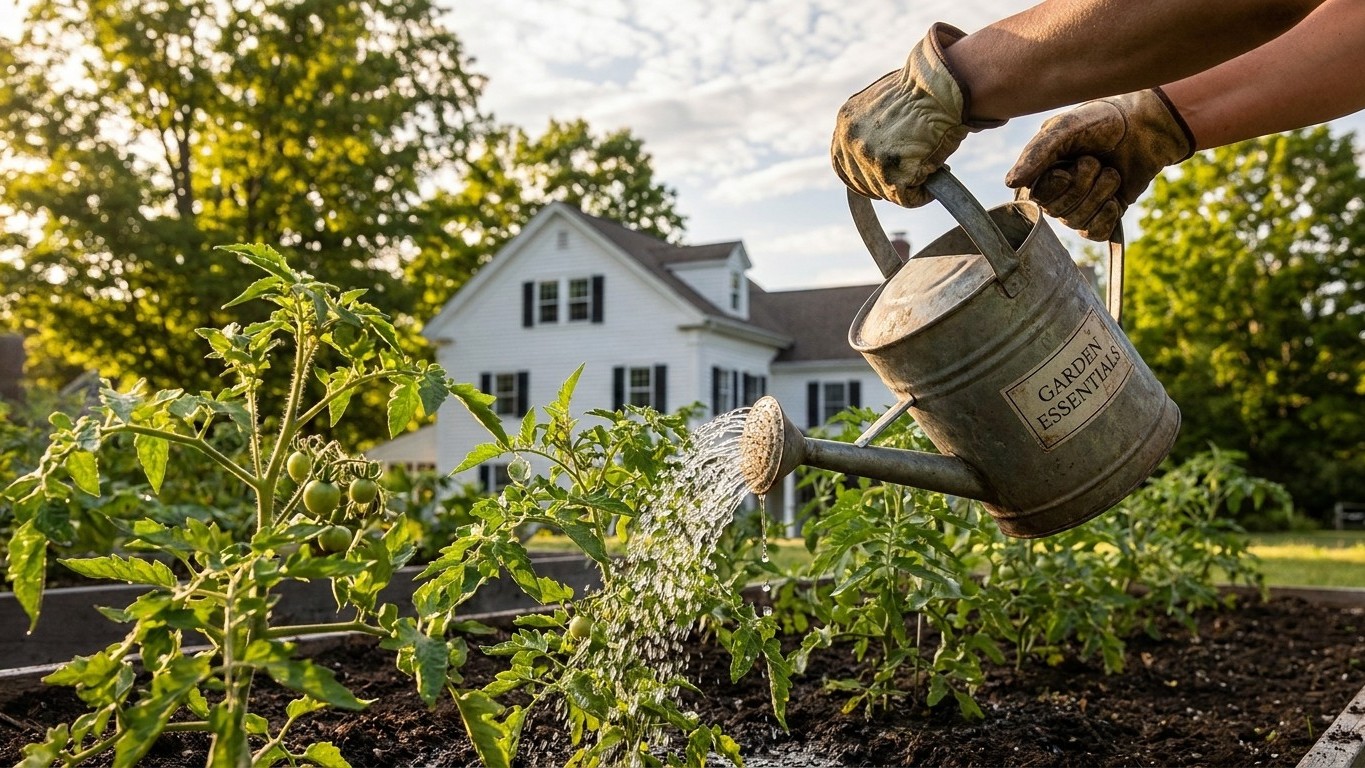

Connecticut gardeners don’t fight true drought the way the Southwest does, but they do fight inconsistency. A stretch of thunderstorms can be followed by two rainless weeks right when tomatoes are setting fruit, and the state’s own heat data explains why those gaps matter more than they look on paper.
What the climate asks of you

The number that should shape every watering decision in Connecticut is 6.2, the average number of days a year that reach 90F or higher, measured at the Bridgeport reference station under NOAA’s 1991-2020 Climate Normals. That’s not a lot of extreme heat compared to states further south or inland in the country, but it’s enough to matter: a handful of 90-degree days scattered through July and August are usually the moments when a garden that looked fine on Monday is wilting by Wednesday afternoon.
Connecticut doesn’t have a defined dry season the way parts of California or the Southwest do. Rain here tends to arrive as scattered thunderstorms and frontal systems rather than a steady weekly total, which means the calendar can show a wet month on paper while a specific garden bed goes ten or twelve days without a real soaking. That unevenness, more than any single monthly average, is why relying on “it rained this week” is a bad habit for anyone growing vegetables or newly planted perennials.
The growing season itself is generous by New England standards, at least along the coast. At the Bridgeport station, the last spring freeze typically falls between April 2 and April 12, and the first fall freeze arrives between October 28 and November 10. That’s a long window, well over six months, for a garden to establish roots and recover from a dry spell. But that same source flags something worth repeating: Bridgeport sits on Long Island Sound and is the mildest part of the state. Inland and northwest Connecticut freeze earlier in fall and thaw later in spring, which shortens the effective watering season and compresses the margin for error when heat days do show up.
Why this matters for the “inch a week” rule
Most garden guidance assumes a bed wants roughly an inch of water a week, from rain or the hose combined. Connecticut’s problem isn’t a shortage of annual rainfall, it’s timing. A month can average out fine while the actual week a plant needed water was one of the dry gaps between storms, which is exactly why Watering Through a Dry Spell in Connecticut becomes a skill of its own. Add a 90-degree afternoon into that gap and the soil surface can be bone dry within 48 hours, even in a summer that finishes near normal on the state’s books.
How much, how often
The standard advice, deep and infrequent watering rather than a light daily sprinkle, holds up especially well in Connecticut’s storm-then-drought pattern, and the same principle applies to Watering Pots and Containers in Connecticut, where the smaller soil volume dries out even faster between those storm gaps. Shallow daily watering trains roots to stay near the surface, exactly where the soil heats up fastest and dries out fastest on one of those 90-degree afternoons. A deep soak every few days pushes roots downward, into soil that stays cooler and holds moisture longer between storms.
The simplest way to know whether it’s actually time to water is to check, not guess. Push a finger, or better, a garden trowel, about two inches into the soil near the base of the plant. If it’s dry at that depth, water. If it’s still damp, wait. This single habit does more to prevent both underwatering and overwatering than any fixed schedule, because it responds to what the soil is actually doing rather than what the calendar says.
Soil texture changes the math considerably. Sandy or gravelly soil, common in parts of coastal and central Connecticut left behind by glacial deposits, drains fast and holds little reserve, so it needs shorter, more frequent soakings even in a summer with decent total rainfall. Heavy clay, more common in pockets of the state’s interior, holds a week’s worth of water but drowns roots if it’s watered again before it has had a chance to dry, and should never be worked or soaked while it’s already wet, since compacted clay recovers its structure slowly. Either way, the goal is the same: match the frequency to what the ground under a specific garden actually does, not to a generic national average.
A practical watering sequence
- Check soil moisture at two inches deep with a finger or trowel before turning on the hose.
- Water early morning, ideally before 9 a.m., so moisture soaks in before the day’s heat and evaporation peak.
- Aim the water at the base of the plant, not the leaves, to limit fungal disease that thrives in Connecticut’s humid summers.
- Deliver roughly one inch of water per session, measured with a rain gauge or a straight-sided can left under a sprinkler.
- Space sessions two to three days apart on sandy soil, and five to seven days apart on heavier clay, adjusting based on the finger test rather than a fixed calendar.
- Reduce or skip a session if a storm has delivered a real soaking within the past two days.
Restrictions and rules
Watering restrictions are a local matter in Connecticut, set by individual water utilities and municipalities rather than by one uniform statewide schedule, and they change from year to year depending on reservoir levels and rainfall. Some water systems issue odd-even day watering schedules during dry stretches, others simply ask residents to avoid midday watering, and the specifics can shift mid-summer if conditions worsen. Because of that, there’s no single rule that applies to every Connecticut address, and any watering restriction printed elsewhere as a fixed fact should be treated as outdated the moment it’s read.
The uneven, storm-then-gap rainfall pattern described above is exactly the kind of pattern that pushes local utilities toward restrictions, since it can produce a summer that looks average on paper while reservoirs still run low after a dry stretch. That makes it worth checking with the local water provider or town hall before setting an automatic timer for the season, rather than assuming last year’s rules still apply.
The UConn Extension service tracks regional conditions and can point gardeners toward current guidance for their specific county, along with soil testing and planting advice tailored to Connecticut’s zone range. Since the state spans USDA hardiness zones 6a to 7b, a single statewide recommendation rarely fits every yard, and a local extension office is a more reliable source than a general rule of thumb.
Using less
Cutting water use in a Connecticut garden isn’t about watering less often out of guilt, it’s about making each soaking count for longer between storms. A few techniques do most of the work.
- Mulch: a two to three inch layer of shredded bark or straw slows evaporation from the soil surface, which matters most during the handful of 90-degree days a year when bare soil can lose moisture within hours.
- Drip irrigation or soaker hoses: delivering water directly to the root zone instead of spraying it into the air cuts losses to evaporation and wind drift, and it also keeps foliage dry, lowering the fungal disease risk that comes with Connecticut’s humid summer air.
- Grouping plants by water need: putting thirsty vegetables and new transplants together, separate from drought-tolerant natives and established shrubs, means the whole bed isn’t watered on the schedule of its neediest plant.
- Organic matter worked into the soil: compost added to sandy soil helps it hold water longer between the state’s scattered storms, while the same addition to clay improves drainage so roots don’t sit waterlogged.
- Rain barrels, where local rules allow them: an inch of rain falling on a thousand square feet of roof yields roughly 600 gallons of runoff. In a storm-then-gap pattern like Connecticut’s, that means a barrel can fill fast during a single downpour but sit empty through the rainless stretch that follows, especially around the state’s handful of 90-degree days when demand is highest and refills are least likely.
Common questions
Does Connecticut ever have real drought restrictions?
Yes, individual water utilities can and do impose restrictions during dry stretches, but the rules are set locally and change year to year, so there’s no fixed statewide schedule to memorize. Check with the local provider each season.
Is the whole state the same for frost dates?
No. The Bridgeport figures (last spring freeze April 2-12, first fall freeze October 28-November 10) reflect a coastal station and the mildest part of the state. Inland and northwest Connecticut freeze earlier in fall and later in spring, shortening the practical watering season there.
How do I know if my soil is sandy or clay without a lab test?
Squeeze a handful of moist soil. If it falls apart immediately, it’s sandy and drains fast. If it holds a ribboned shape and feels sticky, it’s clay-heavy and holds water longer but drains slowly.
Why does watering in the morning matter so much in Connecticut specifically?
The state’s humid summer air already favors fungal disease on wet foliage overnight. Morning watering lets any splashed leaves dry before evening, while also getting water into the soil before the day’s heat, including those 6.2 average days a year above 90F, drives evaporation up.