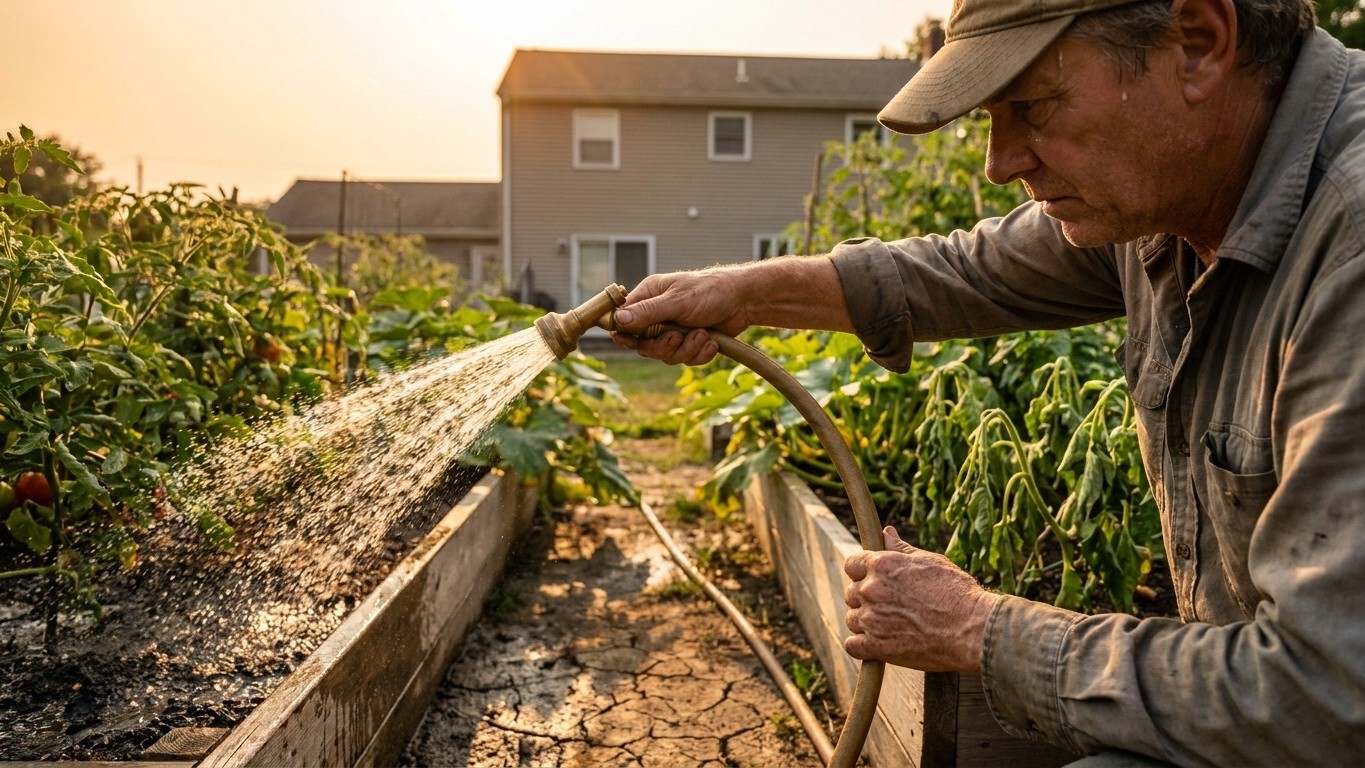

Connecticut’s driest summer month, July, brings about 3.32 inches of rain, while the state’s reference station logs 6.2 days a year at 90°F or hotter. Together, that means a garden gets less than an inch of rain most weeks during the hottest stretch of summer, and the gardener has to make up the difference by hand.
What changes here

The two numbers that matter most are 3.32 inches of rain in July, the driest summer month on record for Connecticut’s reference station, and 6.2 days a year that reach 90°F or above. Neither number is dramatic on its own. Together, they tell a gardener something specific: the sky delivers water unevenly during the exact stretch when heat is pulling the most moisture out of the soil.
A vegetable bed or a young shrub bed wants roughly an inch of water a week to keep growing without stress. Split July’s 3.32 inches across that month’s roughly 4.4 weeks, and the sky is providing about 0.75 inch a week on average. That leaves a gap of roughly a quarter inch a week that has to come from a hose or a sprinkler, and that gap assumes the rain falls evenly, which it rarely does. Connecticut’s summer rain tends to arrive as thunderstorms, a half hour of hard rain followed by days of nothing, so a lot of that 3.32 inches runs off a compacted surface or a slope before it ever reaches root depth.
Soil texture changes how much of that rain actually counts. On sandy ground, an inch of rain drains through the top few inches within a day, leaving little reserve for the days that follow. On heavy clay, the same inch can sit near the surface for a week, which sounds like an advantage until a second storm arrives on top of ground that hasn’t drained, and roots start suffocating instead of drinking. Connecticut soils run from sandy river-valley ground to dense clay loam depending on the town and even the specific yard, so the 3.32-inch figure has to be read against what’s actually under a gardener’s feet, not against a statewide average.
The 6.2 days above 90°F isn’t a huge number compared to states farther south or west, but it’s enough to matter. Those are the days evaporation spikes, when a bed watered on Monday can look parched by Wednesday even if July’s average rainfall would suggest otherwise. A rain gauge staked in the actual garden bed, not a weather app reading for the nearest airport, is the only way to know what a given week really delivered.
How to water when it matters
The method that works in Connecticut’s climate is the same one that works almost everywhere plants have roots: water deeply, water infrequently, water at the base, and water in the morning. Each piece does a specific job, and skipping one undoes the others.
Deep watering pushes moisture down past the top couple inches of soil, which encourages roots to grow downward chasing it. Shallow watering does the opposite: it keeps roots near the surface, where the day’s heat, and Connecticut will deliver 6.2 of those 90°F days a year, bakes them out fast. Watering at the base instead of overhead means the water goes where roots can use it instead of evaporating off leaves or drifting on a breeze. Morning watering gives plants moisture before the day’s heat arrives, and gives any water that does land on foliage time to dry before nightfall, which matters because wet leaves sitting overnight are exactly what fungal disease needs to take hold.
Checking soil at root depth rather than trusting the surface is the habit that prevents both over- and under-watering. A finger pushed two inches down, or a trowel turned to check the same depth, tells the real story. If it’s dry two inches down, it’s time to water regardless of how the surface looks; if it’s still damp, waiting another day costs nothing.
Sandy Connecticut soil, common in river valleys and coastal towns, holds little reserve and drains fast, so it asks for shorter, more frequent soakings rather than one big weekly dose. Heavy clay, more common inland, holds a week’s worth of water but punishes impatience: watering it again before it’s had a chance to dry pushes out the oxygen roots need and starts rot at the crown.
- Check soil moisture two inches down with a finger or trowel before watering, rather than watering on a fixed calendar.
- On sandy ground, water in shorter sessions every two to three days during July’s driest stretch; on clay, water less often but more heavily, roughly once a week, and let it dry between sessions.
- Apply water slowly at the base of the plant, aiming for the equivalent of about an inch a week between rain and hose combined, adjusted up on the 90°F days.
- Water in the early morning so foliage dries before evening and roots get moisture ahead of peak heat.
- Treat the once-a-week, one-inch figure as a starting point, then adjust based on what the finger test actually finds in that specific bed.
What goes wrong
“I water a little every day to be safe”
Daily light watering feels responsible, but it trains roots to stay shallow near the surface where the water lands, instead of growing down toward reserves. On a day pushing toward 90°F, those shallow roots dry out fast, and the plant that got watered every day this week can wilt faster than one watered deeply twice.
“I water in the evening so it soaks in overnight”
Evening watering, especially overhead, leaves leaves wet through the night. Connecticut’s summer humidity gives fungal spores exactly the damp, dark window they need to establish on foliage. Morning watering avoids this because the sun and daytime air dry leaves within a couple hours.
“It rained yesterday, so I skipped watering”
A thunderstorm can dump visible rain that only wets the top half-inch of soil, especially on compacted ground or a slope, then run off before it reaches roots. July’s 3.32-inch average hides a lot of variation between storms; the only way to know if a given rain event actually helped is the same finger-and-trowel check used before any watering decision, not a glance out the window.
“I don’t bother with mulch, it’s extra work”
Bare soil under a Connecticut summer sun loses moisture fast, especially on the 6.2 days a year that hit 90°F, when bare ground can lose water almost as fast as it’s applied. A couple inches of mulch keeps that moisture in the soil instead of handing it back to the air, which means less frequent watering and steadier root conditions between sessions.
Local help
The UConn Extension offers Connecticut-specific guidance on soil testing, irrigation timing and drought management for home gardens. Watering restrictions vary by town and water district and change with drought conditions, so check current rules with the local water provider before setting an irrigation schedule for a dry stretch.
Common questions
How much should I water my garden each week in Connecticut?
Aim for roughly an inch of water total between rain and hose, adjusted up during stretches near 90°F, and always checked against actual soil moisture two inches down rather than a fixed schedule.
Is July really the driest month in Connecticut?
Yes, based on 1991-2020 climate normals, July averages 3.32 inches of rain, slightly below June’s 3.77 and August’s 3.98, making it the summer month most likely to leave gardens short on natural moisture.
Does Connecticut have official watering restrictions during droughts?
Restrictions exist but vary by town and water utility, and they change with drought severity. Check directly with the local water provider rather than assuming a statewide rule applies.
Why does my garden dry out fast even after a rainstorm?
A short, intense thunderstorm, common in Connecticut summers, can wet only the top half-inch of soil while running off the rest, especially on sloped or compacted ground. A finger or trowel check at root depth confirms whether the rain actually reached where it’s needed.