
Connecticut gardens get about 3.32 inches of rain in July, the driest summer month, while the state averages 6.2 days a year at or above 90F. Put together, that means most of the summer arrives moderately wet on paper, but the hottest stretches concentrate demand into short windows where a garden bed can dry out fast even after a decent rain the week before.
What changes here

Start with the two numbers that matter most for a hose in hand: 3.32 inches of rain in July, the driest month of the Connecticut summer, and 6.2 days a year that hit 90F or higher. Neither number alone tells you much. Together, they say something a gardener can actually use: rainfall during the driest month is not scarce by national standards, but the handful of very hot days concentrate evaporation into short windows, so a bed can go from adequately moist to stressed faster than the monthly total suggests.
Do the arithmetic and it gets more specific. A vegetable bed or a young perennial border wants roughly an inch of water a week. July has about 4.4 weeks in it, so 3.32 inches spread evenly works out to roughly 0.75 inch of rain per week from the sky. That leaves about a quarter inch a week that the gardener has to supply by hand or by irrigation to hit the one-inch target, assuming rain actually falls evenly, which July rain rarely does. A single thunderstorm can dump half an inch in twenty minutes and then nothing for ten days, which is a very different pattern from the same 0.75 inch spread across gentle showers.
The soil under that rain changes the story further. On sandy or fast-draining ground, that quarter-inch gap widens in practice, because water moves through the root zone quickly and doesn’t linger for the plant to use. On heavy clay, the same rainfall total behaves almost the opposite way: water sits near the surface longer, which can mean less hand-watering is needed in a normal week, but also means a heavy rain on already-saturated clay does the roots no favors. The one-inch rule is a starting average, not a guarantee that any particular bed in Hartford County or along the shoreline is getting what it needs.
How to water when it matters
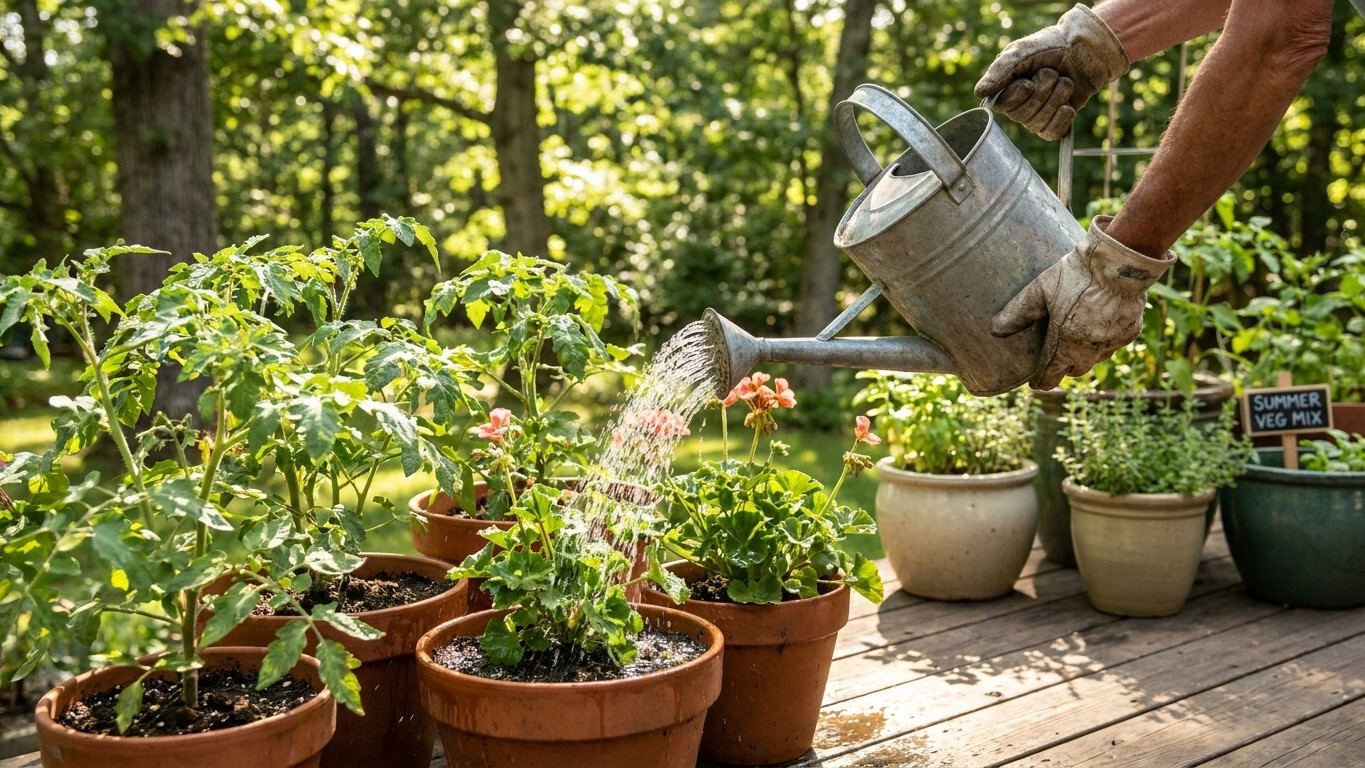
Connecticut’s rain pattern, generous most weeks but capable of long dry gaps during the hottest stretches, calls for a specific rhythm rather than a fixed schedule. Deep, infrequent watering at the base of the plant, done in the morning, outperforms a quick daily sprinkle almost every time. Deep watering pushes moisture down to where roots actually live, which trains them to grow deeper and become more drought-tolerant. Morning watering gives leaves time to dry before evening, cutting down on the fungal problems that thrive in overnight humidity. Watering at the base instead of overhead avoids wasting water to evaporation and keeps foliage dry in the first place.
Here’s a routine built around this state’s numbers rather than generic advice:
- Check soil moisture two inches down with a finger or a trowel before watering at all; if it’s dry at that depth, water, and if it’s still damp, wait another day or two.
- Water deeply enough to soak the top six to eight inches of soil, roughly the equivalent of one inch of water applied over the bed at once, rather than splitting it into daily sips.
- Time it for early morning, ideally before 9 a.m., so leaves dry quickly and roots get the whole day to draw on the moisture before evaporation peaks.
- On sandy soil, shorten the interval between waterings since the ground holds less; on heavy clay, lengthen it and always check for lingering wetness before adding more.
- During any run of days near or above 90F, check soil moisture more often rather than watering more automatically, since the heat load is what’s changing, not necessarily the calendar.
The one-inch weekly target and the two-inch finger check are a starting point, not a rule etched in stone. A raised bed with amended soil, a native plant established for three seasons, and a fresh transplant in July heat all have different real needs, and the only way to know for certain is to check the actual soil in front of you.
What goes wrong
Watering a little every day
A daily light sprinkle feels responsible, but it wets only the top inch or two of soil. Roots follow the moisture, staying shallow and close to the surface where summer heat bakes them the moment watering stops for even a day or two. Deep, infrequent watering trains roots to grow down toward more stable moisture; daily sprinkling trains them to stay right where the sun can reach.
Watering leaves in the evening
Wetting foliage after work, when it’s cooler and more pleasant to be outside, leaves leaves damp overnight. Fungal spores that cause powdery mildew and various leaf blights need exactly that combination: moisture and darkness for hours at a stretch. Morning watering, even if it’s less convenient, dries the plant out before the fungal window opens.
Trusting a rain shower that barely got the surface wet
A brief afternoon storm can look like it solved the watering problem while only wetting the top half-inch of soil, especially once soil has already started to dry and initially sheds water rather than absorbing it. The only way to know is the same finger check used before watering: two inches down, dig in, and see if the storm actually reached the root zone or just refreshed the surface.
Skipping the mulch
Bare soil in a Connecticut summer, especially through the handful of 90F days each year, loses moisture to the sun almost as fast as it’s applied. A two- to three-inch layer of mulch slows that evaporation, keeps soil temperature more stable, and stretches the interval between waterings. Given that this region’s dry stretches are short but intense rather than prolonged, mulch is one of the cheapest ways to buy a garden a few extra days of buffer before it needs attention.
Local help
The UConn Extension service offers region-specific guidance for soil, plant selection, and watering practices across Connecticut. Watering restrictions vary by town and water district and change with drought conditions, so check current rules directly with your local water provider before setting an irrigation schedule.
Common questions
How often should I water my garden in Connecticut during summer?
Check soil moisture two inches down every couple of days rather than watering on a fixed schedule. Given July’s average rainfall of 3.32 inches, most beds need supplemental watering once or twice a week beyond what rain provides, more often on sandy soil.
Does Connecticut get enough rain for a vegetable garden without irrigation?
Not reliably. With about 3.32 inches falling in July, the driest month, roughly a quarter of the weekly one-inch target still has to come from a hose or irrigation system, and that gap widens during the state’s average 6.2 days a year of 90F heat.
Is it better to water in the morning or evening?
Morning. It lets foliage dry before evening, cutting the risk of fungal disease that thrives on overnight moisture, and gives roots the full day to use the water before the day’s heat peaks.
Do I need to worry about local watering restrictions?
Yes, in some towns during dry stretches. Restrictions are set locally and change with drought status, so check with your specific water provider rather than assuming statewide rules apply.