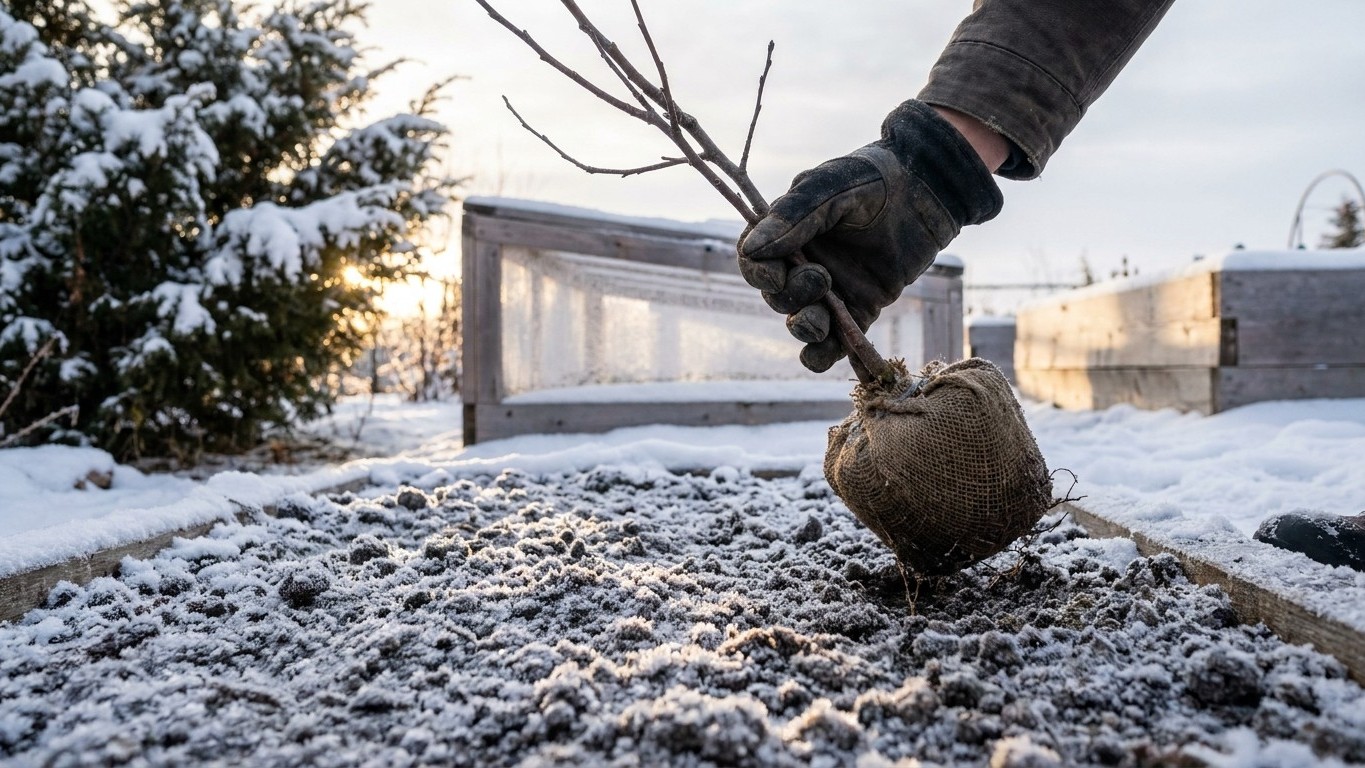

Short answer: nothing goes into open ground in Alberta in December. The soil is frozen solid across the province, and the growing season closed weeks ago. What’s left is indoor forcing, cold-frame upkeep, dormant work in the orchard, and the planning that decides how well next spring goes.
What goes in the ground in December

Alberta’s frost math explains why. The average first fall frost lands around September 16, and the average last spring frost doesn’t arrive until May 21, based on Environment and Climate Change Canada’s climate normals for the Calgary Int’l A station. That’s an eight-month gap, and December sits almost exactly in the middle of it. Those are averages, not guarantees: in roughly half of all years the real frost date falls later, so treat both figures as the midpoint of a window rather than a hard line. Either way, by December the ground has been frozen for weeks in most of the province, and it stays that way until spring.
Alberta sits in Canadian hardiness zone 4a, a rating built from seven climate variables rather than the single minimum-temperature figure the USDA system uses. The two scales don’t convert directly, and a Canadian 4a rating spans a wide range of conditions depending on where you sit in the province. The practical result is the same everywhere in Alberta this month: no direct sowing, no transplanting, nothing new going into the open garden.
Garlic and shallots are the one exception gardeners often ask about, but their window closed before now. Both go into the ground in September or October, before freeze-up, so they can root before dormancy. By December that window is shut. If you missed it, the honest move is to hold the cloves in a cool, dark spot and wait, rather than force them into frozen soil now.
What actually works this month happens under cover or indoors: cold frames and low tunnels protecting greens sown earlier in the fall, forcing rhubarb crowns or chicory roots in a dark, warm space for tender winter shoots, and any bare-root or dormant nursery stock kept in an unheated but frost-protected garage rather than planted outside. None of it touches open soil until the ground thaws.
What to start under cover
Seed starting in Alberta is counted backward from that average May 21 last-frost date, not forward from a fixed calendar day. Long-season crops like onions, leeks, and peppers typically need 10 to 12 weeks indoors before they’re ready to go out, which points to a January or February start, not December. Tomatoes, at 6 to 8 weeks, start even later. Do the arithmetic from your own county’s frost pattern, not from Calgary’s, since northern and higher-elevation districts run behind it.
That leaves December light on actual sowing. Starting long-season transplants this early is the first failure mode: the plants become rootbound and leggy long before outdoor conditions are safe, and a leggy pepper or tomato rarely recovers its vigor once it hits the ground. The opposite mistake, waiting too long into spring, leaves too little season for fruit to mature before the fall frost arrives again in September.
What does make sense in December is prep work that pays off later: cold-stratifying seeds that need a chilling period before they’ll germinate, such as many native perennials and some hardy flowers, by mixing them with damp sand and holding them in the refrigerator for six to twelve weeks. Slow-germinating perennial herbs like rosemary or lavender can also go in now if your county’s frost window is late enough to need the extra lead time, since they take longer than most vegetables to reach transplant size. Everything else on the vegetable list waits for January or February.
What is ready to pick
Outdoors, the answer is close to nothing. Any kale, leeks, or Brussels sprouts left in the ground under a thick layer of snow can sometimes still be harvested where the snow itself insulates the soil enough to keep the crop from freezing solid, but that depends entirely on local snow cover and isn’t something to count on province-wide.
Cold frames are the more reliable source. Spinach, mâche, and other hardy greens sown in early fall keep producing small pickings through winter as long as the frame stays closed against the worst cold and gets brushed clear of snow so what little daylight there is can reach the plants.
Indoors, microgreens and sprouts fill the gap on a countertop, ready in one to two weeks from seed with no soil and no frost risk at all.
The other December job on the harvest side is inspection, not picking. Go through stored squash, potatoes, and onions and pull anything showing a soft spot, a wrinkled patch, or mold, since one turning squash or a sprouting onion can spread rot to everything touching it in storage. Check weekly rather than once and forgetting.
The jobs that matter this month
Winter in Alberta is not a pause in the gardening calendar, it’s a different set of deadlines. Dormant pruning of fruit trees, currants, and raspberry canes is best done now while the plants are fully dormant and the structure is easy to see without leaves in the way; cuts made in December heal cleanly before spring growth starts pulling sap through the wound.
Seed catalogs move fast. Ordering now, rather than in February, is often the only way to get the specific varieties that sold out the previous spring, particularly for shorter-season vegetables bred to work with an eight-month frost gap like Alberta’s.
Soil work belongs here too. Where beds aren’t fully frozen or are accessible in a covered space, testing pH and organic matter now gives time to source and apply amendments before the spring rush. Turning an outdoor compost pile keeps it from going anaerobic under snow, and indoor bins should get checked for moisture and balance on a regular schedule through the cold months.
Tool maintenance is the job most often skipped and most often regretted. Cleaning soil and sap off pruners and spades, sharpening blades, and oiling metal parts before they sit unused for months prevents rust and dull cuts that cost time in spring. Fences, raised bed frames, and cold frame joints are also easier to repair now, while there’s no growing crop to work around.
Planning next season’s rotation, on paper, is the quiet work that determines how much disease and pest pressure builds up over the following year. December’s short days are the natural time to map it out.
What not to do in December
The most common mistake is trusting a warm afternoon over the calendar. A chinook wind can push temperatures well above freezing for a day or two in parts of southern Alberta, and that mild stretch tempts gardeners to pull back mulch or uncover a cold frame early. The ground underneath is still frozen, and the warm spell rarely lasts; uncovering protected plants exposes them to the next cold snap with no buffer left. Leave winter protection in place until there’s a sustained, multi-week thaw, not a single mild day.
Starting warm-season vegetable seeds indoors this early is the second trap. It feels productive, but tomatoes, peppers, and squash started in December will be leggy and rootbound long before Alberta’s soil is warm enough to take them, months from now near the May 21 average last frost.
Fertilizing dormant plants or lawns is a waste at best and a stress at worst. Nitrogen applied now pushes no growth, since the plant isn’t active, and can leach away with snowmelt before roots ever use it. Hold feeding until active growth resumes in spring.
Walking on frozen or partially thawed garden beds compacts the soil structure for the whole season ahead. Stick to paths and leave the beds alone until they’ve dried out properly after thaw.
Checking this against your own county
A province-wide frost date is a starting point, not an instruction. Alberta’s elevation changes, the chinook belt along the eastern slopes, and the difference between the Peace Region in the north and the prairie south of Calgary can shift real frost dates by weeks in either direction from the Calgary Int’l A averages used here. Foothill and northern gardens typically run later in spring and earlier in fall than the province-wide figures suggest.
For local frost data, soil conditions, and season-specific advisories, Alberta’s Ministry of Agriculture and Irrigation publishes current guidance at alberta.ca/agriculture-and-irrigation. Cross-check any date here against your own recent winters before setting a schedule.
Common questions
Can I plant garlic in Alberta in December?
No. Garlic needs to go into unfrozen soil in September or October to root before winter. By December the ground is frozen and the window has closed; hold the cloves cool and dark until fall planting comes around again.
Is it too early to start tomato or pepper seeds indoors in December?
Yes, for most of Alberta. Working back from the average May 21 last frost, peppers and tomatoes are typically started 6 to 12 weeks ahead, pointing to January or February, not December. Starting this early usually produces leggy, rootbound plants by transplant time.
What can I actually harvest in an Alberta garden in December?
Very little outdoors. Cold-frame greens like spinach or mâche may still be pickable, and kale or leeks under deep snow can sometimes hold on. Indoors, microgreens and sprouts are the most reliable December harvest.
What is Alberta’s plant hardiness zone, and does it match USDA zones?
Alberta (reference city Calgary) sits in Canadian zone 4a, a rating from Natural Resources Canada built on seven climate variables. It does not convert directly to a USDA zone; the two systems measure different things, and a Canadian 4a rating can overlap several different USDA zones depending on location.