
Count 60 to 80 days from seeding. Beets are sown in place, so a transplant never starts the clock. In the Calgary area, sowing two to three weeks ahead of the May 21 average last frost puts the pull somewhere between the end of June and late July. Storage reverses the usual root-crop rule. Topped beets keep best at 33 to 36 F, while the 32 to 34 F that suits most root crops brings more black spot and rot.
The short answer
Alberta’s most common soil is a Chernozem, the deep, dark grassland soil of the prairies, rich in organic matter and naturally fertile. It covers 40 percent of the mapped surface, with Luvisolic soils next. Taking the median of the surface measurements, the province’s dominant profile is a loam to silt: 37 percent sand, 21 percent clay and 42 percent silt. Organic matter sits near 5.2 percent, pH near 6.5 (slightly acid), and drainage is good. That comes from the Canadian Soil Information Service at Agriculture and Agri-Food Canada, drawing on 2,154 mapped soil components.
What the dominant soil means for a beet
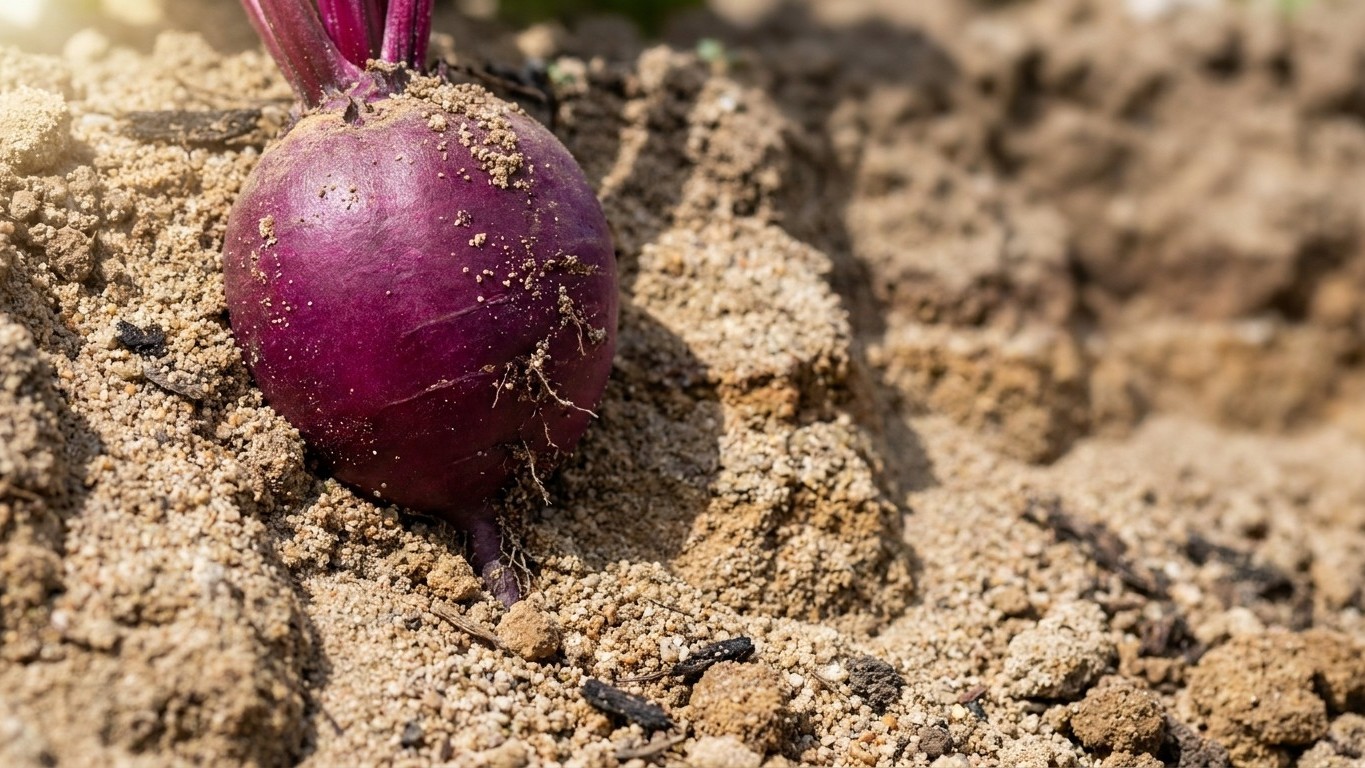
Utah State University Extension describes the beet’s ideal as deep, sandy, well-drained soil rich in organic matter. Alberta’s typical ground meets two of those three. It drains well and it is loaded with organic matter. It is siltier than sandy, though, with a fifth of it clay, so it tends to hold more water than the ideal bed and to firm up as it dries. The same extension guidance caps compost at no more than 1 inch per 100 square feet. With organic matter already above 5 percent, that cap is a ceiling you may never need to approach.
Treat all of this as a starting point. A province spans hundreds of soils, and the survey covers only the agricultural regions, so the far north is not represented. River bottoms, muskeg and any lot a builder has scraped or filled will behave nothing like the median, and the 6.5 is not your pH. A soil test gives your number. More on what a beet root meets underground is in Beet Soil in Alberta: What the Root Will Meet.
Heat, and the days above 90 F
Calgary is the reference city here, and the number of days a year it passes 90 F is not published in the data behind this page, so I won’t guess at one. What the source does give is a lower line: heat above 85 F combined with water stress makes the root woody. Woodiness is a late-season failure of roots that stay in the ground through a hot, dry spell. It has nothing to do with the early-season flowering covered below.
That shapes the pull date. A bed sown around the average last frost reaches the 60 to 80 day mark before the hottest weeks of a prairie summer are likely to settle in, and roots pulled on time have simply dodged most of the risk. Leaving them in the ground “to size up” through a hot spell is the move that invites a tough, stringy core. For the full picture of the crop, start with Growing Beets in Alberta.
The six weeks that decide it here
Where the six weeks land
The May 21 figure comes from Environment and Climate Change Canada, read from the Calgary Int’l A station normals. It is a mean date, not a safe one. In one year out of two the last frost falls later, so think of May 21 as the midpoint of a window. The station also sits in one spot, and northern or upland districts run weeks behind it. These are Canadian normals, and the US figures elsewhere on this site cover a different averaging period, so the dates are not directly comparable.
Sowing two to three weeks before May 21 means seeding roughly April 30 to May 7. Count six weeks forward and the critical stretch runs to about June 11 through June 18. That is the period Utah State University Extension flags: water stress in the first six weeks causes premature flowering. Seed date plus 60 to 80 days then gives a pull window from about June 29 to July 26, shifting later in a cold spring or a late-frost year.
What that spring usually does
Alberta springs swing. Warm spells give way to cold snaps, and snow in May is not unusual. Moisture arrives unevenly, so a stretch of dry, breezy weeks between rains is common. A well-drained Chernozem sheds water as easily as it stores it, which means the top layer where beet seed sits can dry out fast during a warm, windy week even when the ground below is fine.
The bolting risk sits right there, in the first six weeks after seeding and in the dry stretches between storms. A beet that flowers early has been stressed for water early. Later watering will not undo it. The practical routine is to check the seed bed every few days from sowing through mid-June and water whenever it has dried, rather than waiting for the plants to wilt. Past that mark the worry shifts to heat, and the two should be managed separately.
What goes wrong here
Most failures with beets in this province trace back to a dry early spring, a hot midsummer, or a storage space that is colder than people assume. Chewing and leaf damage is a different subject, covered in What Eats Beet in Alberta, and When. The soil and climate problems look like this:
- Bolting. Plants send up flower stalks after dry spells in the first six weeks. The remedy comes before the damage: keep the seed bed evenly moist from sowing through mid-June, especially during windy, warm weeks when the top layer dries fastest.
- Woody roots. Heat above 85 F with water stress toughens the root. This is a separate failure from bolting, and the remedy is different too. Water through hot spells and pull on schedule, within the 60 to 80 days from seeding, instead of leaving roots to bulk up in midsummer heat.
- Over-amending. Piling compost on soil that already holds about 5.2 percent organic matter is easy to do. Stay at or under 1 inch per 100 square feet, and test your own soil first, since your garden may look nothing like the provincial median.
- Storing with the leaves on. Bunched beets last only 10 to 14 days. Top them first and store the roots alone.
- Storing too cold. The USDA Agricultural Handbook 66 puts topped beets at 33 to 36 F and 98 percent relative humidity, and says more black spot and rot occur at 32 to 34 F than a little warmer. Pits and cellars should stay between 31 F and 41 F. An unheated Alberta garage can fall below that floor in a hard cold snap, so check it with a thermometer before trusting it.
- Keeping the wrong roots. Large roots keep much better because they lose water and shrivel more slowly. Save the big ones for storage and eat the small ones first.
Common questions
How many days from seeding until I can pull beets?
Plan on 60 to 80 days from seeding. Beets are sown in place, so there is no transplant date to count from. Sown in early May in the Calgary area, that points to late June through late July, later in a cold spring.
Is May 21 a safe date to sow?
It is the average last spring frost at the Calgary Int’l A station, from Environment and Climate Change Canada. That makes it the midpoint of a window, with the frost falling later in one year out of two. Northern and upland districts run weeks behind that station. A fall frost date is not published here, so check a local source for that one.
What temperature should I store topped beets at?
Aim for 33 to 36 F and 98 percent relative humidity. The USDA handbook found more black spot and rot at 32 to 34 F, so colder is not better here. Keep pits and cellars between 31 F and 41 F. Bunched beets, leaves on, last only 10 to 14 days at 32 F and above 98 percent humidity.
Does Alberta soil need compost for beets?
The province’s dominant soil is a Chernozem with about 5.2 percent organic matter, so many gardens need little. That is a median, though, and your bed may be nothing like it. If you do add compost, keep it to no more than 1 inch per 100 square feet, and let a soil test on your own ground decide.