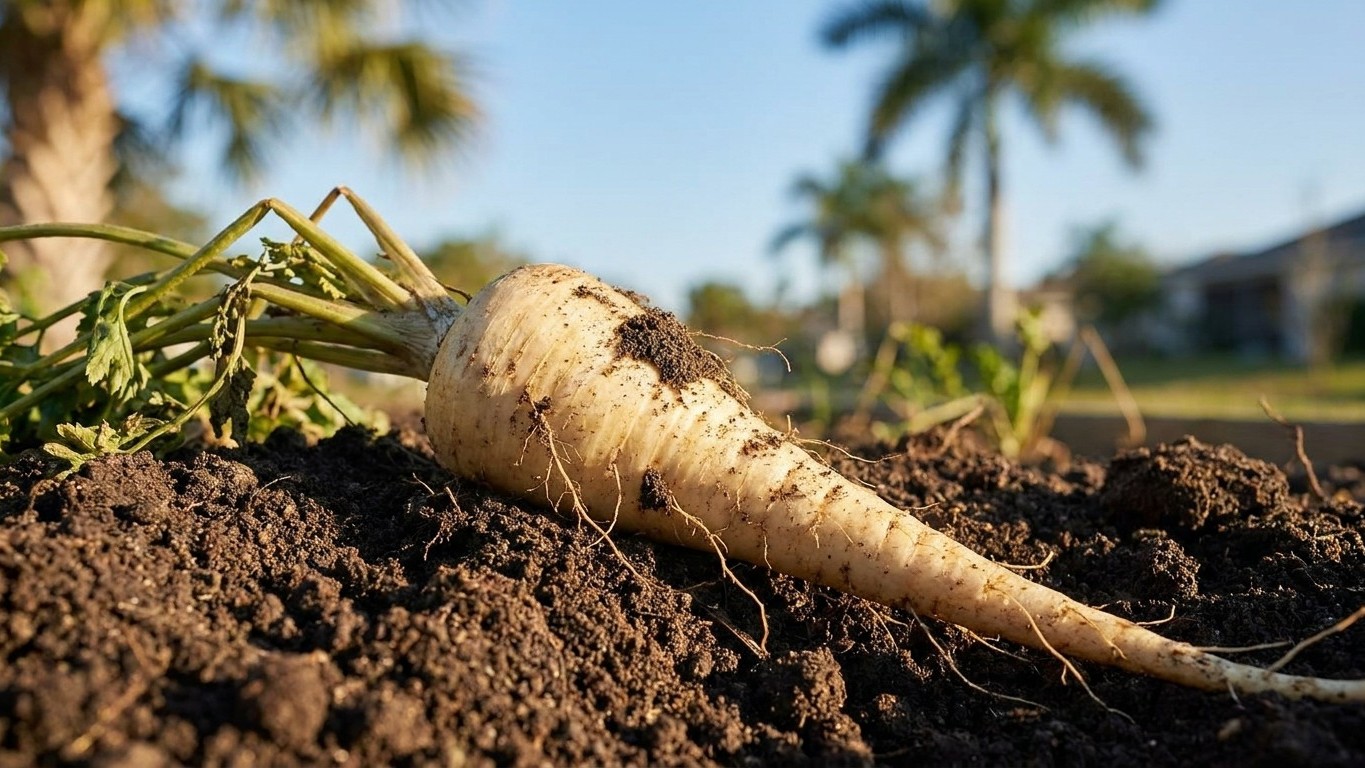

Wait for frost, then wait some more. In Alberta, parsnips are ready to lift for flavor once several frosty weeks have passed, which on the average Calgary calendar means October rather than September. The first fall frost arrives on average September 16. Stored well, the roots keep four to six months. “Well” means cold, humid, and nowhere near the fruit bowl, because ripening apples turn parsnips bitter.
The short answer
Does Alberta deliver several frosty weeks? Without much argument. At the Calgary reference station, the mean daily minimum of the coldest month is -13.2 °C. That is the average overnight low for the worst month of the year, not a record low and not a monthly average that blends days and nights. A parsnip grown here will sweeten, not merely grow.
The reason is frost exposure, and the hardiness zone has nothing to do with it. Per Utah State University Extension, parsnips need 100 to 120 days from seeding and taste best after several weeks of cool, frosty weather, which converts stored starch into sugar. A comfortable zone number is not the same thing as several frosty weeks, and a garden can be rated hardy while its roots never see enough cold to change. Alberta’s problem runs the other way, since the cold is generous. The full story on that conversion is in Will Parsnips Sweeten in Alberta?
When to lift
The mean first fall frost at the Calgary airport station is September 16. Treat it as the midpoint of a window, not a safe date: in one year out of two, the frost comes later. Several frosty weeks starting from there put the first properly sweet roots in October. Lifting in late September gives you a perfectly edible parsnip that tastes more like a carrot’s plainer cousin. Northern and upland districts run weeks behind Calgary on both ends of the season, so lift by your own garden’s frost history, not the airport’s. Dig before the ground locks up solid, since a fork will not go in after that.
How long they keep
USDA Agricultural Handbook 66 puts parsnip storage at four to six months at 0 to 1 °C with 98% relative humidity (USDA Handbook 66). That is a long keeper by any standard. The figure assumes cold and humidity held steady, which almost no house does. A garage that swings with the weather will shorten it.
The surprise is what spoils them. Parsnips are not chilling sensitive, so cold is not the enemy. Ethylene is. Even low levels in cold storage cause bitterness, and ripening fruit, apples above all, gives off plenty. Keep parsnips in a separate space. Top them after harvest, but do not trim into the crown.
Does the season fit?
Parsnips are sown in place, so the 100 to 120 days run from seeding, not from transplanting. The usual advice is to sow 2 to 3 weeks before the last frost. Here is the arithmetic against the Calgary frost window, in order:
- The mean last spring frost is May 21. Sowing 2 to 3 weeks earlier lands between April 30 and May 7.
- Germination takes 14 to 21 days, so seedlings show between May 14 and May 28. Until then the row looks like bare soil. Do not dig it up and re-sow.
- Counting 100 days from the sowing, the quickest case ends around August 8 (sown April 30) and the slowest at August 15 (sown May 7). Counting 120 days, the range runs from August 28 to September 4.
- The mean first fall frost is September 16. Even the slowest case, sown May 7 and taking the full 120 days, finishes about 12 days ahead of it. The fastest finishes more than five weeks ahead.
Comfortable, with one soft spot
On mean dates the season fits comfortably. The crop also does not have to beat the first frost the way tomatoes do, since a frost in September is welcome and starts the sweetening early. What matters is the spring end. Sowing before the last frost means seed sits in cold soil for up to three weeks, and the dates are averages: in half of all years the last frost comes after May 21.
Those figures come from one station, CALGARY INT’L A, and from older 30-year normals. A province is not one climate. A garden in the foothills or farther north may count a shorter frost-free stretch, and a sowing that works at the airport can leave a slow variety with too little summer. If your season is shorter than Calgary’s, move the sowing as early as the soil can be worked. The wider growing picture sits in Growing Parsnips in Alberta.
What goes wrong here
Most failures are predictable, and each has a different fix:
- Forked roots from heavy or stony ground. A parsnip taproot splits when it hits resistance. Utah State University Extension calls for deep sandy soil, and says heavy soil must be double dug. Clay or stones must be worked out of the row before seeding. The state soil is a starting point, not a diagnosis, so dig a test hole in your own bed.
- Forked roots from overwatering. This is a separate cause and a separate fix. Even in loose soil, constant surface moisture can encourage forking, so water to a steady schedule and let the top layer dry between waterings rather than keeping the row soggy.
- A season that runs out. Gardens weeks behind Calgary’s May 21 and September 16 have less room. Sow as early as the ground allows, and expect smaller roots rather than none. Slugs, root maggots, and other pests also matter here; see What Eats Parsnip in Alberta, and When.
- Lifting before the cold has done its work. A mild fall can hold off the frosts that sweeten. A winter too mild to sweeten is the failure Alberta is least likely to deliver, given a coldest-month mean minimum of -13.2 °C, but an unusually warm October can still leave roots starchy. Wait for several frosty weeks, then dig.
- Bitter roots from storage. Ethylene from stored apples or any ripening fruit causes the bitterness, even at the correct temperature. Keep parsnips away from fruit, and keep the crown intact when topping.
Common questions
Can I lift parsnips right at the first frost?
You can, but you will have missed the point. A single frost starts the conversion; it is several weeks of cool, frosty weather that make the root sweet. With the mean first fall frost at September 16, October is the realistic start for good flavor.
Does the -13.2 °C figure mean parsnips need that exact cold?
No. That is the mean daily minimum of the coldest month at the Calgary station, a measure of how much frost Alberta supplies. Utah State University Extension names no temperature threshold for sweetening, only several weeks of cool, frosty weather.
Can I store parsnips next to my apples?
No. Parsnips produce very little ethylene themselves, but low levels of it in cold storage make them bitter, and apples are a steady source. Give them their own space at 0 to 1 °C, and aim for the four to six months the handbook describes.
Does the Calgary frost date apply to my garden?
Only roughly. May 21 and September 16 are mean dates from one airport station, so frost comes later than those dates in one year out of two. Northern and upland districts run weeks behind, and the older normals period behind these numbers may not match recent seasons. Keep your own frost dates for a few years and sow and lift by those.