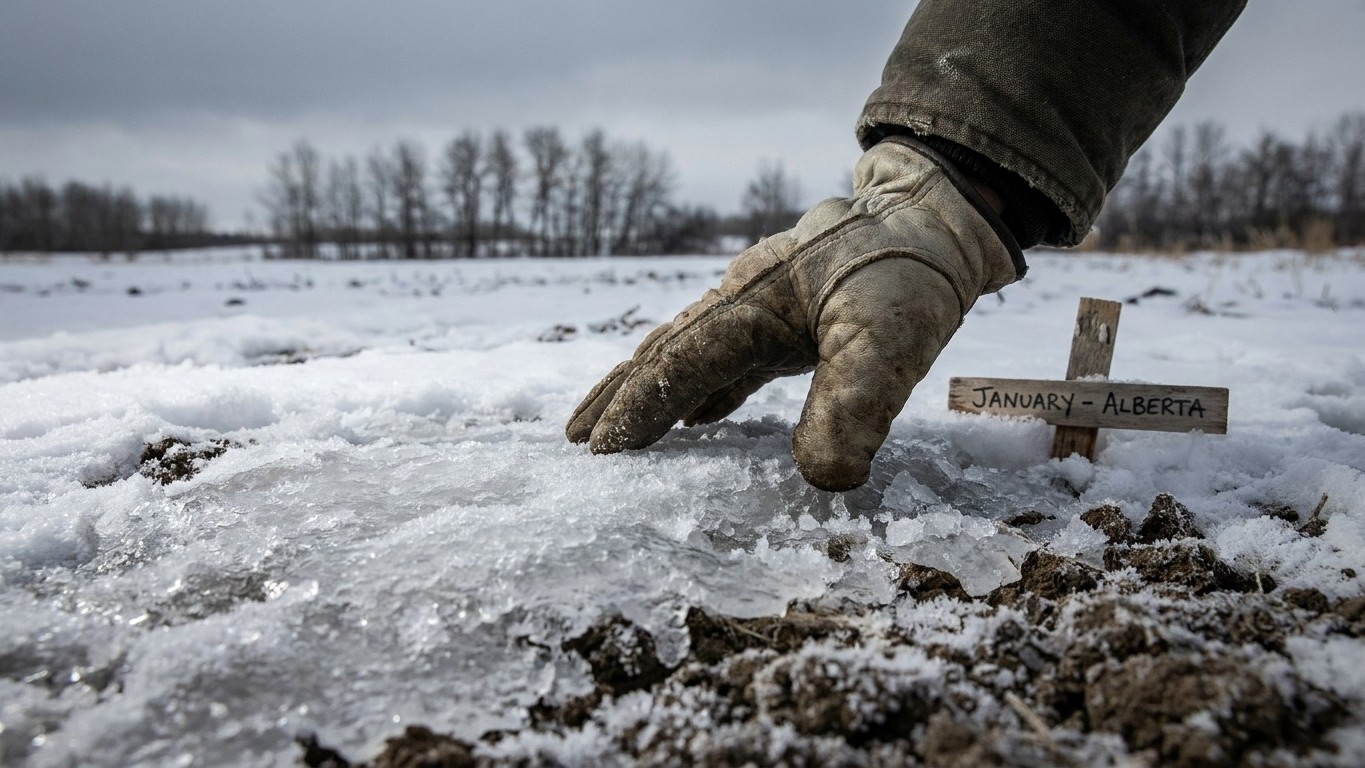

The direct answer: nothing goes into open ground in Alberta in January. The soil is frozen solid across the province, often to a depth of several feet, and no seed or transplant survives that. What the month actually offers is indoor sowing of a short list of slow crops, forced roots for winter greens, and a stretch of jobs that decide how the spring garden performs once the thaw finally arrives.
What goes in the ground in January

The decision here isn’t the calendar page, it’s soil temperature, and in Alberta that number sits well below freezing for the entire month. Environment and Climate Change Canada’s normals for the Calgary Int’l A station put the average last spring frost at May 21, and that’s a mean date, not a guarantee: in one year out of two, frost arrives even later than that. January sits four full months before that midpoint. There is no version of this climate where a seed or a root goes into an open bed and survives.
So say it plainly: the ground is closed. Garlic and shallots, which in milder states might still be tucked in during a late-season window, need to be in the soil by early-to-mid fall in Alberta, well before freeze-up, so that job is already finished or already missed by January. Cold frames don’t rescue the month either. A cold frame traps daytime heat and buffers a light frost, but it doesn’t thaw ground that’s frozen a foot or more down, and in a Canadian zone 4a winter, most unheated frames are frozen shut along with everything else outside.
What January does allow is work with material that never touches frozen dirt. Dormant, bare-root fruit trees and canes ordered for spring delivery can be heeled into pots of damp soil or sand and held in an unheated garage or cold cellar until planting weather returns, which keeps roots from drying out without asking them to grow. Forcing is the other real option: rhubarb crowns or Belgian endive (chicory) roots lifted and stored before the ground froze can be brought into a dark, cool space indoors and coaxed into tender new growth for the table, which is the closest thing to a January harvest this province produces.
What to start under cover
Seed starting in January only makes sense for the handful of crops slow enough to need a head start measured in months, not weeks. The math runs backward from that same May 21 average last frost, and because it’s an average, the safer habit is to treat it as the midpoint of a window rather than a fixed line to plan against.
Onions grown from seed, rather than sets, are the classic January candidate: they want roughly 10 to 12 weeks of growth indoors before they’re hardened off and moved outside once the soil has warmed enough to work. Counted back from a last-frost midpoint in late May, that puts seeding in mid-to-late January for gardeners chasing the largest bulbs. Leeks follow a similar timeline and tolerate the same early start. A few slow-germinating perennial flowers and long-season herbs also belong on a January tray, since they can take weeks just to sprout before the real growing even begins.
Almost everything else, tomatoes, peppers, squash, cucumbers, is too early. Start those now under grow lights and by the time outdoor planting weather actually arrives in Alberta, they’ll be rootbound and leggy, stretching for light and stalling instead of taking off. The opposite mistake matters too: wait too long on the true slow crops like onions and leeks, and there won’t be enough season left after the last frost for them to size up before the first fall frost, which averages September 16 at the same station, a growing window of well under four months.
What is ready to pick
Outdoors, the honest answer is nothing. Alberta’s ground freezes deep enough, and stays cold enough through January, that even the hardiest overwintered greens like kale or leeks are locked in frozen soil under snow, not harvestable, no matter how tough the plant is on paper. Cold frames that stretched the fall harvest a few extra weeks are typically frozen shut by this point too, so treat any outdoor bed as closed for the month rather than checking it hopefully.
What still reaches the table comes from indoors. Sprouts, grown from seed in a jar on the counter, are ready in days, not months, and microgreens under a simple grow light give a fresh, green harvest in one to three weeks depending on the variety, both useful ways to fill the gap while nothing outdoors is producing. Forced rhubarb or chicory started from stored roots, as mentioned above, becomes ready to cut within several weeks of being brought into the warmth and dark.
The other January job on the food side is inspection, not harvest. Stored squash should be checked for soft spots or a sweetish smell, both signs it’s turning and needs to be used immediately or composted before it spreads. Potatoes in storage want a look for sprouting eyes or green-tinged skin, and any that show soft, wet rot should be pulled out before they take neighboring potatoes down with them. Stored onions are worth a squeeze test: any that feel soft or mushy near the neck are done and should come out of the bin.
The jobs that matter this month
A winter month in an Alberta garden is not an empty month, it’s a planning and maintenance month, and the jobs that get skipped now show up as problems in June.
Pruning, ordering, and planning
Dormant pruning of fruit trees, grapevines, and berry canes is best done while the plant is fully asleep and the structure of the branches is easy to see without leaves in the way. The one caution worth building into the schedule: avoid making major cuts during the coldest snaps of the season, since wood is more brittle and slower to seal a wound in extreme cold, and a milder stretch within the month is a better window for the actual cutting.
Seed ordering belongs on the same list. Popular varieties, especially short-season types bred for a shorter Alberta growing window, sell out early, and ordering in January instead of March means the seed is in hand well before that mid-to-late-January onion-starting deadline arrives. This is also the month to sketch next season’s crop rotation on paper, moving heavy feeders like tomatoes and squash away from where they grew, and rotating alliums and brassicas to fresh ground to break up pest and disease cycles before they get a foothold.
Tools, soil, and stored crops
Compost piles slow down drastically in freezing weather but don’t need to be abandoned; turning one on a milder day keeps some microbial activity going and prevents the whole pile from freezing into a solid, matted block. Garden tools benefit from a January cleaning and sharpening while they’re not in daily use, since dull blades tear stems instead of cutting them cleanly come spring. And the stored-crop checks described above, squash, potatoes, onions, are worth repeating on a weekly rhythm through the month, since one rotting item left in a bin can take out several others before the next check.
What not to do in January
The most common mistake in this climate is trusting a warm afternoon over the calendar’s own math. A chinook can push temperatures up sharply for a day or two in the middle of a hard Alberta winter, and it’s tempting to read that as a sign the ground is workable or that mulch can come off. It isn’t, and it shouldn’t: the soil several inches down is still frozen even when the air feels almost springlike, and pulling back protective mulch during a mild spell exposes dormant roots and crowns to the hard freeze that typically follows once the chinook passes, which does far more damage than the cold ever would have on its own.
Starting warm-season seedlings this early is the second classic error. Tomatoes, peppers, and squash sown in January in a zone 4a climate will be weeks past their prime, tall and weak, long before it’s safe to plant them outside near that late-May frost average. And feeding dormant beds a shot of nitrogen fertilizer in January serves no purpose except to sit unused in frozen or waterlogged soil, since nothing is actively growing to take it up; that job belongs closer to when growth actually resumes, not while the garden is still asleep.
Checking this against your own county
A single frost average for the province is a starting point, not a set of instructions for a specific yard. Alberta’s elevation changes, its north-south length, and local microclimates shift real planting windows by weeks in either direction from the Calgary station figures used here. A garden in the Peace Country will lag well behind one in the southern chinook belt, and a valley bottom will hold cold longer than a nearby slope. For a local read, the Alberta Agriculture and Irrigation site is the right place to check regional guidance before locking in a schedule based on province-wide averages.
Common questions
Can I direct-sow anything outdoors in Alberta in January?
No. Ground is frozen across the province through the month, and there’s no crop that survives being sown into frozen soil. Wait for the ground to thaw and warm before any outdoor sowing begins.
What’s the earliest seed to start indoors?
Onions and leeks grown from seed are the standard early starts, sown roughly 10 to 12 weeks before the last-frost midpoint of May 21, which lands the sowing date in mid-to-late January for most home setups.
Is Alberta’s hardiness zone the same as a USDA zone?
No. Alberta’s reference city sits in Canadian zone 4a, a rating built from seven climate variables under Natural Resources Canada’s system. That figure doesn’t convert directly to a USDA zone; NRCan itself notes that Canadian zone 4a spans nine different USDA zones, from 3a to 7a, so the two scales shouldn’t be treated as equivalent.
What should I do with stored vegetables this month?
Check squash, potatoes, and onions on a weekly basis. Squash with soft spots or a sweet smell, potatoes with wet rot or green skin, and onions that feel soft at the neck should all be pulled and used or discarded right away, before the problem spreads to the rest of the stored crop.