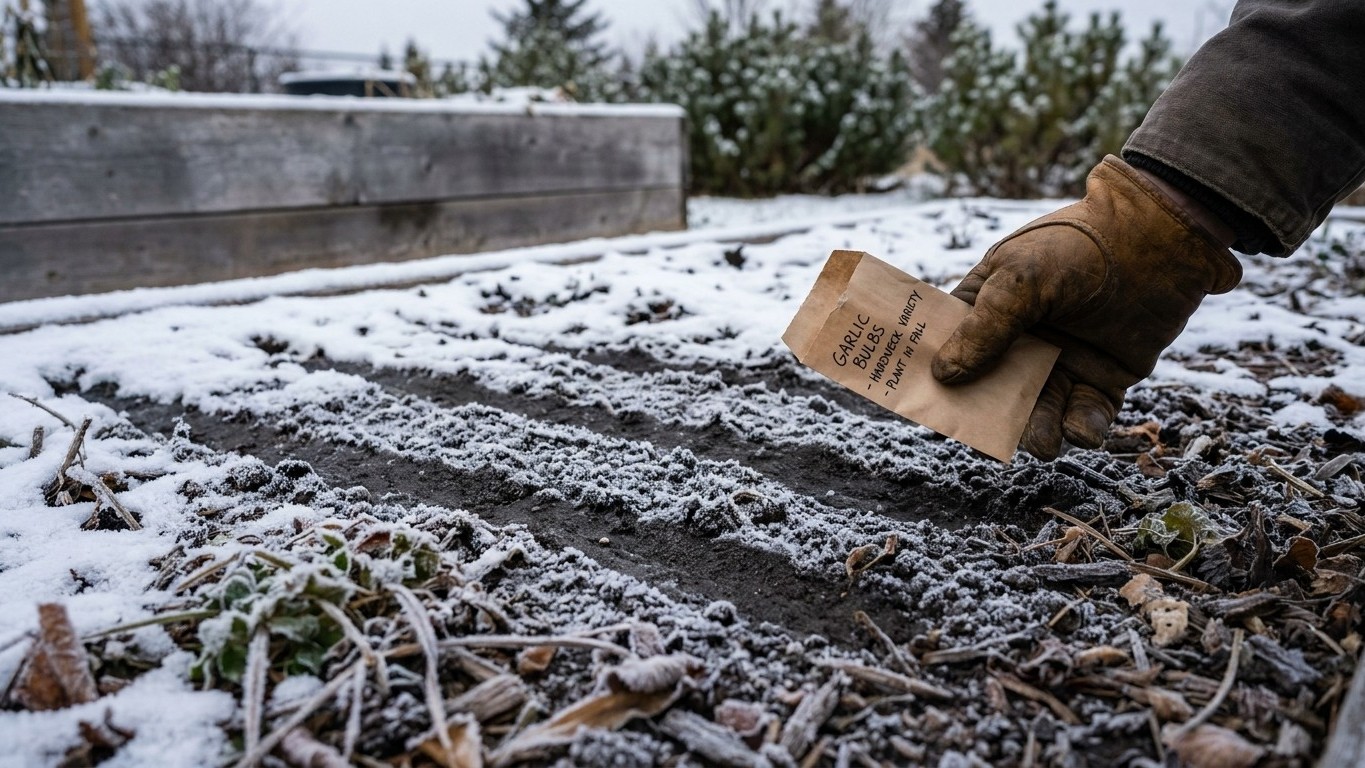

In Alberta, the mean first fall frost lands September 16 at the Calgary Int’l A station, and by November that date is six to seven weeks behind you. In hardiness zone 4a (Canadian system, for the Calgary reference city), the ground is frozen solid across most of the province by now. There is no open-soil planting window left. The work that matters this month is dormant pruning, stored-crop checks, seed ordering, and anything you can do under cover.
What goes in the ground in November

The calendar says November, but the soil decides everything. With a mean first fall frost of September 16 at Calgary Int’l A, most of Alberta has already had at least one hard freeze before this month even opens, and the ground is either frozen or closing fast. That single fact rules out almost every open-ground planting decision this month. It is worth saying plainly: for the overwhelming majority of Alberta gardeners, nothing new goes into open garden soil in November.
There are narrow exceptions, and they depend entirely on whether the ground in front of you is still workable, not on what the thermometer reads at noon. If a stretch of mild weather has kept the soil from locking up, garlic and shallots can still go in as one of the last calls of the season, planted deep and mulched heavily the moment they’re in. This is a gamble that shrinks by the week. In a typical year it has already closed by November; treat any success here as borrowed time, not a plan to rely on.
Cold frames and low tunnels change the math slightly. Hardy greens already established under cover before the freeze, things like spinach, mâche, and some kales, can keep limping along and even be harvested through a cold frame long after open beds are done. Bare-root and dormant plantings of trees, shrubs, and cane fruit are another possibility, but only while the planting hole can still be dug; once the ground is frozen, that job waits for spring. Indoors, forcing chicory roots or a lifted rhubarb crown in a dark, cool spot is a genuine November project, one that turns a dormant root into a harvest while the garden outside sits idle.
What to start under cover
Count backward from the mean last spring frost of May 21, and November sits roughly six months out, far beyond the six-to-ten week runway most vegetable transplants actually need indoors. Starting tomatoes, peppers, or brassicas now sets up the classic failure: a leggy, rootbound plant that has outgrown every pot on the windowsill long before soil temperatures near Calgary come close to that May mark. Remember too that May 21 is a mean date, so in roughly half of past years the real frost has landed later still; padding any countdown, rather than trusting it to the day, is the safer habit.
What actually fits this month’s timeline is seed that benefits from a cold spell before it will germinate at all. Many native perennials, hardy shrubs, and some tree seed break dormancy better after weeks spent near freezing. Sowing them into pots now and setting those pots in a cold frame or an unheated garage lets the winter do the stratifying work between now and spring, so the seed is ready to grow the moment warmth returns. It’s a slow bet rather than a quick one, but it puts the month to use instead of losing it entirely.
The second failure mode runs the other way: waiting too long into winter to start that cold treatment leaves too few properly cold weeks before spring warmth arrives, and the seed’s dormancy never fully breaks. Anything on a short six-to-eight week clock should simply wait for its proper turn later in winter; anything that needs the cold itself has a real reason to start now.
What is ready to pick
Outdoors, the honest answer for November in Alberta is little to nothing. Whatever wasn’t harvested before the ground froze is largely lost to open-air picking now, and that’s worth accepting rather than fighting. What still feeds the table comes from three places: what was tucked under cover before the freeze, what’s in storage, and what can be grown indoors on purpose.
Kale and leeks that were left standing and heavily mulched can sometimes still be dug or cut where snow cover has insulated the ground, though in a true zone 4a winter that window closes fast once temperatures settle in hard. A cold frame with greens established earlier in the season is a more reliable source, offering slow but steady pickings of spinach or mâche on any day the cover isn’t frozen shut. Indoors, sprouts and microgreens are the closest thing to a fresh, fast harvest this time of year, ready in days rather than weeks and needing nothing more than a windowsill and a tray.
The other job this month is checking what’s already in storage. Go through squash, potatoes, and onions by hand rather than by eye alone: a soft spot under a firm-looking skin, a sprouting eye on a potato, or a papery onion that’s gone soft at the neck all signal something starting to turn. Pull those out now, because one rotting squash left in a bin will take its neighbors down with it before the month is out.
The jobs that matter this month
November in Alberta is a working month, not a waiting month, and the list is long enough that skipping it costs real ground come spring.
- Dormant pruning of fruit trees and cane fruit, done while the wood is fully dormant and the structure of the plant is easy to see without leaves in the way
- Ordering seed before the strongest varieties sell out, since catalog stock for popular cultivars thins out well before spring
- Planning next season’s rotation on paper now, while this year’s successes and failures are still fresh
- Testing and amending soil wherever it’s still workable, or bagging a sample to send off while the lab isn’t backed up
- Turning and insulating the compost pile so it keeps breaking down slowly instead of stalling out cold
- Cleaning and sharpening tools before they sit unused all winter and rust
- Repairing beds and fencing while there’s no crop in the way to work around
- Checking stored crops for rot on a weekly rhythm, not just once
None of these are filler tasks. A pruning cut made now on dormant wood heals differently than one made in spring sap flow, a compost pile left untended through a hard freeze can take months to restart, and a fence post reset while the ground is soft is a fraction of the work it becomes once it’s frozen in place. The gardener who treats November as an off month is the same one scrambling to catch up in March.
What not to do in November
The most common mistake this month is trusting a mild afternoon over the soil itself. A stretch of unseasonably warm air can feel like an invitation to get one more planting in, but soil temperature lags well behind air temperature, especially this late in the season, and ground that feels workable at 2pm can be frozen solid again by the following morning. Treat any mild November spell as a bonus for outdoor jobs like pruning or bed repair, not as a green light for planting.
The second mistake is uncovering cold frames, row covers, or mulch too early after that same mild spell, on the assumption that the worst of the cold has passed. It hasn’t. Pulling protection off greens or newly mulched perennials during a warm stretch leaves them exposed the moment temperatures drop again, which they reliably do. Leave winter protection in place until it’s clearly done its job for the season, not until one warm afternoon suggests it might be.
The third is feeding nitrogen at the wrong point in the calendar. Any fertilizer that pushes soft new growth this late does the plant no favors: that tender growth has no time to harden off before a hard freeze arrives, and it’s often the first tissue to die back, taking some of the plant’s stored energy with it. If feeding is needed at all this time of year, it belongs on next spring’s schedule, not this month’s.
Checking this against your own county
A province-wide month is a starting point, never an instruction. Elevation, foothill proximity, and the long north-south stretch of Alberta all shift these windows by weeks in either direction from the Calgary Int’l A figures used here.
| Region | General pattern relative to Calgary | Practical effect |
|---|---|---|
| Northern Alberta | Colder, shorter season | Ground freezes earlier; November protection jobs should already be complete |
| Central Alberta (Calgary/Edmonton corridor) | Matches the reference station most closely | The figures on this page apply most directly here |
| Southern Alberta (Lethbridge and area) | Milder, later freeze-up in some years | Occasional narrow windows may stay open slightly longer |
For local detail, check with Alberta Agriculture and Irrigation before betting a planting decision on a province-wide average.
Common questions
Can you plant garlic in November in Alberta?
Only if the ground is still workable, which is unusual by November given a mean first fall frost of September 16. Where soil hasn’t yet locked up, garlic can go in as a last, narrow chance, but treat it as an exception rather than the plan.
What hardiness zone is Alberta for gardening?
The reference city, Calgary, sits in zone 4a under the Canadian hardiness system, which is built on seven climate variables and does not convert directly to a USDA zone. Canadian zone 4a can overlap several different USDA zones, so avoid comparing it directly to US zone maps.
When is the first frost in Alberta?
The mean first fall frost at Calgary Int’l A is September 16, based on 1981-2010 climate normals. This is a mean date, not a guarantee: in roughly half of past years, frost has arrived later than that.
Can you start seeds indoors in Alberta in November?
Most vegetable transplants need only six to ten weeks indoors, far shorter than the roughly six months between November and the mean last spring frost of May 21. November suits cold-treatment seed, like some perennials and shrubs that need weeks near freezing to break dormancy, rather than tender vegetable starts.