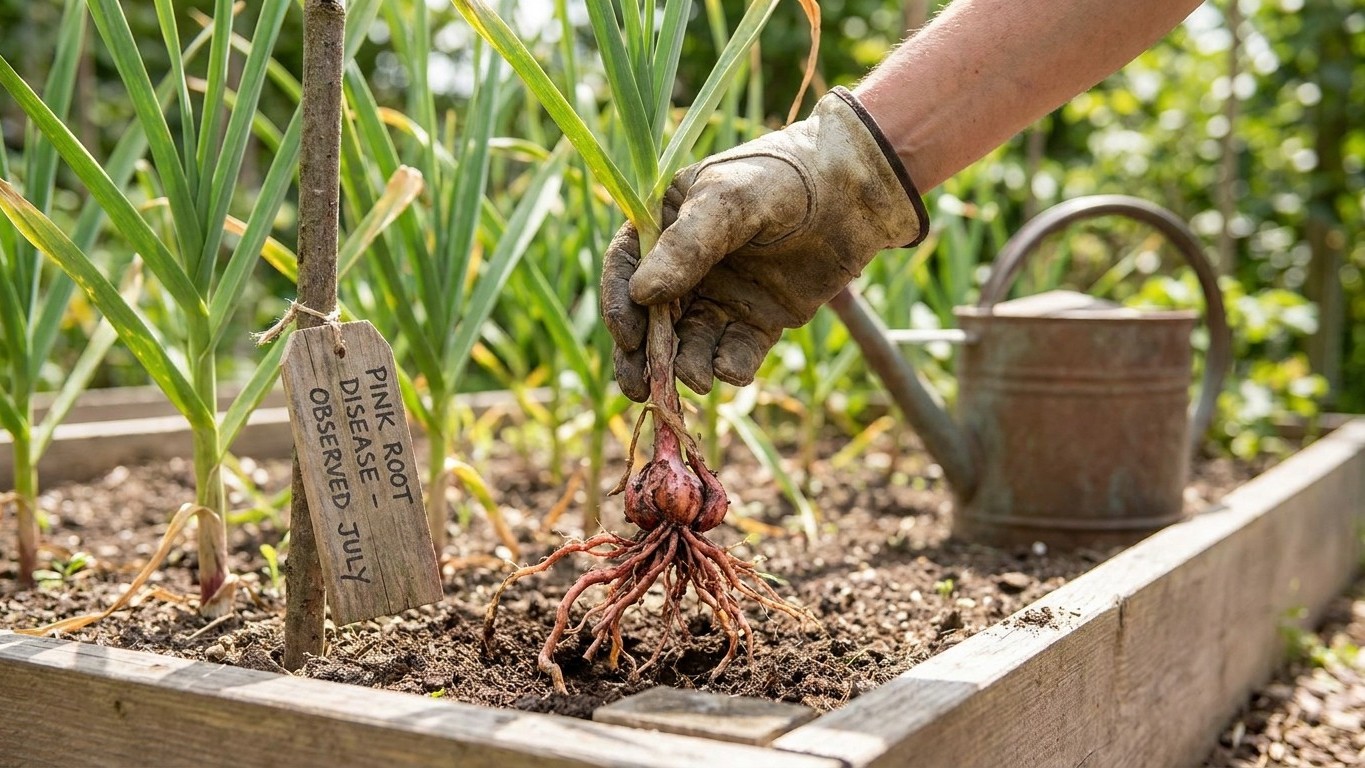

Pink root in garlic shows up as roots that turn light pink, then dark red and purple, shriveling and blackening, according to the UC IPM Pest Management Guidelines for Onion and Garlic (UC ANR Publication 3453). The plant itself is rarely killed. Only the roots and outer scales are affected, so a stunted plant can still produce a smaller, usable bulb. Pull one weak-looking plant and rinse the roots under the tap: if they show that pink-to-purple discoloration rather than uniform white or brown decay, you are looking at pink root, not a feeding or watering problem.
What you are looking at

The first thing most gardeners notice is not the roots at all. It is a patch of garlic that lags behind the rest of the bed: shorter stalks, leaves that yellow and dry down earlier than their neighbors, and an overall look of plants that are struggling rather than thriving. Nothing about the foliage points specifically to a disease at this stage. It just looks weak.
Underground, where the disease actually lives
Dig up one of the lagging plants and rinse the root mass clean. Early infection shows as roots with a light pink tint, easy to miss if you are not looking closely. As the disease progresses, those same roots darken to dark red and purple, then shrivel and turn black at the tips. The outer scales of the bulb can pick up similar discoloration, but the disease stops there. Inner cloves are typically unaffected in appearance, which is why an infected plant often still yields cloves worth eating, just fewer and smaller than a healthy one. You will not find lesions on the leaves or stem from this disease. Everything diagnostic happens below the soil line, which is exactly why it gets misread as a watering or fertility issue until someone actually pulls a plant and washes the roots.
What it is not
Most yellowing garlic is not pink root, and treating every yellow leaf as a disease outbreak does more harm than good. Garlic yellows naturally as it approaches maturity, and lower leaves die back on a normal schedule before harvest regardless of soil health. Uneven watering and low nitrogen both produce generalized yellowing across a bed, usually starting at leaf tips and moving inward, with no particular pattern of stunted patches.
Two other diseases are worth ruling out because they get confused with pink root in casual conversation. Garlic rust shows up as orange pustules on the leaf surface, a symptom pink root never produces since it stays confined to the roots. Southern blight also stunts and yellows plants, but it kills them outright and leaves white fungal growth and small round sclerotia at the base of the bulb, something pink root does not do. The single fastest way to separate pink root from everything else on this list is to check root color. If the roots are pink, red, or purple rather than white, tan, or rotted black from the crown down, pink root is the likely explanation.
Where it comes from and when it strikes
Pink root is caused by the soilborne fungus Setophoma terrestris. It does not arrive on the wind or ride in on aphids. It moves in soil, on contaminated tools and equipment, in irrigation water that carries soil particles, and most commonly on infected planting stock, since a clove pulled from a diseased planting carries the pathogen with it into the next bed.
The soil temperature window that matters
UC IPM lists 75 to 85 degrees Fahrenheit as the published optimum for disease development, and that figure describes soil temperature, not air temperature. A cool spring with warm afternoons will not necessarily put your soil in that range, so checking a forecast high is not the same as knowing what the root zone is actually doing. This is a published optimum, not a strict cutoff. Outside that window the fungus is less active, not absent, so soil that runs cooler or hotter than the optimum range can still carry infection, just more slowly.
It is also worth knowing that pink root is primarily a disease of onions. Garlic gets it too, but economic losses on garlic are rarely significant compared with what growers see on onion crops, which is part of why a stunted patch in a home garlic bed is worth investigating calmly rather than treating as a crisis.
What to do about it now
There is no cure once a plant is infected. Fungicide treatments are not part of the home management picture for this disease, and nothing you spray on an already-symptomatic plant will reverse root damage that has already turned red or black.
What to do with plants you find
Pull affected plants if they are badly stunted and clearly not going to size up, since leaving them in place gives the fungus more time in that soil without giving you a better bulb. Where a plant still looks like it is forming a reasonable bulb despite stunted roots, you can leave it to finish the season and simply expect a smaller harvest.
Do not compost pulled plants, root debris, or the soil clinging to them. Because the pathogen persists in soil, home compost piles rarely reach the sustained heat needed to kill it off, and the easiest way to spread pink root to a new part of the garden is to spread infected compost there later. Bag and discard affected root material instead, and treat the bed itself, not just the plants, as contaminated ground going forward.
Do not save cloves from an infected planting as seed stock. Visual symptoms are confined to roots and outer scales, so a clove that looks clean can still come from an infected plant and carry the fungus into next year’s planting hole.
Keeping it out of your garden
The controls that actually work for pink root are things a home grower can do without special equipment, and they line up in a fairly clear order of priority.
What to prioritize
- Start with clean seed stock. Buy certified or trusted-source garlic rather than replanting cloves from a bed with a history of stunted, discolored roots.
- Rotate away from alliums. UC IPM recommends rotating out of onion and garlic for three to six years once pink root shows up in a bed, since the fungus has no reason to decline while a host crop keeps feeding it.
- Plant resistant varieties where seed catalogs identify them, checking the variety description for pink root tolerance specifically rather than assuming all garlic responds the same way.
- Consider soil solarization during the hottest stretch of summer if your climate supports it: clear plastic laid over moist, tilled soil for several weeks can raise soil temperatures enough to reduce fungal populations near the surface.
The persistence figure is the one number worth remembering here. UC IPM states that Setophoma terrestris persists in soil indefinitely once established, which is a longer horizon than most home gardeners plan around. That single fact is why rotation length matters more than any one-season fix, and why a bed that has hosted pink root should be treated as compromised ground for alliums for years, not just skipped for one planting cycle. A few of the controls used in commercial onion and garlic production, such as deep plowing between crops, soil fumigation, and banded fungicide applications at planting, are field-scale practices tied to specialized equipment and are not something a home garden setup can reasonably replicate. Clean seed stock and a real rotation plan do the actual work for a backyard bed, and both fit within general good practice for garlic diseases as a group, not just this one.
Common questions
Can I still eat garlic that had pink root?
Yes, cloves from an infected plant are safe to eat as long as they look and feel normal once you peel away the outer scales. The disease is confined to roots and outer tissue, so it does not make the edible cloves unsafe, though bulbs are often smaller than a healthy harvest.
Will pink root spread to my other vegetables?
No, Setophoma terrestris is specific to onions, garlic, and other alliums. Tomatoes, beans, squash, and other unrelated crops planted in the same bed are not at risk from this particular fungus.
How do I know if it’s pink root or just normal garlic dieback at harvest?
Dieback near harvest affects the whole planting evenly and shows no root discoloration when you pull a bulb. Pink root usually shows up as a patchy problem within the bed, and the giveaway is root color, not timing.
Is there a resistant garlic variety I should just switch to?
Seed catalogs sometimes note pink root tolerance on individual varieties, so check the description for the specific cultivar you are considering rather than assuming resistance is universal across garlic types. Resistance reduces severity but is one part of a plan that still needs clean seed stock and rotation behind it.