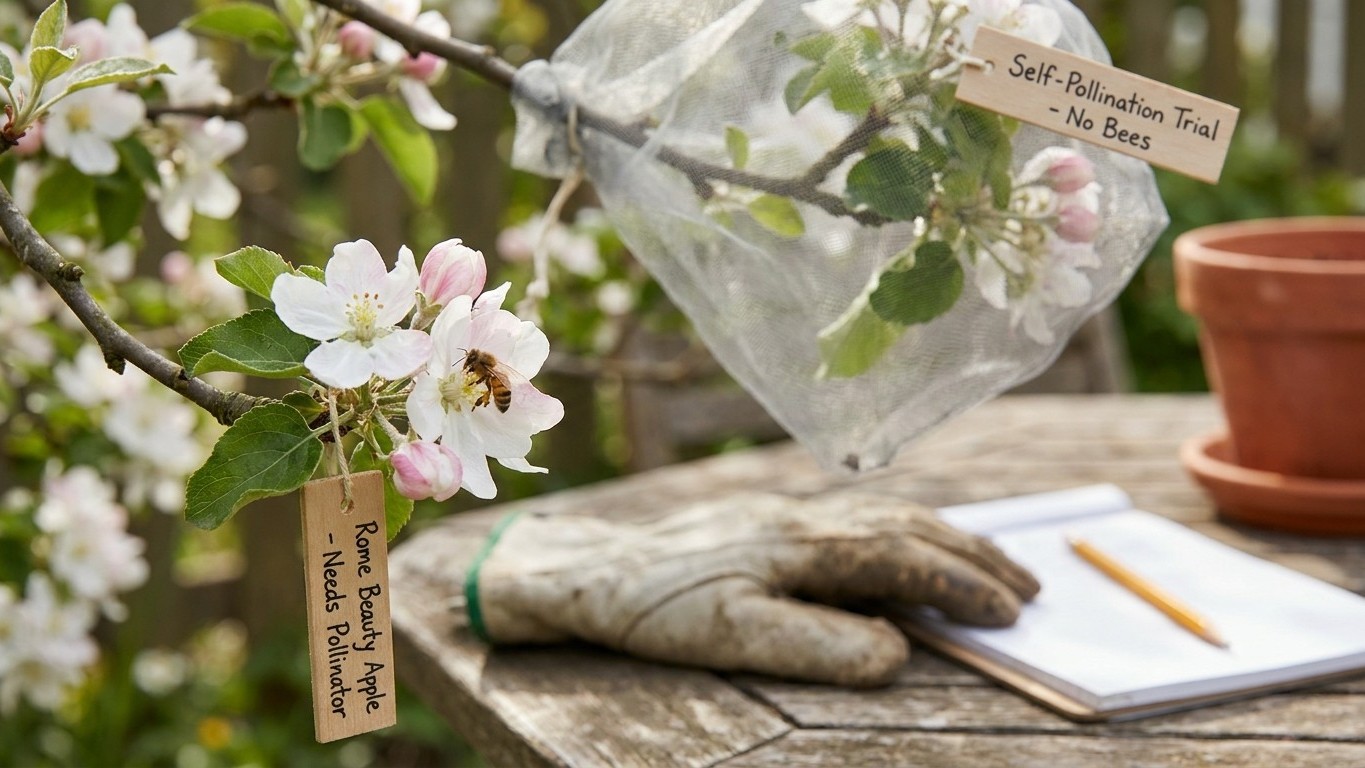

Rome Beauty is pollinated by other apple varieties that flower in the same window it does. Clemson Cooperative Extension’s bloom-group chart (matched by the University of Georgia’s UGA C740 publication) places Rome Beauty in bloom group C, and the varieties confirmed to work as partners are Arkansas Black, Golden Delicious, Ozark Gold, and Priscilla. Plant one of those four close enough for bees to move between the two trees, rather than guessing at a neighbor’s tree by its bloom date alone.
The short answer
The pollen partners confirmed for Rome Beauty are Arkansas Black, Golden Delicious, Ozark Gold, and Priscilla. Any one of them, set close enough for bees to cross between the two canopies, gives Rome Beauty the outside pollen it needs, since nearly all apple varieties crop better with a partner than alone. For the general mechanics of cross-pollination in apples, see Apple Pollination.
For most home orchards, two trees are enough: a Rome Beauty and any one of the four names above. Each of them carries fertile pollen, so the partner tree gets pollinated in return and both set fruit. That changes if the second tree you already own is Jonagold or Stayman. Their flowers open at the same time as Rome Beauty’s, but their pollen is sterile, so they cannot pollinate anything, including each other. Keep one in the yard and you need a third tree with fertile pollen just so the Jonagold or Stayman sets fruit at all, on top of whatever Rome Beauty needs.
This list is short by design. Breeders and extension services test specific crosses before publishing a compatibility list, so a lot of otherwise healthy varieties simply don’t have documented pairings with Rome Beauty yet. If you’re also placing an early bloomer like What Pollinates Dorsett Golden, and What Cannot or a variety such as Sansa (see What Pollinates Sansa, and What Cannot) somewhere in the same yard, treat each one’s compatibility list separately, since bloom groups differ by variety and a partner for one won’t necessarily suit the other.
Why these varieties and not others

Clemson Cooperative Extension’s bloom-group chart, echoed in the University of Georgia’s UGA C740 publication, sorts apple varieties into letter groups purely by when they open their flowers relative to each other. Rome Beauty sits in group C alongside Arkansas Black, Golden Delicious, Ozark Gold, and Priscilla, which is exactly why those four work: two trees have to be shedding and receiving pollen on the same days for a bee to carry anything useful between them.
What the letter actually measures
The letter is a relative order, not a date on a calendar. USU Extension’s guide to apple production in Utah describes Rome Beauty’s bloom as late in the season, and in a warm spring group C might open in early April in one region while a cooler spring pushes the same group C trees into May somewhere else. What doesn’t move is the order: group C opens after group A and B, together with the rest of group C, wherever the orchard sits. That’s the reason a bloom-group letter is useful across states while a specific date only applies to the location it was measured in.
Sharing a bloom group is a necessary condition, not a full guarantee. Two trees flowering on the same days still need two other things to line up, the pollen has to be fertile, and the two varieties can’t be parent and offspring. Neither of those shows up in the bloom-group letter itself, which is purely a calendar tool. A tree can be correctly placed in group C and still be a poor or useless partner for reasons the letter says nothing about, which is exactly the case with two other group C varieties covered next.
Cold hardiness matters here too. USU Extension lists Rome Beauty as suited to USDA zones 5 through 8, and a pollen partner has to survive the same winters to still be alive and blooming come spring. Arkansas Black, Golden Delicious, Ozark Gold, and Priscilla are all commonly grown across that same range, which is part of why they show up as confirmed partners rather than some untested pairing from a warmer or colder region.
What cannot pollinate it
Jonagold and Stayman both flower at the same time as Rome Beauty, both sit in the same bloom group C, and neither one will set a single Rome Beauty apple. Their pollen is sterile, meaning the flower parts still open and bees still visit, but the pollen grains they carry can’t complete fertilization. A garden planted with only Rome Beauty and one of these two gets no fruit, even though the bloom timing looks perfect on paper.
Sterile pollen runs one direction only. Jonagold and Stayman still need pollen from somewhere else to set their own fruit. Rome Beauty, Arkansas Black, Golden Delicious, Ozark Gold, or Priscilla could do that job for them, but Jonagold and Stayman can’t return the favor to any tree, Rome Beauty included.
| Variety | Bloom group | Pollen | Pollinates Rome Beauty |
|---|---|---|---|
| Arkansas Black | C | Fertile | Yes |
| Golden Delicious | C | Fertile | Yes |
| Ozark Gold | C | Fertile | Yes |
| Priscilla | C | Fertile | Yes |
| Jonagold | C | Sterile | No |
| Stayman | C | Sterile | No |
There’s a separate rule worth knowing even though it doesn’t name a specific exclusion for Rome Beauty: a variety bred from another cannot fertilize its own parent. Breeding programs record the parentage of named cultivars, and that lineage sometimes rules out a pairing that would otherwise look fine on a bloom chart. No such parent-offspring exclusion is published for Rome Beauty specifically, so beyond the six varieties in the table above, compatibility with Rome Beauty simply isn’t documented. Check with your county extension office before betting a season’s fruit on an unlisted variety.
How close the second tree has to be

Pollen moves on bees, not on wind, so distance is a practical question about how far a bee will fly between two trees on the same trip, not a fixed number of feet. The closer the two trees stand, the more reliably it happens: the same yard beats the same block, and a shared fence line beats a lot across the street.
The partner doesn’t have to be a second full-size tree you planted on purpose. A neighbor’s Golden Delicious two yards over can do the job, and so can an ornamental crabapple blooming at the same time, since crabapples are apples and most produce plenty of viable pollen. A grafted branch of a compatible variety on an otherwise single-variety tree works too, because as far as a bee is concerned, it’s just another flowering branch in reach.
What breaks the arrangement isn’t distance so much as weather during the bloom window itself. Cold or wet conditions keep bees in the hive, and if that stretch lines up with the few days Rome Beauty and its partner overlap, no amount of proximity fixes it. A perfectly placed partner tree still sets no fruit if the bees never fly while both are in flower.
Planting more than one compatible variety around the yard doesn’t just add insurance against a single tree dying. It also widens the days on which some pollen source is open, since Arkansas Black, Golden Delicious, Ozark Gold, and Priscilla don’t all reach full bloom on exactly the same morning even inside one bloom group. A grower with two or three of them scattered near the Rome Beauty has a longer combined window for the handful of good bee-flight days a spring actually offers. None of this substitutes for having at least one confirmed partner in bee range to begin with.
If there is no room for a second tree
A multi-grafted tree carries several varieties on one trunk, so a single planting spot can hold Rome Beauty and Golden Delicious, for instance, as different branches of the same tree. It solves the pollination problem outright, but it takes more pruning attention than a single-variety tree, since each variety on the trunk grows at its own rate and one branch can shade out another if left unchecked.
Grafting a pollinator branch onto an existing Rome Beauty is a smaller version of the same fix: one scion of a compatible variety added to a mature tree, rather than a whole second trunk. It costs a season or two of patience while the graft establishes and starts flowering, and it demands basic grafting skill or a willingness to learn it, but the footprint is close to zero. Keep fire blight in mind before you cut into the tree: USU Extension rates Rome Beauty as very susceptible to fire blight, and any fresh graft wound is an entry point, so time the work for dormant season and clean tools between cuts.
A columnar apple variety planted alongside a full-size Rome Beauty takes up a fraction of the ground a second standard tree needs, and a flowering crabapple does the same job in even less space, since most gardeners plant crabapples for the blossom anyway. Neither one changes the pruning or spraying schedule the Rome Beauty itself needs, and neither one helps if it isn’t in bloom on the same days, so the bloom-timing question covered above still applies to whatever you pick.
Common questions
Can a flowering crabapple actually pollinate my Rome Beauty, or is it just decoration?
A flowering crabapple can do real pollination work. Crabapples are apples, most varieties produce abundant viable pollen, and a bee moving between a crabapple and a Rome Beauty in bloom together treats it the same as any other apple tree.
My Rome Beauty already sets some fruit with no other apple tree nearby. Why bother with a partner?
Some fruit without a partner is common, but it’s usually a light, unreliable crop. Nearly all apple varieties, Rome Beauty included, crop far better with a confirmed pollen source than they do alone.
Could I graft Jonagold onto my Rome Beauty to save space and get pollination too?
No. Jonagold’s pollen is sterile, so a Jonagold branch grafted onto a Rome Beauty tree adds another variety’s fruit but does nothing for pollination. You’d still need a fertile partner such as Golden Delicious somewhere in bee range.
How do I find out exactly when Rome Beauty blooms where I live?
Bloom group C tells you the order relative to other varieties, not a calendar date for your area. Your local extension office can tell you roughly when group C apples typically flower in your climate, which is the number this page can’t give you.
Is Rome Beauty a good pollinator for other apple varieties?
That isn’t confirmed in the sources behind this page, which only cover pollen coming into Rome Beauty, not going out from it. Check the compatibility page for whatever variety you’re trying to pollinate before assuming Rome Beauty will do the job.