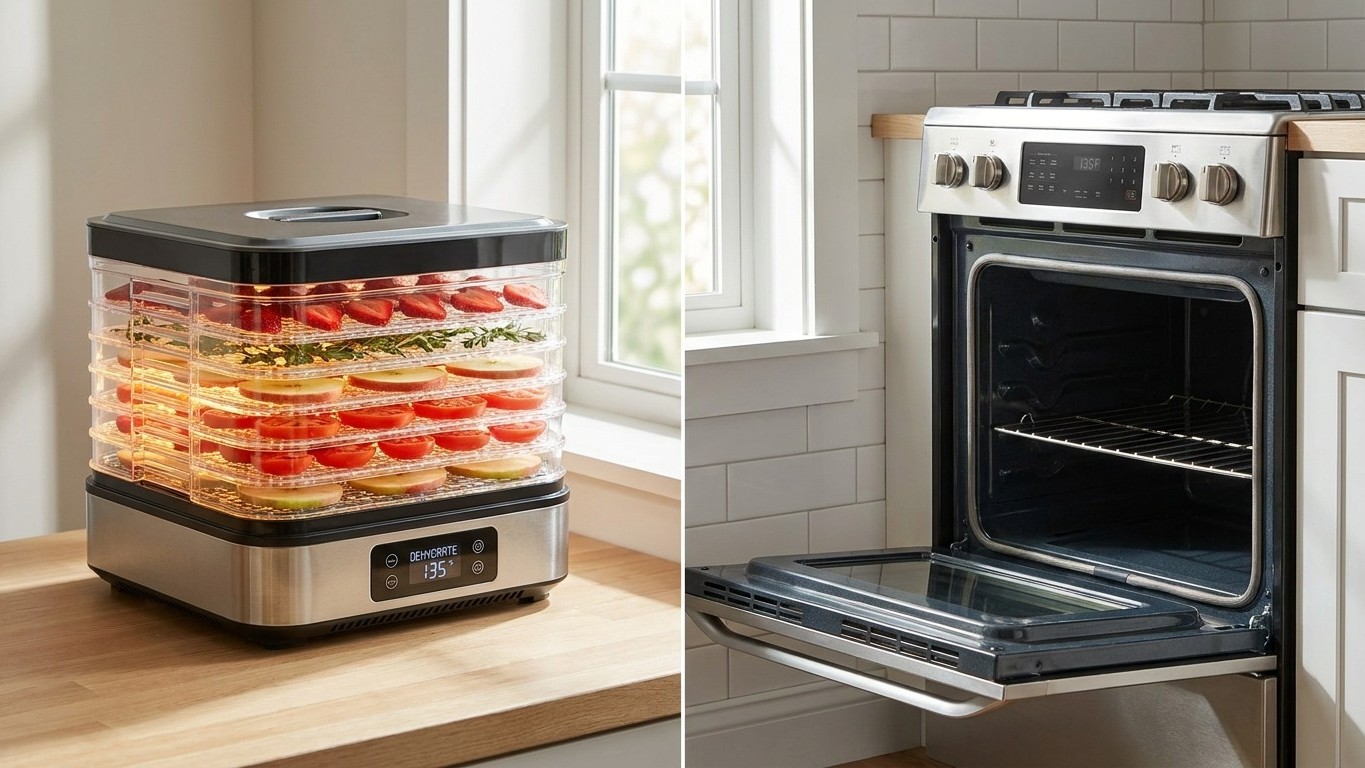

Here’s what changes: a dehydrator holds a steady 140 F with airflow built to move that heat evenly across every tray, while a home oven wasn’t designed for drying at all and can’t reliably hold a low, steady temperature or move air the same way. That single difference in engineering, not the appliance’s price tag, is what the National Center for Home Food Preservation points to when it comes to reliable results.
The short answer

A food dehydrator works at 140 F, according to the National Center for Home Food Preservation (University of Georgia). That’s not a suggestion or a starting point you adjust by feel. It’s the operating temperature the appliance is built around, and it’s the figure NCHFP uses when it talks about drying food safely at home. The dehydrator’s fan and heating element are designed to hold that number steady, tray after tray, for as long as the food needs.
An oven doesn’t have that design goal. Ovens are built to bake and roast at temperatures far above 140 F, and most residential ovens don’t have a reliable low-end setting that sits there without drifting. Some ovens can be propped or set low enough to approximate drying conditions, but NCHFP does not publish a general drying temperature or duration that applies across ovens the way it does for a dehydrator. That’s an important distinction: the 140 F figure is documented for dehydrators specifically, not as a universal drying number you can port over to any appliance.
This is why the honest short answer isn’t “oven versus dehydrator, pick one.” It’s that the dehydrator is the appliance NCHFP describes with a specific, tested operating temperature, and the oven is a workaround that depends entirely on your specific oven’s ability to hold a low, steady heat with decent air movement. If your oven can’t do that reliably, you’re not drying food safely. You’re guessing.
None of this means an oven is useless for drying. Plenty of people have used ovens for this for generations. But the moment you swap appliances, you lose the built-in consistency that makes the dehydrator’s 140 F figure meaningful in the first place. That consistency, not the heat source itself, is the real thing that changes.
What actually decides it
Three mechanical realities decide whether an appliance dries food safely and evenly, and they explain why a dehydrator and an oven behave so differently even when you try to match their temperatures.
Airflow design
Horizontal-flow dehydrators push air sideways across each tray. That design keeps flavors from mixing between trays, heats every tray the same way, and keeps dripping juices off the heating element. Vertical-flow dehydrators, which pull air up through a stack of trays, do none of those three things: flavors travel upward through the stack, trays closer to the fan or heating element run hotter than trays further away, and juices from upper trays can drip onto the heat source below. An oven has neither design. Its air movement depends on whether it has a convection fan, how the racks are spaced, and how much food is crowded onto each rack blocking circulation. That’s the mechanical root of “some spots dry, some don’t” when people try ovens for drying.
Temperature stability
A dehydrator’s thermostat and fan work together to hold 140 F steady over hours. An oven’s thermostat cycles the heating element on and off to maintain a set temperature, and that cycling range is usually wider than what a dehydrator holds, because ovens weren’t built for the fine control drying requires. A few degrees of drift matters more at drying temperatures than it does at baking temperatures, because drying relies on sustained, even heat over a long stretch of time rather than a quick temperature spike.
What heat is actually doing to the food
Drying preserves food by removing the water that microorganisms need to grow. It does not heat the food to a killing temperature. That’s the mechanism worth remembering for any food: dried food is not sterile. Whatever organisms were present before drying can still be present after, just dormant without enough moisture to multiply. That’s true whether you use a dehydrator or an oven, and it’s why the food’s starting condition, and the specific instructions for that food, matter as much as the appliance.
How to do it
- Choose the appliance based on what it can actually hold steady: a dehydrator built to run at 140 F, or an oven you’ve confirmed can hold a low, even temperature with decent airflow.
- Look up the specific drying instructions for the food you’re preparing from the National Center for Home Food Preservation before you start, since temperature and duration vary by food.
- Prepare the food as that specific recipe directs, since pre-treatment steps affect how evenly and safely a food dries.
- Load the trays or racks without overcrowding, leaving space for air to move around each piece.
- If you’re using a vertical-flow dehydrator, rotate trays periodically to compensate for the uneven heat that design produces near the fan or heating element.
- If you’re using an oven, check periodically that the temperature is holding steady and that air is circulating, since ovens don’t self-correct for drying the way a dehydrator’s design does.
- Follow the specific food’s guidance for judging doneness, since that determination depends on the food, not on the appliance.
- Cool and store the dried food according to that same food-specific guidance.
What goes wrong
- Uneven drying from a vertical-flow dehydrator. Trays near the heating element or fan finish before trays further away, because vertical-flow designs don’t heat every tray the same way. Rotate trays regularly and expect to check the food in batches rather than all at once.
- Flavor mixing between trays. In a vertical-flow unit, air carrying the aroma of one food travels up through trays holding a different food. A horizontal-flow dehydrator avoids this because air moves sideways across each tray rather than up through the stack. If you’re using a vertical-flow unit, avoid drying strongly flavored foods and mild foods at the same time.
- Juices dripping onto the heating element. This happens in vertical-flow designs where trays sit above the heat source. It’s a fire and smoke risk, not just a cleanup issue. A horizontal-flow layout keeps the heating element out of the drip path.
- An oven that won’t hold a low, steady temperature. Many residential ovens cycle within a wider range than a dehydrator does, and some can’t be set low enough at all. If your oven’s low end runs hotter than intended, or swings widely, the food isn’t drying under the conditions the recipe assumed.
- Treating “dried” as “sterile.” Drying removes water; it does not apply a killing heat. Assuming dried food is automatically free of microorganisms skips the actual mechanism at work, and leads people to skip food-specific safety steps that matter regardless of which appliance they used.
- Using a generic drying temperature and time for every food. Because NCHFP doesn’t publish one universal drying temperature or duration, applying the same numbers to every fruit, vegetable, or meat ignores real differences in moisture content and density between foods.
Where the exact figures come from
A food dehydrator works at 140 F, as documented by the National Center for Home Food Preservation. Every other number, including how long a specific food needs to dry or what temperature applies if you’re using an oven, depends on the food itself and isn’t published here. Guessing at that figure is genuinely risky. Drying doesn’t sterilize food, and an under-dried or unevenly dried batch can still support the kind of microbial growth that drying is supposed to prevent, without any warning smell or taste. Look up your specific food on the National Center for Home Food Preservation’s site before you start, and follow that guidance rather than a number from memory or a different food’s recipe.
Common questions
Can I dry food in an oven if I don’t own a dehydrator?
Some ovens can approximate drying conditions if they hold a low, steady temperature with decent airflow, but NCHFP doesn’t publish a general oven drying temperature or time. Confirm your specific oven can hold a steady low temperature before relying on it, and follow the food-specific guidance for your item.
Why does tray position matter in a dehydrator?
It matters because of airflow design. Horizontal-flow dehydrators heat every tray the same way, so position matters less. Vertical-flow dehydrators heat trays unevenly depending on distance from the fan or heating element, so rotating trays becomes necessary.
Is dried food safe to store indefinitely once it’s dry?
Drying removes water but doesn’t sterilize the food, so storage conditions still matter. This page doesn’t cover storage specifics; check the National Center for Home Food Preservation’s guidance for your particular food.
Does a higher temperature dry food faster and just as safely?
Not necessarily. The 140 F figure for dehydrators reflects a tested operating point, not a minimum you should exceed for speed. Going outside documented temperature guidance for a specific food isn’t something this page, or a general assumption, can vouch for as safe.