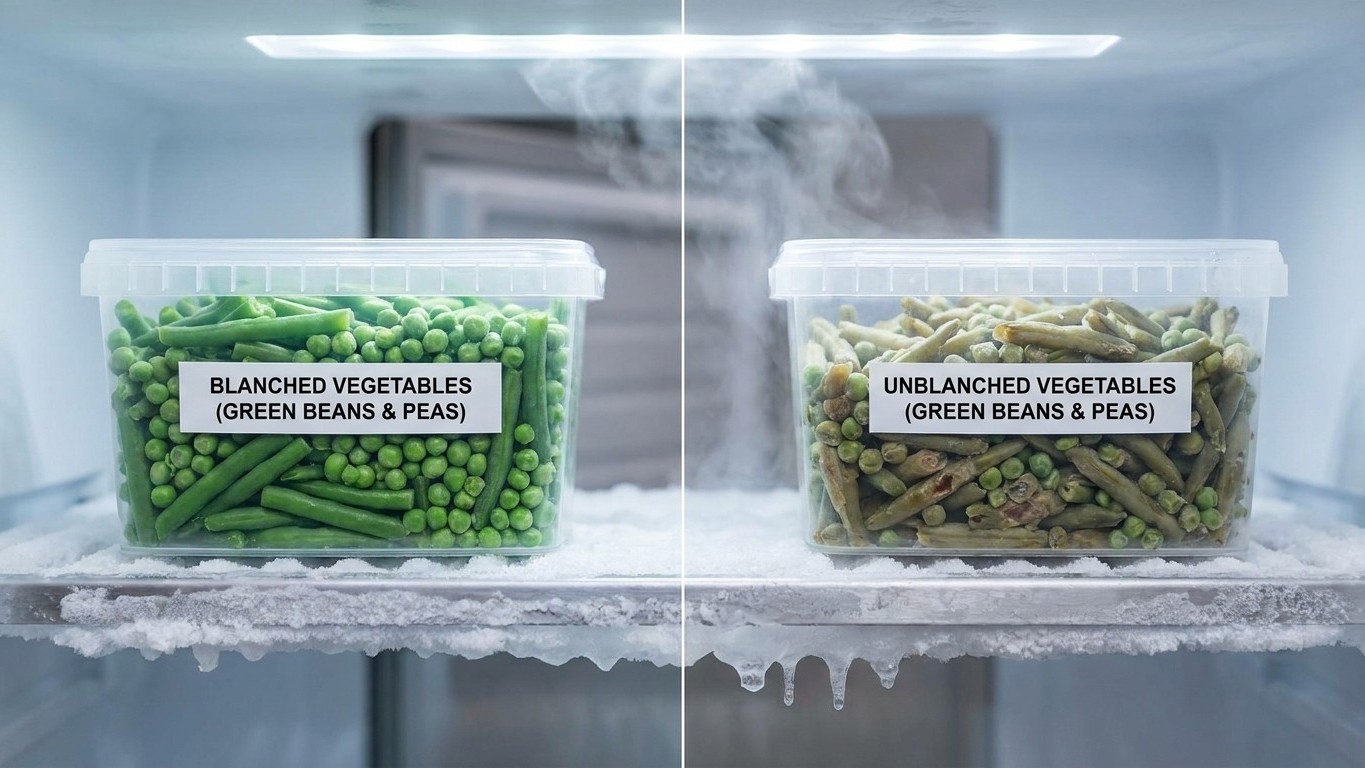

Vegetables that go into the freezer raw, without being blanched first, do not freeze well. The enzymes still active in raw produce keep working in the freezer, slowly wrecking flavor, color and texture over weeks of storage. The National Center for Home Food Preservation at the University of Georgia is explicit about this: blanching is what stops those enzyme actions, and skipping it is the single biggest reason frozen vegetables come out mushy, faded or off-tasting.
The short answer

Raw vegetables frozen without blanching are the clearest example of something that does not freeze well, and the National Center for Home Food Preservation names the exact reason: blanching stops the enzyme actions that cost flavor, color and texture. Freezing itself does nothing to those enzymes. Cold slows chemistry down, it doesn’t switch it off, so an unblanched pea or green bean keeps degrading in the freezer, just more slowly than it would on the counter.
What makes this counter-intuitive is the halfway measure. A lot of home cooks assume a quick dip in hot water, even if it’s shorter than it should be, is better than nothing. The National Center for Home Food Preservation says the opposite: underblanching stimulates the activity of enzymes and is worse than no blanching at all. A partial heat treatment doesn’t disable the enzymes, it agitates them, so the vegetable can end up in worse shape than if it had gone into the bag raw and untouched.
There’s a second failure mode on the other side of that line. Overblanching causes loss of flavor, color, vitamins and minerals. So the vegetable that “doesn’t freeze well” isn’t necessarily one that was frozen without any treatment at all; it can just as easily be one that sat in hot water too long, or too short, before the cold hit it. Both directions punish the same food for the same underlying reason: enzyme control has to be precise, not approximate.
Blanching also does double duty that’s easy to overlook. Beyond stopping enzymes, it removes dirt and microorganisms clinging to the surface of the vegetable and slows the loss of vitamins during storage. None of that happens by accident in the freezer. The cold air in a home freezer isn’t sterilizing anything and isn’t scrubbing anything off the produce; it’s just holding whatever state the vegetable was in the moment it went in. Freezing preserves a moment; it doesn’t improve it.
What actually decides it
Two separate mechanisms explain why some foods freeze fine and others fall apart, and confusing them is where most freezer disappointments start.
Enzyme activity that never gets an off switch
Every raw vegetable carries enzymes that were doing useful work while it was still growing, ripening or just sitting on a shelf. Those enzymes don’t know the vegetable has been picked, bagged and frozen. Cold temperatures slow their reaction rate but don’t stop it, which is why the National Center for Home Food Preservation treats blanching, not freezing, as the step that actually halts enzyme action. A food that has no built-in way to have its enzymes deactivated before freezing, and isn’t blanched to make up for that, is a food that will keep changing in the bag: losing color, turning the texture soft or grainy, and drifting away from its fresh flavor the longer it sits.
Freezing stops the clock, it doesn’t reset it
The second mechanism is broader and applies to every frozen food, not just vegetables: freezing does not sterilize. It stops what is already there. Whatever microorganisms, enzyme activity or spoilage process was already underway in a food at the moment of freezing gets paused, not eliminated. Thaw that food back out and everything that was present before resumes exactly where it left off, sometimes faster, because ice crystals can rupture cell walls and leave more surface area exposed to that reaction. This is why a food that was already in poor shape, already partly spoiled, or never treated to stop its own internal chemistry, doesn’t come back improved after a stint in the freezer. Freezing has no corrective power. It only has a pause button, and the pause only works well on a food that was properly prepared for it in the first place.
How to do it
- Prepare the vegetable as you normally would before cooking it, since blanching is a heat step that happens before freezing, not a substitute for washing or trimming.
- Blanch the vegetable according to the tested time for that specific vegetable, following the National Center for Home Food Preservation’s published guidance rather than a general rule, since blanching needs differ from one vegetable to the next.
- Cool the vegetables at once in a large quantity of cold water at 60 F or below, moving quickly from the hot blanching step to the cold water so the residual heat doesn’t keep cooking the vegetable.
- Keep the vegetables in that cold water for as long as the blanching itself took, matching the cooling time to the heating time rather than guessing at a shorter cool-down.
- Drain the vegetables thoroughly once cooling is complete, since excess water carried into the freezer becomes ice that changes texture on thawing.
- Package and freeze the vegetables promptly after draining, since the goal of the whole sequence is to lock in the state the vegetable is in right after blanching and cooling, not to let it sit at room temperature again first.
Every specific blanching time belongs to the vegetable being frozen, not to a single number that works across the board, which is exactly why the National Center for Home Food Preservation publishes a tested table by vegetable rather than one blanket figure.
What goes wrong
- Skipping blanching entirely. The vegetable’s own enzymes keep acting in the freezer, slowly degrading flavor, color and texture; the fix is to blanch before freezing, following the tested time for that specific vegetable rather than assuming raw freezing is close enough.
- Blanching for too short a time. This doesn’t neutralize the enzymes, it stimulates them, leaving the vegetable in worse condition than if it had never been blanched at all; the fix is to use the full tested blanching time for that vegetable, not a shortened version meant to save a few minutes.
- Blanching for too long. Extra time in hot water strips out flavor, color, vitamins and minerals that blanching is supposed to help protect; the fix is to stop at the tested time rather than treating “more heat is safer” as a rule that applies here.
- Cooling too slowly, or not enough. Vegetables left to cool gradually on a counter, or cooled in a small amount of water, keep cooking from residual heat past the intended blanching point; the fix is a large quantity of cold water at 60 F or below, with cooling time matched to the blanching time.
- Assuming the freezer will fix a food that was already going downhill. Freezing does not sterilize and does not reverse spoilage already underway; it only stops what’s already there, so a vegetable frozen past its prime, or frozen without blanching to arrest enzyme activity, comes out of the freezer in the same declining state it went in, just paused along the way.
Where the exact figures come from
This page deliberately doesn’t list a blanching time, a cooling time, or a quantity for any single vegetable, because those figures are tested per vegetable and published in the National Center for Home Food Preservation’s own guidance. Borrowing a time from one vegetable and applying it to another isn’t a shortcut, it’s a way to underblanch or overblanch something and land in one of the two failure modes described above.
An untested figure is a real risk, not just a quality issue in every case. Freezing does not sterilize, and improper preparation of certain foods before freezing or storage can create conditions where harmful organisms are not adequately controlled. Botulinum toxin in particular has no taste and no smell, which is exactly why home preservation guidance leans on tested, published figures rather than approximations. For the vegetable in front of you, look up its specific entry on the National Center for Home Food Preservation site (nchfp.uga.edu) rather than relying on a rounded-off number from memory.
Common questions
Can I skip blanching if I plan to cook the vegetable thoroughly after thawing?
Cooking after thawing doesn’t undo the enzyme activity and quality loss that already happened during frozen storage. Blanching is meant to happen before freezing specifically because it stops enzymes before they get the chance to act over weeks in the freezer.
Is a vegetable that turns mushy after freezing unsafe to eat, or just lower quality?
Texture and color loss from enzyme activity is generally a quality issue, not automatically a safety one, but it’s also a signal the vegetable wasn’t properly blanched, which means other aspects of preparation may not have been handled correctly either. When in doubt about a specific food, check the National Center for Home Food Preservation’s guidance for that item.
Why does underblanching make things worse instead of just not helping?
Enzymes respond to heat in stages. A partial dose of heat can stimulate enzyme activity rather than deactivate it, which is why the National Center for Home Food Preservation specifically warns that underblanching is worse than skipping blanching altogether.
Does a longer freezer storage time make up for a vegetable that wasn’t blanched properly?
No. Freezing does not sterilize and does not stop enzyme activity that blanching failed to address; it only pauses whatever process was already underway. A longer stay in the freezer doesn’t correct an underblanched or unblanched vegetable, it just delays how long it takes for the existing quality loss to show up once thawed.