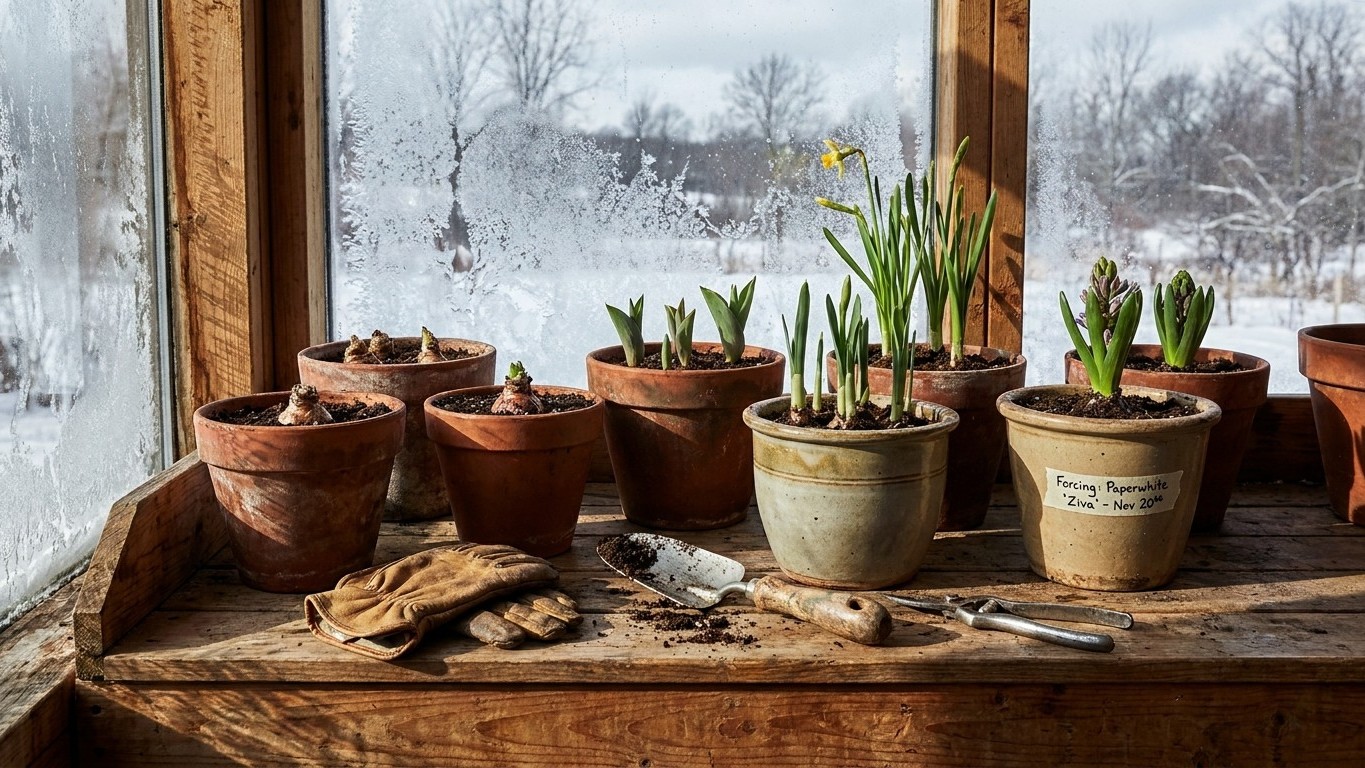

Forcing Spring Bulbs Indoors works reliably in Michigan, but the state’s cold isn’t the obstacle. Winter here already delivers more chill than any bulb needs. The real work is controlling where and how that cold reaches the bulb, especially once it’s sitting in a pot instead of the ground.
Why this matters in Michigan

The mean daily minimum temperature in Michigan’s coldest month sits at 19.2°F, based on the NOAA NCEI Climate Normals for 1991-2020 at the Detroit reference station. That’s not a record low or a fluke cold snap. It’s the average low, month after month, for the coldest stretch of winter. A spring bulb needs roughly twelve to fourteen weeks below 45°F to break dormancy and bloom. Michigan’s ground delivers that in spades, often starting in November and running well past the required window.
So this isn’t a territory short on cold. It’s a territory with a different problem entirely: containers. Soil in the ground freezes from the surface down, and below a certain depth it barely freezes at all, insulated by the earth around it. A pot has no such insulation. Surrounded by air on every side, a container freezes through, root ball and all, at temperatures the same bulb would shrug off if it were planted in a bed. That distinction matters because Michigan’s USDA hardiness zone, per the 2023 USDA Plant Hardiness Zone Map (built on 1991-2020 normals), ranges from 4a to 6b across the state. A bulb rated hardy for zone 5 ground can still die in a zone 5 container, because the pot itself behaves like a colder zone.
That range also means a Detroit gardener and someone in the northern Lower Peninsula are working with different baselines. The 19.2°F figure and the zone range both come from the Detroit reference station; conditions in the Upper Peninsula or along the Lake Superior shoreline run colder, sometimes by a full zone or more. Anyone using a specific planting or protection recommendation should treat Detroit as the benchmark and adjust conservatively if they’re farther north.
Forcing indoors, then, isn’t a workaround for insufficient cold. It’s a way to borrow the outdoor chill Michigan already has and aim it precisely, either to bring bloom indoors weeks before the garden wakes up, or to keep a container bulb alive through a winter that would otherwise freeze it solid.
How to do it here
The sequence below assumes you’re forcing bulbs for indoor bloom, using either a refrigerator or an unheated space on the property. Each step depends on something you can check yourself, not a guess about what “cold enough” means.
- Pick a bulb suited to forcing. Hyacinths, crocus, tulips, and dwarf daffodils are the standard choices. Skip anything that needs more than 16 weeks of cold unless you’re planning far ahead.
- Pot the bulbs in well-draining potting mix, with the tips at or just below the soil surface, and water thoroughly once.
- Find a cold storage spot that stays between roughly 35°F and 45°F. A refrigerator crisper drawer works, but keep it away from ripening fruit. Apples, pears, and other ripening produce release ethylene gas, and ethylene damages the flower bud inside a forced bulb before it ever gets the chance to open. An unheated garage can also work, but only if it reliably stays above freezing; a garage that dips below 32°F for extended stretches will freeze the potted soil solid, which stops the cooling process from doing its job and can kill the bulb outright.
- Leave the pots in cold storage for the full 12 to 14 weeks. Check the soil every couple of weeks and water lightly if it’s dried out; the mix should stay barely moist, never soggy.
- Watch for pale shoots one to two inches tall. That’s the signal the cold requirement has been met.
- Move the pot into indirect light at room temperature for the first few days, then into brighter light as the shoots green up. Full bloom typically follows within two to three weeks.
If the plan is to keep a potted bulb outdoors through winter rather than forcing it for indoor bloom, the container needs to behave like ground soil two hardiness zones colder than what the bulb is rated for, since a pot loses heat from every side. Given Michigan’s 4a-6b range, that means either sinking the pot into the ground up to its rim and mulching heavily, or moving it into an unheated garage or shed for the season. Leaving an exposed container outdoors on a patio through a Michigan winter is the single most common way a hardy bulb dies from cold it would have survived in a garden bed.
Which bulbs are worth it
Not every bulb pays back the effort of forcing. The ones that force well tend to share two traits: a relatively short cold requirement, and a stem that stays upright once it’s blooming in a pot rather than braced by garden soil and neighboring plants. Bulbs with long, thin stems that grow tall outdoors often flop over indoors, where there’s no wind resistance to strengthen the stem and no surrounding foliage to lean on.
Where a bulb is already a one-season purchase, forcing costs nothing in the long run. Paperwhite narcissus and most forced tulips are treated as disposable after their indoor bloom; they were never reliably going to rebloom outdoors in Michigan’s climate anyway, so there’s no perennial value being sacrificed.
- Crocus – short cold requirement, compact growth, rarely topples
- Hyacinths – strong, sturdy stems even indoors, reliable bloom timing
- Tulips (shorter varieties) – force well when the cold period is met fully
- Dwarf daffodils – compact size holds up better than standard trumpet types
- Paperwhite narcissus – need no cold period at all, bloom in a few weeks from potting
Some bulbs sulk, either refusing to bloom on schedule or producing flowers that can’t support themselves once they open.
- Standard trumpet daffodils – tall stems tend to flop in a pot without garden support
- Alliums – long cold requirements make timing unpredictable, and they rarely perform well as forced indoor bulbs
- Lilies – too tall and top-heavy for reliable indoor forcing
- Large-cupped daffodil hybrids – same flopping issue as trumpet types, worse with heavier blooms
What goes wrong, and when you can still fix it
Leaves but no flower
Green growth appears, but no bud ever forms. This almost always means the cold period was cut short, either because the bulb was moved out of storage too early or because the storage spot didn’t stay cold enough for the full stretch. There’s no fix for the current pot; the flower bud simply never finished developing. The bulb can sometimes be planted outdoors afterward to recover on its own timeline, but it won’t produce an indoor bloom this season.
Short stem, hidden bloom
The flower opens, but the stem barely clears the soil line, and the bloom sits low and cramped. This points to warming the bulb too fast after cold storage, usually by moving it straight into bright, warm light instead of easing it through a few cooler, shadier days first. This one can’t be reversed once the stem has set its height, but it’s not a lost bloom, just a shorter one than expected.
Rot in the pot
Soft, mushy bulb tissue and a sour smell mean standing water, almost always from a pot without adequate drainage or from watering too heavily during cold storage. Once rot sets in, the bulb is not salvageable. The only fix is prevention next time: drainage holes, a well-draining mix, and watering just enough to keep the soil barely moist rather than wet.