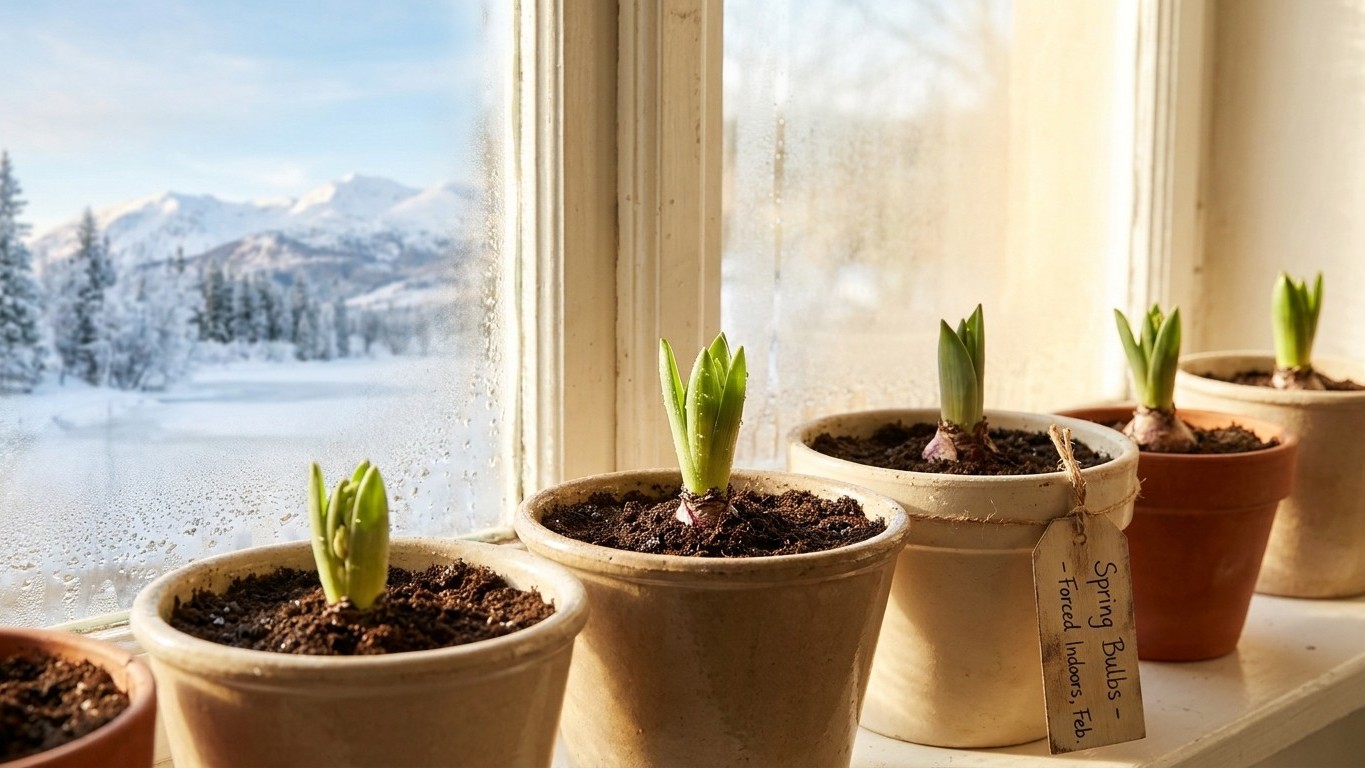

Forcing spring bulbs indoors works in Montana the same way it works anywhere: a chilled bulb, kept cold but not frozen, then brought into warmth and light on your schedule instead of nature’s. The twist here isn’t a shortage of cold. It’s the opposite. Winter supplies more of it than any potted bulb can survive unprotected, which changes how the chilling gets done.
Why this matters in Montana

The coldest-month average low at the NOAA NCEI reference station in Billings sits at 17.9°F, drawn from the 1991-2020 climate normals. That number does the real work of deciding what happens to a bulb here, more than any record cold snap or a single hard freeze. A spring bulb only needs a chilling period somewhere below 45°F to break dormancy. Montana’s ordinary winter runs a good 27 degrees colder than that threshold, for weeks at a stretch. There’s no deficit to make up.
That abundance is exactly the problem for anything sitting in a container outdoors. Garden soil has mass. It buffers a bulb planted a few inches down from the full swing of the air temperature above it, so a bed that experiences 17.9°F air doesn’t necessarily freeze solid at bulb depth. A pot has no such buffer. Once the soil in a container reaches the same temperature as the surrounding air, root and bulb tissue freeze together, and ice inside plant cells is usually lethal. This is why the USDA Plant Hardiness Zone Map (2023 edition, built on 1991-2020 normals) lists Montana across a 3a-6a range: a spread wide enough that a bulb rated hardy for an in-ground bed in the milder pockets of that range can still die outright in an unprotected pot anywhere in the state.
So the practical answer to “why force indoors here” isn’t that Montana lacks the twelve to fourteen weeks of cold a bulb needs. It’s that giving a potted bulb that cold outdoors, unprotected, risks freezing it past saving. Forcing indoors, using a refrigerator or an unheated garage that stays above freezing, delivers the same chilling window without the lethal exposure a bare pot would face sitting against a Montana winter. That distinction, cold supplied on purpose versus cold that arrives and freezes a container solid, is the whole reason this method exists as a separate approach from simply planting bulbs in a bed and letting the ground handle it.
How to do it here
The sequence below assumes you’re potting bulbs specifically to bloom indoors, not trying to overwinter a container outdoors. Each step depends on something you can check yourself, in your own garage or refrigerator, rather than a date on a calendar.
- Pot the bulbs before the ground freezes hard. Use a container with drainage holes and a standard potting mix, bulb tip up, spaced close enough to touch without stacking.
- Water once, thoroughly, then let the pot drain. The soil should be moist through the chilling period, never soggy.
- Move the pot to a space that holds steady temperatures between about 35°F and 45°F. An unheated attached garage often works if it stays above freezing on its coldest nights; check a thermometer left in the space rather than assuming, since outdoor lows averaging 17.9°F mean a detached or poorly insulated garage can drop well below the safe range.
- If using a refrigerator, keep the pot away from any ripening fruit. Apples, pears, and similar fruit release ethylene gas, which can damage or kill the flower bud forming inside a chilling bulb, even though the leaves may still emerge normally.
- Hold that cold, damp storage for 12 to 14 weeks, checking soil moisture every few weeks and adding water if the surface has dried out.
- If you’re instead trying to overwinter a potted bulb outdoors rather than force it indoors, the pot needs to be rated at least two hardiness zones colder-hardy than the bulb itself, or it needs to be moved against a foundation and mulched heavily. Given the state’s 3a-6a range, and given that conditions at the Billings reference station sit toward the colder half of that spread, don’t assume a zone rating that works for a garden bed will protect the same bulb in a container; check your own local zone rather than the state-wide range.
- Once the cold period is finished, move the pot to a cool, bright indoor spot, around 50-60°F, for one to two weeks before full warmth. This lets shoots green up gradually instead of stretching pale and weak.
- Shift to normal room temperature and full light once growth is a few inches tall. Flowers typically open within two to four weeks of that final move.
Which bulbs are worth it
Some bulbs reward the effort of forcing without much fuss. Others fight you the whole way, either because their cold requirement runs long or because their finished height makes them top-heavy in a pot. A bulb with a short chilling requirement moves through the process faster and tends to bloom on a sturdier, shorter stem, which is why the small early bloomers dominate the reliable list.
- Crocus, short cold requirement, compact and rarely flops
- Grape hyacinth (muscari), forces easily, stays low
- Hyacinth, dense flower spike, sturdy stem for its size
- Dwarf iris (Iris reticulata), very short, blooms fast once warmed
- Paperwhite narcissus, needs no chilling at all, blooms in two to three weeks from potting
- Amaryllis, also needs no chilling, blooms from a bare bulb in warmth alone
Paperwhites and amaryllis are worth noting for a different reason: neither is hardy anywhere in Montana’s 3a-6a range, so they were never going to survive outdoors after blooming regardless. Forcing them costs nothing in the long run. You’re not sacrificing a plant that could have naturalized in the garden; it was always a one-season purchase.
- Large trumpet daffodils, long stems that topple in a lightweight pot
- Tall Darwin or Emperor tulips, same top-heavy problem, plus a longer cold requirement
- Alliums, extended chilling period and height that outgrows most indoor containers
- Fritillaria, finicky about temperature swings and slow to reward the effort
What goes wrong, and when you can still fix it
Leaves, but no flower
This means the chilling period ran short, whether from a garage that dipped in and out of the safe range or a bulb pulled early. There’s no fixing it for the current pot; the flower bud simply never fully developed. If the bulb species is hardy in your part of the state, plant it out in a bed once the ground can be worked and let it recover over a season or two outdoors. If it’s a tropical one-season bulb like a paperwhite, it isn’t coming back either way.
Short stem, flower buried in the leaves
This is a warming problem, not a cold problem. Skipping the cool, gradual transition and moving a pot straight from cold storage into full warmth and light rushes the flower stalk before it can elongate properly. This bloom can’t be stretched out after the fact. Next time, hold the two-week intermediate stage at 50-60°F before full warmth.
Rot in the pot
Soft, mushy bulb tissue during the cold storage period almost always traces back to drainage that never worked, water sitting against the bulb for weeks in a container without adequate holes or with compacted soil. Once tissue has gone soft, there’s no rescue for that bulb this season. Discard it, check that the pot drains freely, and start the next batch with fresh mix and a container that actually lets water through.
Related guides
- Growing Spring Bulbs in Containers in Montana
- Forcing Spring Bulbs Indoors in Nebraska