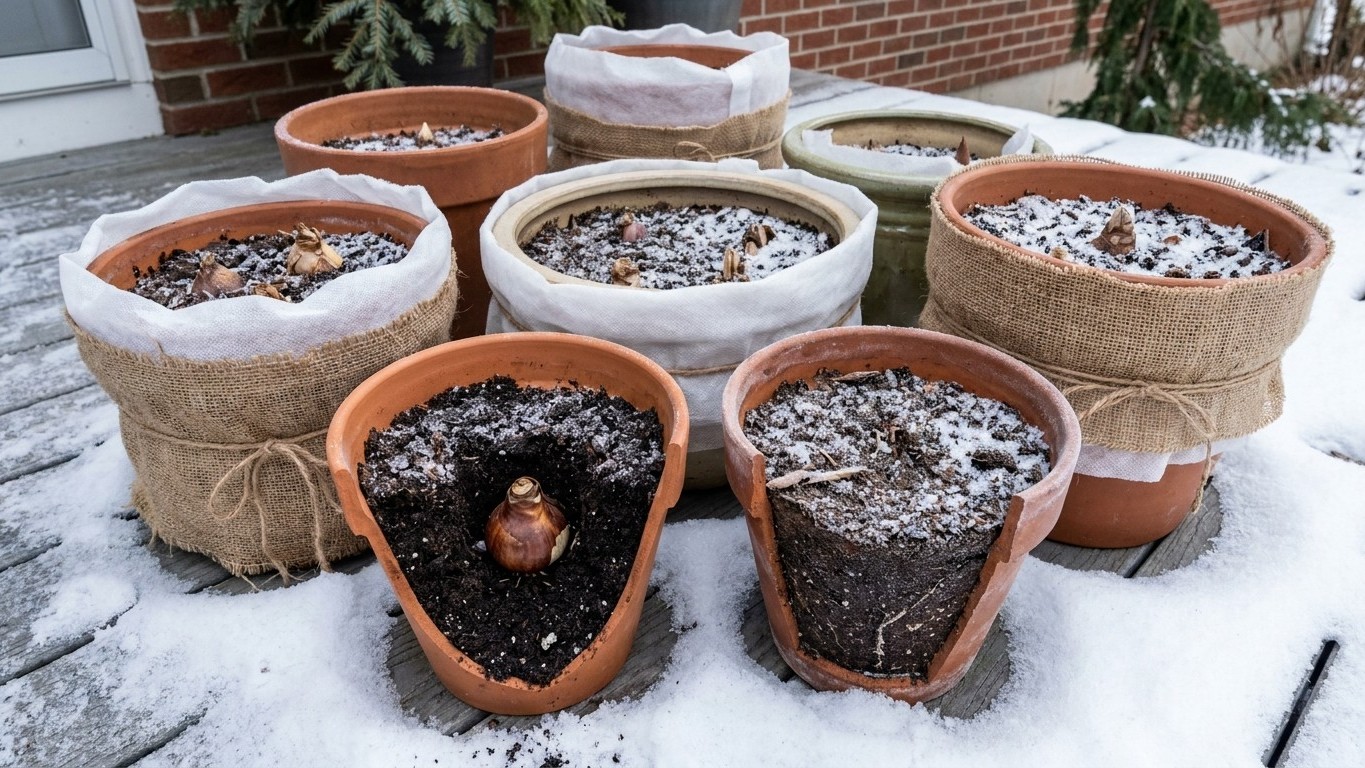

Spring bulbs can grow in containers in New Hampshire, but the same cold that keeps a garden bed’s bulbs alive can kill the identical bulb sitting in a pot, because a container has no surrounding soil mass to buffer a hard freeze. The fix is protection, not warmth: match the bulb to a hardier rating than the ground calls for, or move the pot somewhere the freeze can’t reach it whole.
Why this matters in New Hampshire

The mean daily minimum temperature during the coldest month at the Manchester reference station runs 17.1°F, based on NOAA NCEI Climate Normals for 1991-2020. That’s not a record low, it’s the average low night of an average January, and it tells you something specific: New Hampshire winters deliver far more than the twelve to fourteen weeks below 45°F a spring bulb needs to break dormancy. Forcing, the practice of manufacturing that cold in a refrigerator because winter won’t provide it, isn’t a necessity here. The chill requirement takes care of itself between November and March in most years.
The problem containers introduce is a different one entirely, and it has nothing to do with how much cold arrives. A bulb planted in the ground sits under a foot or more of soil that acts as insulation; the surface may freeze hard, but the bulb a few inches down often doesn’t experience anything close to the air temperature above it. A bulb in a container gets no such buffer. The pot is exposed on every side above grade, so when air temperatures drop, the entire root ball, soil and bulb included, can freeze straight through. That’s a mechanical difference, not a matter of degree.
USDA hardiness zones across New Hampshire span 3b to 6a, according to the USDA Plant Hardiness Zone Map built on 1991-2020 normals. That’s a wide range for one state: the North Country runs colder, the Merrimack Valley near Manchester sits milder, and the zone rating that applies to your specific yard depends on where in that range you fall. But every one of those zone numbers assumes in-ground planting. A tulip bulb rated hardy to zone 5 is rated for a zone 5 winter in the earth, not in a pot sitting on a deck where the freeze-through effect can drop the bulb’s actual experience two zones colder or more. That gap is the whole reason container growing in this state needs its own set of rules rather than borrowing the ones written for garden beds.
How to do it here
The method below treats New Hampshire’s abundant natural cold as a given and focuses on the one thing a garden bed handles automatically but a pot does not: keeping the bulb from freezing solid.
- Check the hardiness rating printed on the bulb package or supplier listing, then choose bulbs rated at least two zones hardier than your ground zone. If your yard sits in zone 5a, look for bulbs hardy to zone 3, since the container will expose them to colder effective conditions than the same spot in open soil.
- Plant in a container with drainage holes, using a material with some insulating mass, glazed ceramic, wood, or thick foam-insulated plastic, rather than thin terracotta, which offers almost no buffer and can crack when the soil inside freezes and expands.
- Give the potted bulbs their twelve to fourteen weeks below 45°F without letting the pot freeze through solid: move it into an unheated garage or attached shed that stays above freezing rather than leaving it exposed on an open porch or deck rail.
- If no unheated garage or shed is available, sink the entire pot into a garden bed or cold frame up to its rim and mound mulch over the top, or store it in a refrigerator drawer, keeping it away from apples, pears, or other ripening fruit, since the ethylene gas they release can kill the flower bud forming inside the bulb.
- Check soil moisture roughly once a month through winter. Potting mix that’s gone bone dry needs a light watering; it should never be soggy.
- Bring the container back into open light once nighttime lows reliably stay above the mid-20s, and resume regular watering as shoots emerge.
Which bulbs are worth it
Not every bulb pays back the extra handling a container demands. The ones that force and overwinter reliably tend to share two traits: a shorter cold requirement and a compact stem that doesn’t need staking once it’s up. The ones that sulk are usually tall, slow to chill, or resentful of the disturbance a pot represents compared to open ground. For a bulb that’s a one-season purchase anyway, meaning it was never going to reliably perennialize in a New Hampshire container regardless of technique, the calculus changes: it costs nothing in the long run to force it hard for one good bloom.
Reliable in a New Hampshire container
- Crocus, short cold requirement, low stem, rarely topples
- Grape hyacinth (muscari), compact and forgiving of a shortened chill period
- Species and botanical tulips (smaller than Darwin hybrids), shorter stems hold up in wind
- Daffodils, standard varieties, dependable bloom even after imperfect chilling
- Snowdrops, among the earliest to break dormancy, low profile in a pot
Bulbs that sulk in containers
- Darwin hybrid and tall tulips, top-heavy stems topple in wind and rarely rebloom well the second year anyway, so treat as a single-season purchase if you use them at all
- Fritillaria, resents root disturbance and container confinement, inconsistent bloom
- Large ornamental alliums, tall flower heads catch wind and pull shallow-rooted pots over
What goes wrong, and when you can still fix it
Leaves come up, no flower
This means the cold period was cut short, whether by an unusually mild stretch in an unheated garage or by bringing the pot indoors too soon. There’s no fix this season, the bulb has spent its stored energy on leaves instead of a bloom. Next year, track the weeks the pot actually spends below 45°F and hold it there the full twelve to fourteen weeks before warming it.
Flower on a stem too short to see
A stunted stem usually means the pot was warmed too fast after its cold period, so the flower stalk never got the chance to elongate before the bud opened. This season’s bloom is what it is; there’s no rescuing that stem once it’s opened short. Next time, move the pot to a cooler intermediate spot for a week or two before bringing it into full warmth and light.
Rot at the base of the bulb
Soft, dark, foul-smelling tissue at the base means water sat around the bulb instead of draining through, usually because the container lacked drainage holes or the potting mix packed down and stopped percolating. A rotted bulb can’t be saved this season. What can be fixed is the setup for next time: drill or choose drainage holes, and use a mix formulated to drain rather than standard garden soil, which compacts inside a pot far more than it does in open ground.