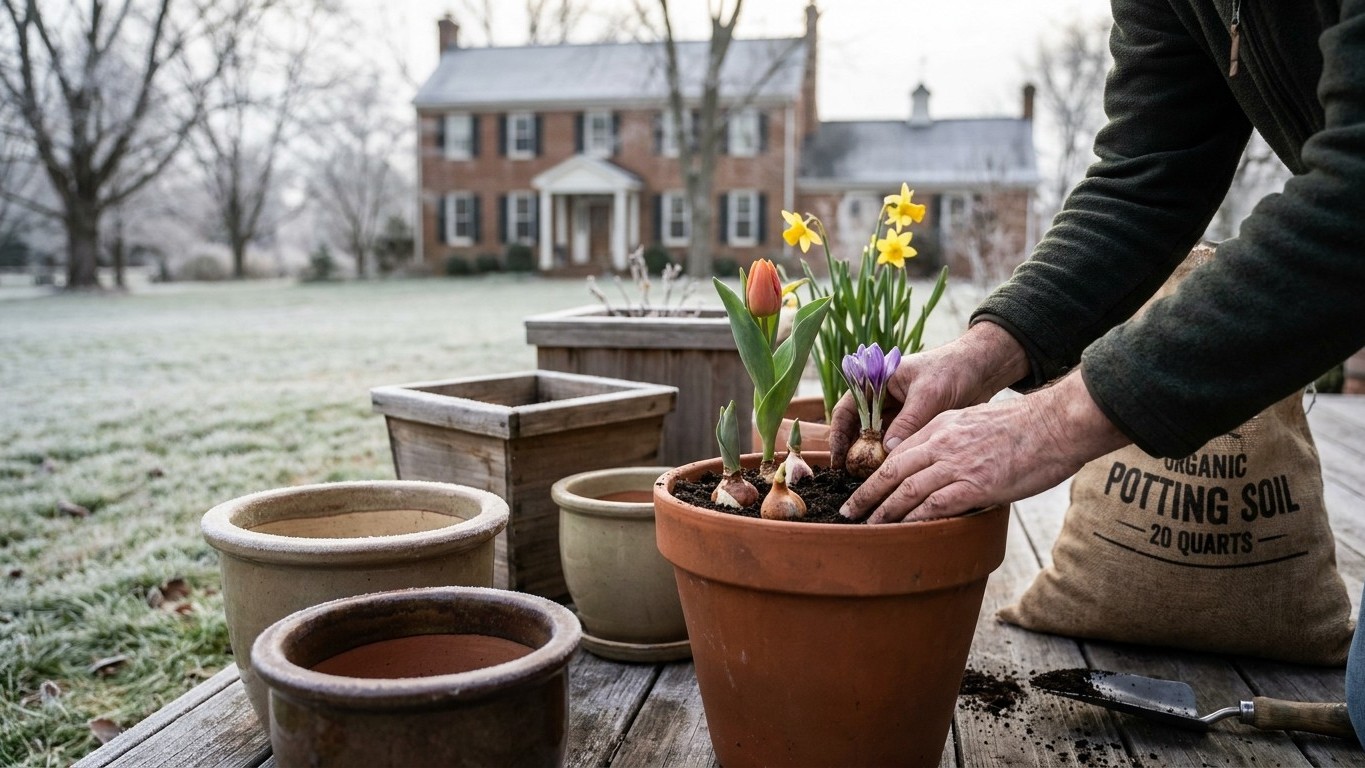

Spring bulbs grow well in containers across New Jersey, but the real obstacle isn’t winter cold; the state has plenty. It’s that a pot freezes solid, roots and all, while the same bulb planted in the ground stays insulated by surrounding soil. That single difference changes which zone rating actually applies, how deep to plant, and where the container needs to sit once temperatures drop.
Why this matters in New Jersey

The mean daily minimum in the coldest month at Newark runs 25.5°F, according to NOAA NCEI Climate Normals for 1991-2020. That’s not the record low for the season, it’s the average low across the coldest month, and it sits far under the 45°F threshold that spring bulbs need to satisfy their chilling requirement before they’ll flower. Bulbs generally need something like twelve to fourteen weeks under that mark to break dormancy properly. At 25.5°F as a coldest-month average, New Jersey clears that bar with room to spare, for months at a stretch, not just a few cold snaps.
That figure settles one question before it’s even asked: forcing, in the sense of manufacturing cold that winter refuses to provide, isn’t the problem here. Gardeners in mild coastal California or the Deep South sometimes have to fake a New Jersey winter in a refrigerator drawer. New Jersey already has one.
What New Jersey does have is the container problem, and it’s a different mechanism entirely. USDA hardiness zones, built on the average annual extreme minimum temperature, place the state across a 6a to 7b range on the 2023 Plant Hardiness Zone Map. Newark itself sits in that range but the map covers the whole state, and a bulb bed in the Pine Barrens or the northwest highlands can sit in a noticeably colder pocket than one near the shore. That zone number describes what happens to a bulb sitting three feet down in undisturbed earth. A container sitting on a deck or a porch step doesn’t get that protection. The soil mass in a pot is small, it’s exposed on every side, and it tracks the air temperature far more closely than garden soil does. A bulb rated hardy to zone 6a in the ground can die in a container in the same yard, because the pot effectively behaves like a colder zone than the address it’s sitting in.
So the practical answer for New Jersey containers isn’t about supplying more cold. It’s about managing where that cold reaches the pot, and how fast.
How to do it here
The sequence below treats New Jersey’s winter as the asset it is and works around the one weak point, which is the pot itself.
- Pick bulbs rated at least two zones hardier than your actual zone. If a container sits in a spot that reads as zone 6b on the state map, choose bulbs rated to zone 4, not zone 6, since the pot will run colder than the ground around it.
- Use a container with real drainage and enough mass. A pot under about 12 inches across freezes through faster than a larger one; more soil volume buys the roots a little more buffer against a hard freeze.
- Plant slightly shallower than a garden bed but mulch the top. A two- to three-inch layer of mulch or leaves over the container’s soil surface slows how fast frost reaches the bulbs underneath.
- Let the container sit outside through the natural cold season. New Jersey’s winter already supplies the weeks below 45°F a bulb needs; there’s no reason to move it indoors early.
- Move the pot once temperatures threaten to freeze it solid for an extended stretch. An unheated garage that stays reliably above freezing works, or sinking the whole pot into a garden bed and mulching over it, using the surrounding earth as the insulation the container lacks on its own.
- If forcing an early indoor bloom is the goal instead, chill the potted bulbs in a refrigerator drawer, away from any ripening fruit, since the ethylene gas fruit gives off damages the flower bud forming inside the bulb.
- Bring the pot into warmth gradually once the chilling period is complete, rather than moving it straight from cold storage into a heated room.
Every step above is something a gardener can check without special equipment: a thermometer for the garage, a look at the pot’s diameter, a finger test on the mulch layer.
Which bulbs are worth it
Not every spring bulb pays off in a container. The ones that force reliably tend to share two traits: a shorter cold requirement, and a stem short enough to stay upright without staking. The ones that sulk usually fail on one of those same two points, either resenting a shortened chill period or toppling out of a lightweight pot once they hit full height.
It’s also worth remembering that many tulip varieties are treated as a one-season purchase even in garden beds, since they rarely rebloom with the same vigor their second year. In a container, that math doesn’t change. Using them for a single strong display costs nothing in the long run, because they weren’t going to come back regardless.
- Crocus
- Grape hyacinth (muscari)
- Dwarf daffodils and narcissus
- Hyacinths
- Short or dwarf tulip varieties
Bulbs that tend to disappoint in pots:
- Tall trumpet daffodils (top-heavy in a lightweight container)
- Standard-height tulips (prone to toppling once in bloom)
- Fritillaria (finicky about cold timing and drainage)
- Alliums (tall, heavy flower heads unbalance most pots)
What goes wrong, and when you can still fix it
Leaves but no flower
This means the cold period was too short. The bulb had enough energy to push up foliage but the flower embryo inside never finished developing. There’s no fix for this season; the bloom simply isn’t coming. Next winter, leave the container in place through the full stretch of cold New Jersey naturally provides before moving or forcing it.
A flower buried low in the foliage, stem too short to see
This is a warming problem, not a cold one. The bulb was brought out of storage or cold exposure too fast, and the stem never had time to elongate before the flower opened. Once it’s happened, there’s nothing to reverse this season. The correction is timing: bring pots into warmth gradually over several days rather than moving them straight from a cold garage or refrigerator into a heated room.
Soft, mushy bulbs in a wet pot
This is drainage failure, not a cold or timing issue. Waterlogged soil starves the roots of oxygen and lets rot organisms take hold. There’s no saving bulbs once they’ve gone soft; they need to be discarded. For the next planting, use a container with real drainage holes and a mix that doesn’t stay saturated, since a pot with nowhere for water to go will rot bulbs long before winter cold ever becomes the issue.