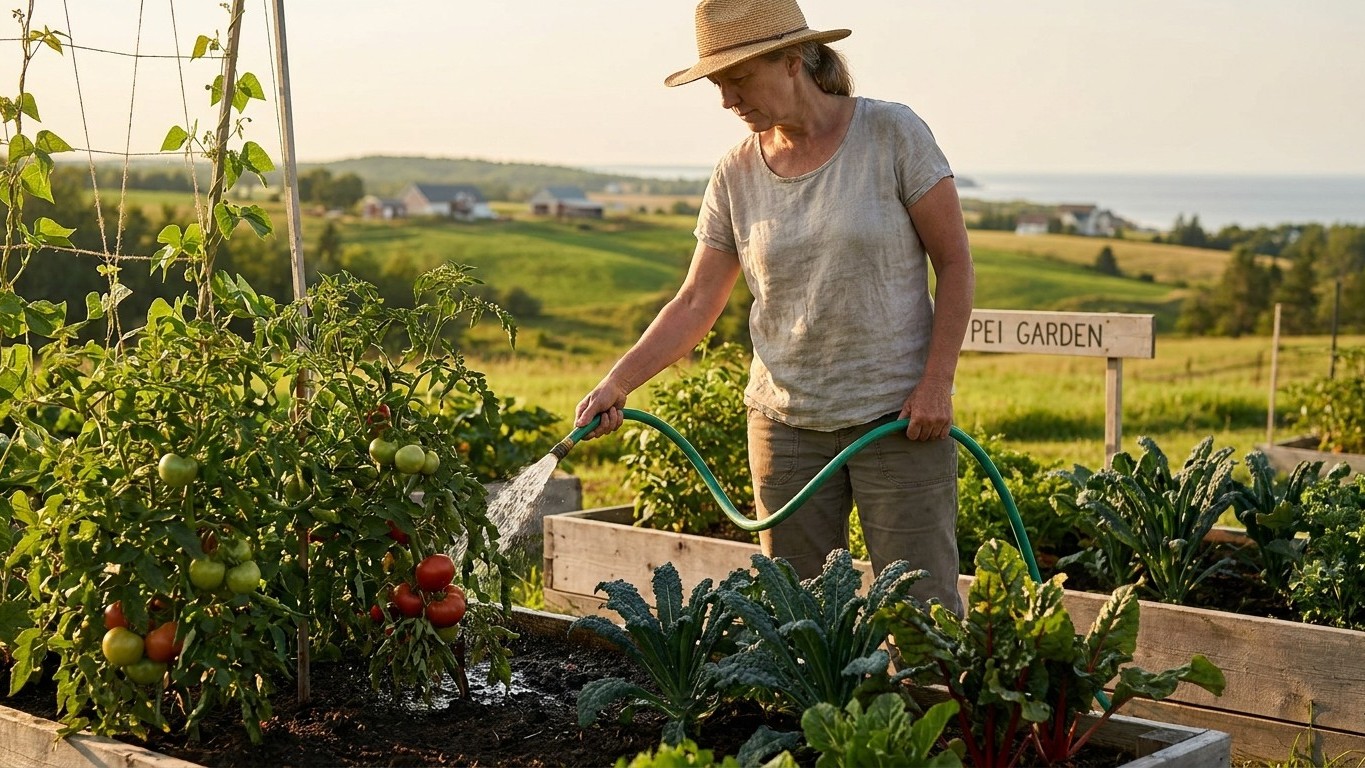

Prince Edward Island almost never bakes: the island averages 0.0 days a year at or above 90F, and even its driest summer month, July, still drops 3.15 inches of rain. That combination means a dry spell here is more about timing than survival. A garden bed still wants close to an inch of water a week, but the sky rarely fails a PEI gardener outright, it just spaces its help unevenly across the month.
What changes here

Start with the two numbers that decide everything about watering on Prince Edward Island: July, the driest month of the summer, brings 3.15 inches of rain, and the island averages 0.0 days a year at or above 90F. Together they say something useful for anyone standing over a wilting row of beans: PEI’s dry spells run low on heat load and reasonably high on rainfall, but they still leave real gaps a gardener has to fill by hand.
Run the arithmetic on that July figure. A vegetable bed generally wants about an inch of water a week to keep growing without stress. Spread 3.15 inches evenly across July’s 31 days and the sky delivers roughly 0.71 inch in an average week, close to three-quarters of what the bed asks for. The remaining 0.29 inch, the part a hose or watering can has to supply, sounds small, but it’s the difference between a bed that coasts through July and one that stalls just as tomatoes are setting fruit.
That figure assumes the rain falls in useful, steady doses. It rarely does. Summer rain on the island often arrives as a single thunderstorm dumping most of a week’s total at once, then nothing for days. A downpour that drops half an inch in twenty minutes can run straight off compacted soil or a sloped bed instead of soaking down to root depth, so the weekly average hides real dry stretches even in a month that looks wet on paper.
Soil texture decides how far that inch travels once it lands. Much of PEI’s cropland sits on the red, sandy loam the island is known for agriculturally, ground that drains fast and lets water through within a day rather than holding it. Where a garden sits on heavier clay, often in low-lying or inland spots, the same rain can sit in the root zone for the better part of a week. A gardener on sandy ground should plan to water more often in smaller amounts; a gardener on clay can wait longer between soakings, and risks doing more harm by watering too soon than by waiting an extra day.
How to water when it matters
The method that works on Prince Edward Island is the same one that works everywhere dry spells show up: water deeply and infrequently, at the base of the plant, in the morning. Each part of that has a reason tied to what’s happening underground and in the leaf.
A deep soak pushes water several inches down, which pulls roots down with it. Roots grow toward moisture, so a plant watered lightly every day never bothers sending roots deeper than the top inch of soil, exactly where the ground dries out fastest once a real dry spell sets in. Water at the base rather than overhead because wet leaves sitting through a cool, humid PEI evening are an open invitation to fungal disease, something the island’s damp maritime air already makes more likely than in drier inland climates. Morning watering lets splashed foliage dry before nightfall and lets the plant take up water before the day’s evaporation gets going, even on an island that almost never sees serious heat.
Checking the soil matters more than checking the sky. A finger pushed two inches into the bed, or a trowel lifted at the edge of a row, tells a gardener whether the root zone is actually dry. Surface soil can look and feel parched an hour after watering while two inches down stays moist, and the reverse happens too: a dark, damp-looking surface can hide dry soil just below it.
Texture changes the rhythm, not just the amount. Sandy PEI soils hold little water and drain fast, so they need shorter, more frequent soakings, maybe every three or four days in a dry stretch. Heavier clay holds a week’s worth of water at once, and watering it again before it has had the chance to dry pushes air out of the soil and starts drowning roots rather than feeding them.
A number to start from: about 0.75 inch of water, delivered in one soak, once or twice during a dry week in July. That’s a starting point built from the region’s average rainfall gap, not a rule, check it against your own bed with the finger test and adjust from there.
- Push a finger or trowel two inches into the soil before watering; if it’s dry at that depth, water now.
- Water at the base of the plant, at the soil line, never over the leaves.
- Water in the early morning, before mid-morning sun starts pulling moisture back out.
- Give about 0.75 inch per session on sandy ground every three to four days, or the same amount less often, roughly once a week, on clay-heavy ground.
- Spread two to three inches of mulch around the base to slow evaporation between soakings.
What goes wrong
Most watering mistakes on Prince Edward Island trace back to one thing: treating the island like a hotter, drier place than it actually is. With no days a year reaching 90F, the pressure to water aggressively just isn’t there the way it is further south, and the failures that show up here tend to run in the opposite direction from what a gardener in a hot, arid state would expect.
A daily sprinkle that keeps roots shallow
A few minutes with the hose every evening feels responsible, but it wets only the top inch of soil. Roots follow the water, so they stay shallow, and a shallow-rooted plant is the first to wilt the moment a real dry stretch, even a mild PEI one, arrives.
Watering the leaves in the evening
Overhead watering after dinner leaves foliage wet through a cool, humid night, and PEI’s maritime air is already damp enough to favor fungal disease on tomatoes and squash without any help. Water splashed on leaves at dusk rarely gets the chance to dry before morning.
Trusting a rain shower that only wet the surface
A ten-minute downpour looks like watering got done for the week. Often it dropped a quarter inch that darkened the surface and nothing more. The only way to know for sure is the same finger test used before hand-watering, checked after rain, not instead of it.
Drowning a bed that never had the chance to dry
This is the mistake that costs the most on the island itself. Between steady average rainfall and clay-heavy ground in many low-lying spots, a bed watered on a fixed schedule regardless of what the soil is doing can stay soaked for days at a time. Waterlogged roots suffocate for lack of oxygen just as surely as dry roots starve for lack of water, and on PEI’s cooler, wetter ground that failure is worth watching for more than heat stress ever is.
Local help
For guidance suited to island growing conditions, from soil health to seasonal planting advice, PEI’s provincial agriculture office keeps a resource hub at the Prince Edward Island agriculture portal. Watering restrictions during dry stretches aren’t uniform across the island; they’re set district by district by individual water utilities and municipalities, so check with your own water provider or municipal office before assuming any particular rule applies to your address.
Common questions
Does Prince Edward Island get hot enough to need heavy watering?
Not for heat alone. The island averages 0.0 days a year at 90F or above, so evaporation demand stays modest compared with hotter provinces and states. The need to water still exists because rainfall, even in the wettest week, doesn’t always land as a steady, useful inch.
How much water does a garden bed need during a PEI dry spell?
Aim for close to an inch a week total. In July, the island’s driest summer month, the sky supplies roughly 0.71 inch of that in an average week, leaving about 0.29 inch for the gardener to add, more on sandy soil, less on clay that holds moisture longer.
What time of day should I water on PEI?
Early morning. It lets water soak in before the day’s mild evaporation starts and lets any wet foliage dry out before evening, cutting down on the fungal disease risk that PEI’s humid maritime air already encourages.
Are there watering restrictions on Prince Edward Island?
They vary by municipality and water utility rather than applying island-wide. Check with your own local water provider for current rules before settling into a fixed watering schedule.