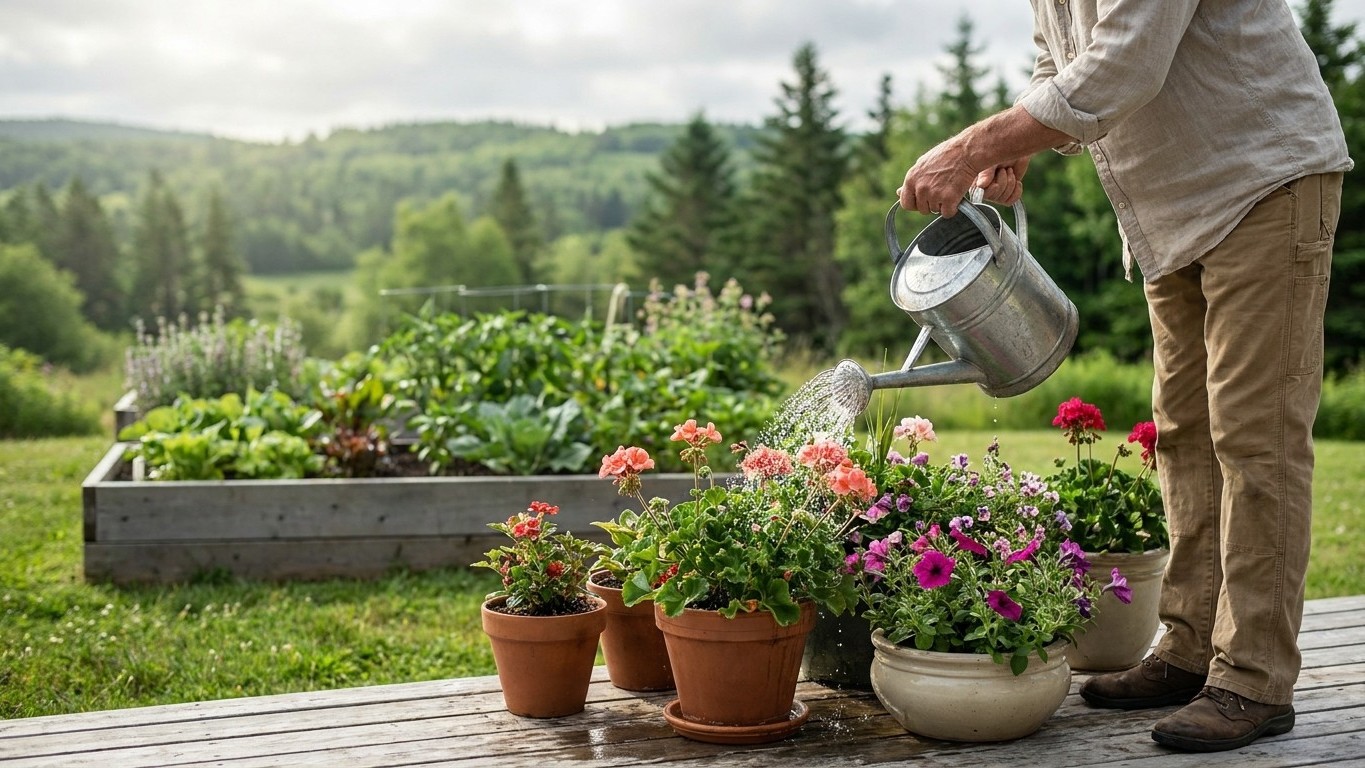

Nova Scotia gardeners get less punishing heat than most of the country, but that doesn’t mean Containers and beds take care of themselves. Zero days a year hit 90F here, and summer rain averages 11.2 inches across June, July and August. That combination changes when you water and how much you carry in a can, not whether you need to.
What changes here

Two numbers do the heavy lifting for this territory. August, the driest summer month at the Halifax Stanfield reference station, gets 3.68 inches of rain. And the region logs 0.0 days a year at or above 90F. Put together, that’s a plain signal: rain does most of the work here, and the heat load that usually forces a gardener’s hand almost never shows up.
Do the arithmetic and it gets more useful. A vegetable bed or a border wants roughly an inch of water a week. Spread August’s 3.68 inches over that month’s roughly 4.3 weeks, and the sky is already delivering about 0.86 inch a week on average. That leaves a gardener carrying maybe 0.14 inch a week themselves, a small top-up rather than a full ration, and only in the driest of the three summer months. June (3.79 inches) and July (3.76 inches) run slightly ahead of August, so the shortfall in those months is even smaller.
The heat side of the equation matters just as much. With 0.0 days above 90F, evaporation demand stays modest most of the summer, which means the textbook “inch a week” rule was written with hotter, drier places in mind. In a Nova Scotia yard it can overstate what plants actually pull from the soil. That’s not an excuse to skip watering, it’s a reason to check the ground before assuming it needs anything.
Soil texture still decides how far that rain goes. A sandy bed lets water drain through within a day, so even a wet summer week can leave the root zone dry again quickly. A heavy clay bed holds the same rain for a week or more, which is good news during a dry stretch but bad news if a gardener adds more water on top of ground that hasn’t drained. Neither figure was tracked at a fixed reference point for this page, so treat your own plot, not a regional average, as the deciding factor.
How to water when it matters
The method that works in a region with mild heat and steady summer rain is the same one that works everywhere, but the rhythm shifts because the sky is doing more of the job. Deep, infrequent watering at the base of the plant, done in the morning, beats a light daily sprinkle for one mechanical reason: it pushes moisture down to where roots actually live, rather than keeping them shallow and exposed near the surface.
Morning watering matters because leaves that go into the evening wet stay wet overnight, and that damp window is exactly when fungal disease takes hold. Watering early gives foliage the whole day to dry.
Checking the soil rather than guessing is what makes the whole approach work in a place where rain is frequent but uneven. A finger or a small trowel pushed two inches down tells you more than looking at the surface ever will. If that depth is dry, water. If it’s still damp from the last rain, wait, even if the top crust looks dusty.
Soil texture changes the schedule more than it changes the method:
- Sandy soil holds little water and drains fast, so it asks for shorter soakings more often, even in a wet Nova Scotia summer.
- Clay-heavy soil holds a week’s worth of rain or more, so watering on top of ground that hasn’t drained is how roots drown, not how they thrive.
Here’s a practical sequence to start from, then adjust against your own soil:
- Push a finger or trowel two inches into the soil near the plant’s base before deciding to water at all.
- If that depth is dry, water deeply and slowly at the base until the top six inches are moist, roughly the equivalent of half an inch to an inch delivered in one session.
- Water in the early morning, before the heat of the day, so foliage dries within hours rather than sitting wet overnight.
- Space sessions further apart on clay soil and closer together on sandy soil, checking depth each time rather than watering on a fixed calendar.
- During August, the region’s driest summer month, expect the sky to supply most of a bed’s needs and use the finger test to catch the gap rather than adding a full inch on top of what already fell.
What goes wrong
“I water a little every day, just to be safe”
This is the most common mistake in a region where rain feels frequent enough to make gardeners nervous about missing a day. A light daily sprinkle wets only the top inch or two of soil, which trains roots to stay shallow near the surface. Those roots then bake the moment a dry stretch actually hits, even a short one, because they never grew deep enough to reach water that’s still there lower down.
“It rained, so I don’t need to check”
A summer shower can look convincing and still only wet the top half-inch of soil, especially if it fell fast and ran off rather than soaking in. With 0.0 days above 90F, evaporation isn’t the threat here, but a quick storm followed by a stretch of dry, mild days can leave the root zone thirsty while the surface still looks dark and damp. The finger test settles it; the sky’s performance doesn’t.
“The bed’s already wet, a little more won’t hurt”
Given how close summer rainfall runs to what most beds need, roughly 11.2 inches against a target near 13 inches across the season, the bigger risk in this territory is overwatering, not underwatering. Adding water to clay soil that’s already holding last week’s rain pushes air out of the root zone, and roots that can’t get oxygen behave the same as roots that are too dry, they wilt and eventually rot.
“I don’t bother with mulch, it’s not that hot here”
Skipping mulch matters less for heat control in a region with no 90F days, but it still costs a gardener moisture retention and weed suppression between the region’s regular rain events, and it leaves bare soil to crust over, which makes the next watering session run off instead of soaking in.
Local help
For soil testing, planting calendars and season-specific guidance, the Nova Scotia Department of Agriculture is the province’s extension-style resource. Watering restrictions vary by municipality and water district and change with drought conditions, so check current rules with your own municipal water provider before setting a summer watering schedule.
Common questions
Does Nova Scotia’s cool summer mean containers need less water than beds?
No, containers typically need more frequent watering than in-ground beds regardless of regional climate, because they hold far less soil volume and dry out faster, especially in wind. Check container soil daily during dry stretches even when regional rainfall looks generous.
Is August really the driest month to plan around?
Based on the 1981-2010 climate normals for the Halifax Stanfield reference station, yes: August averages 3.68 inches, slightly below June’s 3.79 and July’s 3.76. The difference between the three months is small enough that a gardener’s own rain gauge matters more than the calendar.
Why doesn’t the “0.0 days above 90F” figure mean I can skip watering?
That figure measures heat stress, not overall water need. Plants still lose moisture through transpiration on mild, sunny days, and uneven summer rain can still leave gaps between showers even without extreme heat.
How do I know if my soil is sandy or clay-heavy without a lab test?
Squeeze a handful of moist soil: if it crumbles apart immediately, it leans sandy; if it holds a sticky, ribbon-like shape, it leans clay. That quick check tells you more about your own watering rhythm than any regional average.