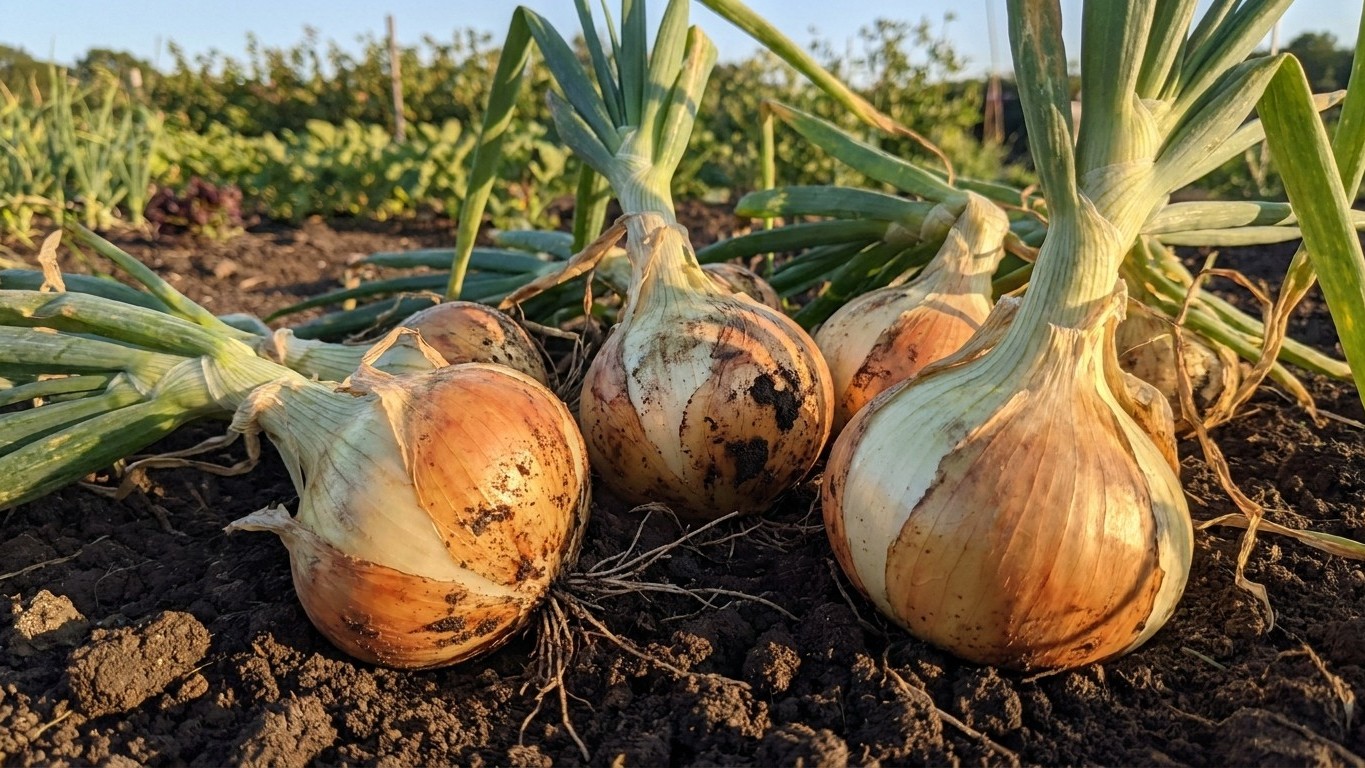

Rhode Island sits far enough north that its onions need long summer daylight to bulb, not warm soil. At 41.72 degrees north, Providence sees 15 hours and 2 minutes of daylight on the longest day of the year, well past the point where long-day onions start building a bulb instead of leaves. That single number rules out an entire category of onions sold everywhere, and it opens the door to a much longer one. Here’s which onions actually reach harvest in this state, and which ones just sit there growing tops.
The short answer for Rhode Island

Rhode Island’s growing season runs on daylight, not on the calendar. Providence, the reference station for the state’s climate data, sits at 41.72 degrees north latitude, and on the summer solstice the sun stays up for 15 hours and 2 minutes. That number decides which onions will actually form a bulb in a Rhode Island garden. Onions don’t bulb because the weather warms up. They bulb when day length crosses a threshold that’s bred into the variety, and nothing else moves the switch.
Long-day onions need 14 to 16 hours of daylight before they stop making leaves and start making a bulb. Rhode Island’s solstice day clears that bar with room to spare, which makes long-day varieties the safest bet across the entire state. Intermediate-day types, which trigger closer to 12 to 14 hours, also do well here. They bulb a little earlier in the season, which gives the plant less time to bulk up first, but they still finish reliably in a Rhode Island garden.
Nineteen varieties documented for this latitude have a published range that covers 41.72N:
- Long-day: Ailsa Craig, Barolo, Blush, Bridger, Frontier, New York Early, Patterson, Red Carpet, Rossa di Milano, Walla Walla Sweet
- Intermediate-day: Cabernet, Calibra, Elsye, Expression, Monastrell, Red Long of Florence, Red Long of Tropea, Scout, Sierra Blanca
That’s a wide bench, and it splits neatly along the lines that matter most to a home gardener: storage keepers on the long-day side, sweeter and more colorful options mixed into the intermediate-day side. Neither group is a compromise here. Both were built for exactly the amount of daylight Rhode Island’s summer provides.
What will not work here
Plant a short-day onion in a Rhode Island garden and it will grow thick, healthy green tops all summer. It will not make a bulb worth harvesting. Short-day varieties are bred to start bulbing once daylight reaches roughly 12 hours, a threshold Rhode Island’s spring days cross before the plant has built any real size. In the Deep South, that timing works because the growing season begins in fall, giving the plant months to bulk up before the short days of late winter trigger bulbing. Planted in a Rhode Island spring, the same variety hits that 12-hour mark while it’s still a seedling with a handful of thin leaves. The bulb forms anyway, but there’s nothing behind it. The payoff is a marble instead of a fist-sized onion, and that’s a variety mistake, not a soil or watering problem.
Eight varieties documented for this latitude fall into that trap:
- Candy (intermediate-day, published 33-40N): its range tops out below Rhode Island’s latitude, so it bulbs before the plant catches up in size
- Gabriella (short-day, 20-35N): a warm-climate variety with no runway this far north
- Madalyn (short-day, 20-35N): bred for winter growing well south of this latitude
- Red Rock (short-day, 30-36N): triggers bulbing far too early here
- Red Sensation (short-day, 25-35N): built for the Gulf Coast and desert Southwest
- Texas Grano 1015Y (short-day, 25-35N): needs a fall planting and a mild winter Rhode Island doesn’t offer
- Vidora (short-day, 25-35N): same short-day ceiling as the others
- White Castle (short-day, 30-38N): still rated well below what this state needs
None of these are bad onions. They’re onions built for a different latitude, and a seed rack rarely explains that clearly. Skipping this whole group is the single biggest favor a Rhode Island gardener can do for their harvest.
What changes across Rhode Island
Rhode Island is compact, and that works in a gardener’s favor here. The distance from the Block Island shoreline to the Massachusetts border amounts to less than a degree of latitude, which is a fraction of what a state like Maine or California has to account for. Providence, at 41.72N, is a reasonable stand-in for nearly the entire state, and the day-length figures above apply almost unchanged whether the garden sits in Westerly or Woonsocket.
The one place it’s worth a second look is the northern edge of the state, up near the Massachusetts line. Four varieties sit in a blurred zone right around this latitude: Powell (long-day, 43-47N), Redwing (long-day, 43-65N), Safrane (long-day, 42-50N), and Talon (long-day, 42-50N). Their published ranges start just a degree or so above Providence’s 41.72N, which means a garden near the state’s northern edge is close enough to that lower boundary that these varieties may bulb reliably there, while a garden closer to the coast is a touch further from their comfort zone. None of the four are ruled out for Rhode Island. They’re simply varieties where a gardener near the state line is standing right at the edge of the published range, rather than comfortably inside it the way the main list of 19 varieties is.
Coastal moderation is the other small factor. Gardens near Narragansett Bay tend to warm a little slower in spring and cool a little slower in fall than inland spots, which can shift planting and harvest by a week or so without changing which varieties are appropriate. Day length doesn’t care about the ocean. Frost dates do.
Sweet now, or onions that last
Every Rhode Island gardener growing onions ends up choosing between two pantries: one full of onions that taste great in July and are gone by September, and one full of onions sharp enough to make you cry that are still solid in March. That’s not a matter of luck or storage technique. It comes down to chemistry. The compounds that give an onion its bite are volatile sulfur compounds, and those same compounds are what protect the bulb from breaking down in storage. A sweet variety simply has fewer of them, and there’s no way to store around that fact, according to University of Missouri Extension guidance on onion growing and storage.
Among the varieties suited to Rhode Island, that trade-off shows up clearly. Long-day varieties like Patterson, Red Carpet, and Ailsa Craig lean toward the sharper, longer-keeping end, the kind that will still be good in a cool basement or root cellar deep into winter. Walla Walla Sweet is the exception worth flagging directly: it’s a long-day variety, but it’s bred and prized for sweetness, not storage, so it belongs on the eat-soon side of the ledger despite qualifying for Rhode Island’s day length. Several of the intermediate-day options, including the Red Long of Florence and Red Long of Tropea types, also trend toward milder flavor and a shorter shelf life.
The practical move is to plant both. Put in a run of sharp, long-day keepers for the pantry, and grow a shorter row of something milder for slicing fresh through late summer. That way the March onion drawer isn’t empty, and the July sandwich isn’t stuck with something that bites back.
Checking this against your own garden
Everything above is built on Providence’s latitude and its 15-hour-2-minute solstice day. A garden a few miles inland, near the coast, or up toward the Massachusetts line is close enough that the same guidance holds, but it’s still worth confirming a few things locally before ordering seed or sets.
- Look up your own latitude if you’re gardening near the state’s northern edge, especially if you’re considering Powell, Redwing, Safrane, or Talon
- Check your local average last spring frost date, since onion sets and transplants go in well before the solstice, not on it
- Note whether your garden sits close to the bay or further inland, since coastal spots often warm a week or so later in spring
- Contact your county’s Cooperative Extension office for planting-date recommendations tuned to your specific town
- Track which varieties you actually grew last season against the lists above, since catalogue ranges are a starting point, not a guarantee
A state-wide figure is a starting point, not a verdict on any one backyard. Rhode Island’s small size means most gardens fall comfortably within the numbers here, but the few miles between the shoreline and the state line are exactly where it pays to double-check before the seed order goes in.