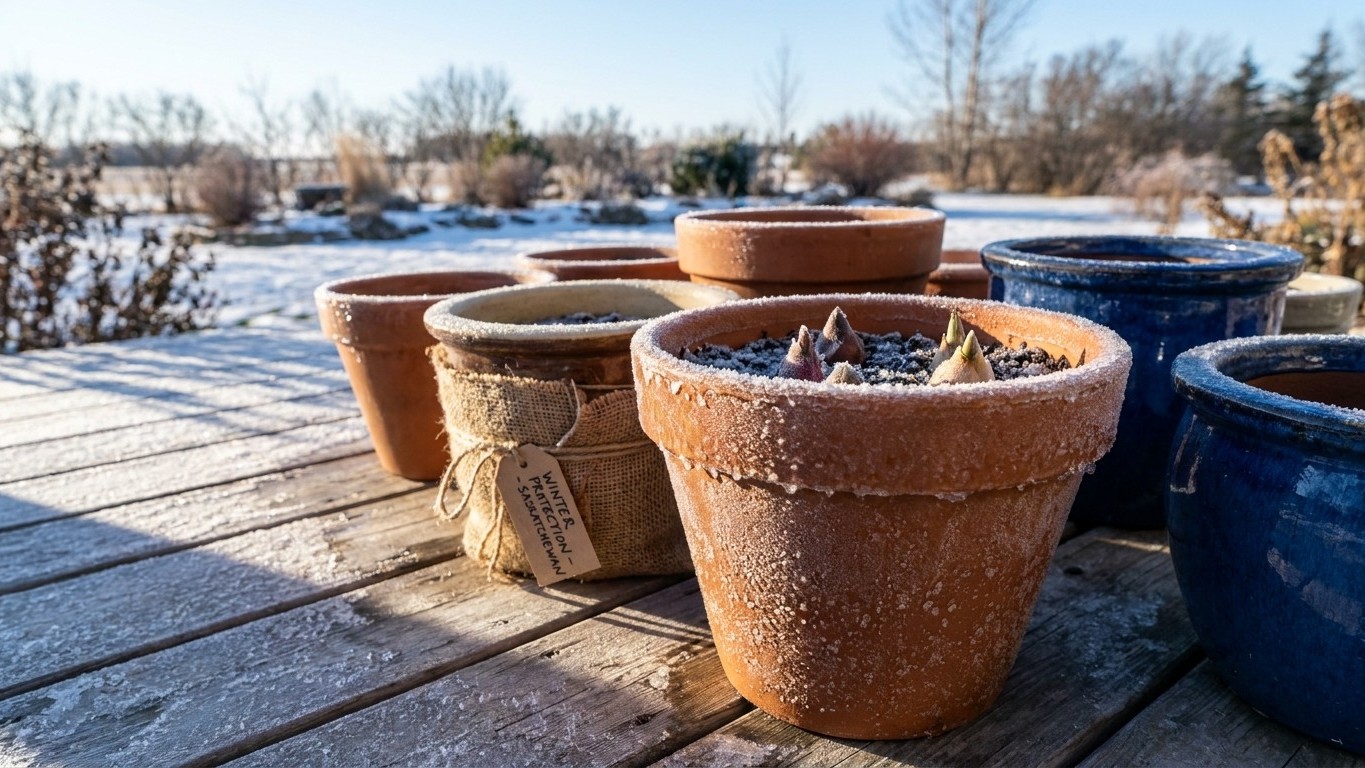

Spring bulbs grow well in containers in Saskatchewan, but the pot itself is the risk, not the bulb. At an average minimum of -5.3°F in the coldest month, a container left outdoors can freeze straight through its root ball, killing a bulb that would have come through the same winter fine in open ground. The fix here is protecting the pot, not chasing more cold. Bulbs in this climate already get all the chilling they need.
Why this matters in Saskatchewan

The mean daily minimum in the coldest month sits at -5.3°F, recorded at the Saskatoon reference station in the Canadian Climate Normals for 1981 to 2010. That single figure changes how a container of bulbs behaves compared to the same bulbs planted straight into a garden bed.
Start with what this territory does not lack: cold. A spring bulb typically needs twelve to fourteen weeks below 45°F to break dormancy and bloom on schedule. Saskatchewan winters run far longer and far colder than that window, so forcing bulbs here is never a matter of manufacturing missing chill in a refrigerator because the outdoors refuses to provide it. The ground gives up more cold than any bulb asks for, for months at a stretch.
Containers are where the trouble actually starts. Natural Resources Canada rates Saskatoon at hardiness zone 3a under the Canadian system, a rating built from seven climate variables and not convertible to a USDA number. That zone rating describes soil, though, not a pot sitting on a deck or a step. Ground holds heat and thaws slowly from below even after the surface has frozen hard, and a bulb planted eight inches down is insulated by earth in every direction. A container has none of that mass. Once the potting mix reaches the outdoor air temperature, which at -5.3°F average minimum happens for weeks running, the whole root ball freezes through solid, from the rim to the base of the pot.
That is the mechanism that kills bulbs in containers that would have shrugged off the same winter in the ground: a hardiness zone rating assumes the insulation soil normally provides, and a pot removes that insulation entirely. A bulb rated hardy to zone 3a in open ground is not automatically hardy to zone 3a in a container, because the container behaves like a colder zone than the thermometer outside it suggests.
The practical rule that follows, and the one container gardeners in this climate lean on, is to treat a potted bulb as needing shelter equivalent to roughly two hardiness zones warmer than open ground, or to move the pot somewhere a full freeze cannot reach. Neither option is optional here. At -5.3°F, an unprotected container is not a marginal risk. It is close to a guarantee.
How to do it here
Growing spring bulbs in containers in Saskatchewan means managing two things at once: giving the bulb its cold, and keeping the pot itself from freezing through before spring arrives. The steps below follow the order a container gardener actually works through, from planting to bloom.
- Pot up in fall, before the ground freezes. Use a container with drainage holes and fresh potting mix, planting bulbs at the depth recommended for garden beds. Water once, then let the mix drain fully.
- Give the bulb its cold somewhere you can check the temperature. Twelve to fourteen weeks below 45°F covers most spring bulbs. An unheated garage that stays above freezing works, and so does a refrigerator drawer, kept away from apples, pears or any ripening fruit, since the ethylene they give off can kill the flower bud forming inside the bulb before it ever emerges.
- Protect the pot from freezing solid, separately from the chilling requirement. A garage or unheated porch that holds above roughly 20°F protects the root ball while still delivering the cold the bulb needs. Leaving the same pot on an open deck at -5.3°F average minimum exposes it to a freeze straight through, which is a different failure than simply falling short on chilling hours.
- If the pot must stay outdoors, bury it or mulch it heavily. Sinking the container into a garden bed up to its rim, or packing straw and leaves a foot deep around its sides, restores some of the insulation a container lacks on its own.
- Check for root growth before moving the pot into warmth. Tip it gently and look for white roots at the drainage holes. Roots showing means the chilling period is far enough along to bring the container into a cool, dim room.
- Move to light gradually, not straight into full sun or heat. A few days in indirect light lets the emerging shoot green up before it faces full sun, which keeps the leaves from scorching or bleaching out.
None of these steps depend on a calendar date, only on temperature and on what the bulb itself shows. That matters in a climate where the first hard cold can arrive weeks earlier some years than others.
Which bulbs are worth it
Not every spring bulb rewards the extra work of a container in this climate. The ones that force reliably share a short chilling requirement and a compact stem, both of which matter more in a pot than in a bed. A tall stem that stands fine in open ground, anchored by an undisturbed root system, can topple in a container where the growing medium is shallower and less stable underfoot.
Where a bulb is sold as a one-season purchase anyway, meaning it was never bred or expected to return the following year, forcing it in a container costs nothing in the long run. The gardener was not giving up a perennial display, only using the bulb for the single bloom it was always going to produce.
- Crocus, short chilling need and compact enough not to topple
- Grape hyacinth (muscari), short stem, reliable bloom in a pot
- Paperwhite narcissus, needs no chilling period at all, bred as a one-season indoor bulb
- Hyacinth, forces well from a firm, large bulb and holds its stem upright in a container
- Dwarf tulip varieties, bred short specifically to avoid the toppling problem taller tulips run into
The bulbs that tend to disappoint in containers are the ones bred for height and for a long life in a garden bed, where their root systems spread and anchor them over years rather than months.
- Standard tall tulips, prone to toppling in a pot and rarely rebloom well even in the ground the following year
- Large trumpet daffodils, tall stems that need more root run than most containers offer
- Allium with tall flower stalks, top-heavy once the flower head opens, unstable in anything but a wide, heavy pot
A gardener scanning this list for a specific bulb should find it in one column or the other, without weighing the tradeoffs paragraph by paragraph.
What goes wrong, and when you can still fix it
Leaves come up, but no flower
This means the chilling period ran short. A bulb pushed into warmth before it logged its full twelve to fourteen weeks below 45°F will often produce foliage using energy already stored inside it, but it never finishes forming the flower bud. There is no fix for the bulb this season. Leave the foliage to grow and feed the bulb, then either replant it in the ground or start a longer chilling cycle next year, this time tracked with a thermometer instead of a calendar guess.
A flower appears, but the stem is too short to see it
This is the opposite timing error: the bulb was warmed too early, before the stem had fully elongated inside the chilled bulb. The flower itself is usually intact and opens on schedule, just low in the pot, sometimes hidden under the foliage. Nothing brings the stem back up this season. Next time, hold the bulb a week or two longer in the cold once roots are visible, before moving it into light and warmth.
The bulb turns soft or rots in the pot
Rot in a container almost always traces back to drainage, either a pot without holes or a saucer left full of standing water under the pot for too long. Once a bulb has gone soft and dark, it is finished for the season and cannot be saved by drying it out or cutting away the damaged part. The pot can be reused, but only after the drainage problem that caused the rot is fixed before the next planting.