
Wyoming sits far enough north that day length, not the calendar, decides when onions stop making leaves and start making bulbs. At Cheyenne’s latitude of 41.15 degrees north, the longest day of the year delivers 14 hours and 58 minutes of daylight, a number that rules out entire categories of onion and dictates a spring, not fall, planting window for nearly every garden in the state.
The short answer for Wyoming

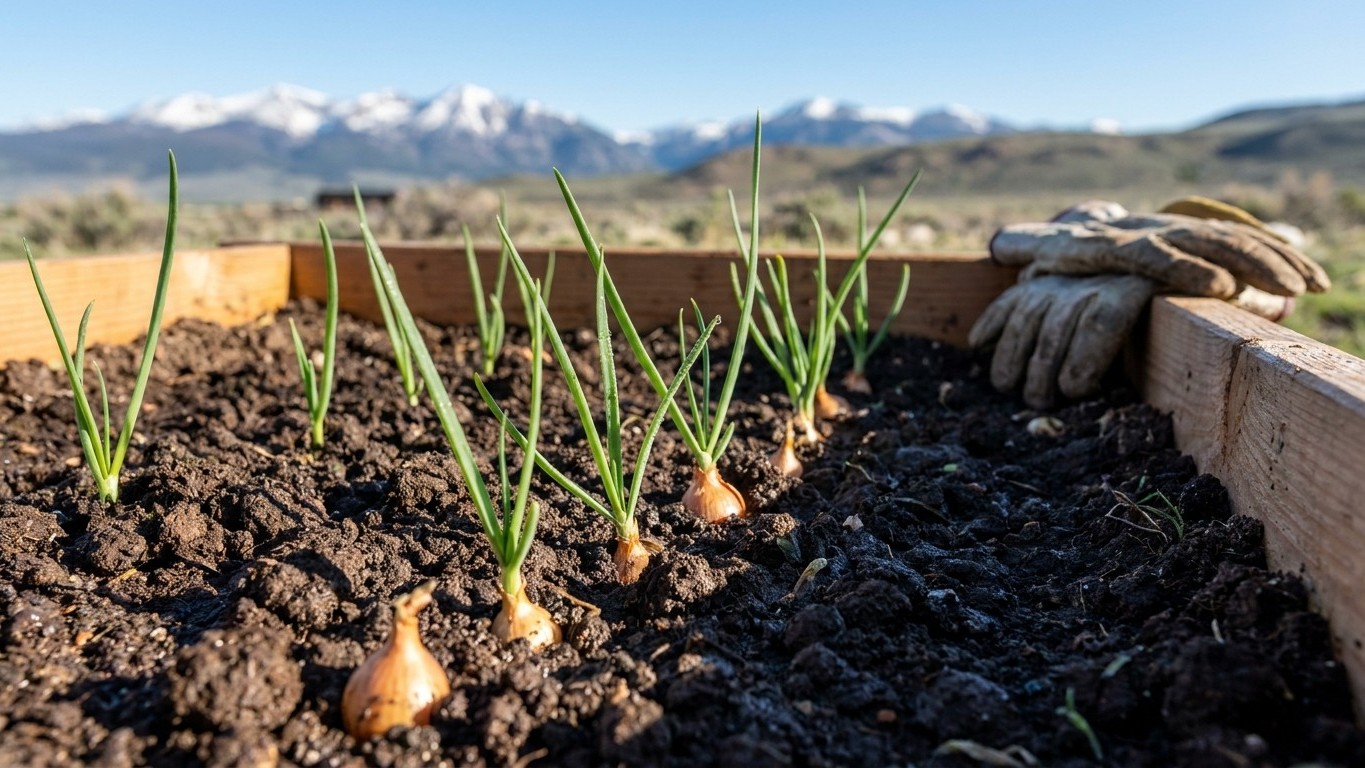
Plant onions in Wyoming in early to mid spring, as soon as the soil can be worked, using sets or transplants rather than waiting to direct-seed. The state’s harsh, high-elevation winters rule out the fall planting some warmer states rely on. A young onion left in the ground through a Wyoming winter has little chance of surviving to spring, so the safer path everywhere from Cheyenne to Sheridan is to get plants in the ground early and let them build leaf mass before daylight starts pulling the trigger on bulbing.
That trigger matters more here than almost anywhere else in the country. Cheyenne’s 14 hours and 58 minutes of daylight on the June solstice sits squarely in long-day onion territory. Long-day varieties wait for something between 14 and 16 hours of daylight before they switch from growing leaves to growing a bulb. At just under 15 hours, Wyoming’s summer solstice clears that bar for most long-day types and puts a good number of intermediate-day varieties within reach as well, since those typically need somewhere in the 12- to 14-hour range and get triggered well before the solstice even arrives.
Nineteen documented varieties on this site have published ranges that cover 41.15 degrees north: long-day types including Ailsa Craig, Barolo, Blush, Bridger, Frontier, New York Early, Patterson, Red Carpet, Rossa di Milano and Walla Walla Sweet, alongside intermediate-day types like Cabernet, Calibra, Elsye, Expression, Monastrell, Red Long of Florence, Red Long of Tropea, Scout and Sierra Blanca. Three more, Candy, Safrane and Talon, fall within a degree and a half of their published boundary, close enough that they may bulb here but sit at the edge rather than comfortably inside it.
The reason timing and variety choice can’t be separated is simple: whatever size the plant has reached when day length hits that threshold is roughly the size the bulb will be. Get the onions in early, build strong leaf growth through late spring, and the bulbs forming in midsummer have something substantial to work with.
What will not work here
Planting a short-day onion in Wyoming does not produce a smaller crop. It produces almost no crop worth harvesting. Short-day varieties are built to bulb at around 12 hours of daylight, a length Wyoming reaches well before the plants have had time to grow, which means they start bulbing while still tiny. Seven short-day varieties fall into this trap here:
- Gabriella (20-35N) — bulbs while the plant is still small, yielding undersized onions
- Madalyn (20-35N) — same early trigger, same result
- Red Rock (30-36N) — too far south for Wyoming’s day length
- Red Sensation (25-35N) — bulbs before adequate leaf growth
- Texas Grano 1015Y (25-35N) — a warm-climate variety, wrong tool for this latitude
- Vidora (25-35N) — triggers bulbing far too early here
- White Castle (30-38N) — still short of Wyoming’s threshold
Going the other direction fails differently, but just as completely. Two long-day varieties published for latitudes above 41.15 degrees north, Powell (43-47N) and Redwing (43-65N), need more daylight than Cheyenne’s sky provides. Planted in southern or central Wyoming, they don’t bulb small. They don’t bulb at all. The day length here never climbs high enough to flip the switch, so the plant spends the whole season making leaves, then rots in the ground as fall arrives. That’s a variety mismatch, not a fertilizer problem or a watering problem, and no amount of garden care fixes it.
The timing mistake compounds all of this. Planting late doesn’t push the harvest back a few weeks the way it would with tomatoes or squash. Onions bulb on a day-length schedule regardless of when they went into the ground, so a late-planted onion simply hasn’t built much leaf structure by the time that schedule kicks in. The bulb that forms reflects the plant’s size at that moment, meaning late planting shrinks the harvest rather than delaying it.
What changes across Wyoming
Wyoming runs from roughly 41 degrees north at its southern border to about 45 degrees north at its northern edge, a spread of four degrees that matters more for onions than it might for most vegetables. The figures in this article come from Cheyenne, sitting right at that southern edge, which means gardeners near the northern border are working with meaningfully more daylight on the solstice than the 14 hours and 58 minutes measured there.
| Location | Latitude | What it changes |
|---|---|---|
| Cheyenne (reference city, south) | 41.15N | 14h58m on the solstice; figures in this article apply directly here |
| Sheridan area (north) | ~44.8N | Daylight measurably longer than Cheyenne’s, not measured here; likely enters the range where Powell and Redwing (43-47N) could bulb successfully |
That gap has practical consequences. A gardener near Sheridan or Gillette, closer to the state’s northern tier, may find that Powell or Redwing, both excluded for Cheyenne, actually bulb reliably at their latitude. The reverse holds too: someone gardening near Cheyenne, Torrington or the Colorado border sits at the extreme southern end of what counts as long-day territory in this part of the country, and should treat the borderline varieties (Candy, Safrane, Talon) with real caution rather than assuming they’ll perform the same way they might a few counties north.
Elevation complicates the picture further. Much of Wyoming sits at 5,000 to 7,000 feet, and while elevation doesn’t change day length, it does compress the frost-free window, which pushes the practical planting date later in spring than latitude alone would suggest. A reader in Laramie or Jackson is working with a shorter season than someone at similar latitude and lower elevation.
Sweet now, or onions that last
Wyoming gardens sit at the low end of the long-day map, which puts sweeter, milder onions within reach even though the state’s overall climate favors keepers. The chemistry behind this trade-off is straightforward: the volatile sulfur compounds that make an onion sharp on the tongue are the same compounds that protect it from breaking down in storage. A variety bred for mildness has fewer of these compounds, which makes it better eaten fresh but far less capable of surviving a Wyoming winter in the root cellar.
Among the varieties documented for this latitude, Walla Walla Sweet is the clearest example of the trade-off working in the sweet direction, a long-day onion known for a milder bite that comes at the cost of shelf life. Onions of that type are best planned for summer and early fall eating rather than storage.
The sharper long-day varieties on the list, including types like Bridger, Patterson and Red Carpet, run the other way. Their higher sulfur content means more bite at the cutting board, but also a bulb that resists rot and sprouting far longer in storage. For a Wyoming pantry, that difference shows up directly in March: a shelf of sharper long-day onions can still be usable deep into late winter, while sweeter varieties from the same harvest are typically long gone by then, either eaten early or soft and spent.
Most Wyoming gardeners end up planting some of both, sweeter onions for the kitchen table through late summer, sharper ones set aside deliberately for the months when nothing else in the garden is producing.
Checking this against your own garden
Everything above is built on Cheyenne’s numbers, and Cheyenne sits at the extreme southern edge of a state that stretches four degrees of latitude further north. Nobody gardening in Wyoming should treat these figures as exact for their own yard without a quick check first.
- Look up your town’s latitude if you’re gardening north of Cheyenne, particularly near Sheridan, Gillette or Cody, where day length runs measurably longer than the figures used here
- Confirm your local last and first frost dates, since Wyoming’s elevation shifts these significantly even between towns at similar latitude
- Contact your county office of the University of Wyoming Extension for planting windows calibrated to your specific elevation and microclimate
- Reconsider borderline varieties like Candy, Safrane or Talon carefully if you garden near the state’s southern edge, where the daylight margin is thin
- Check whether your site sits above 6,000 feet, which typically compresses the safe planting window later into spring than latitude alone would predict