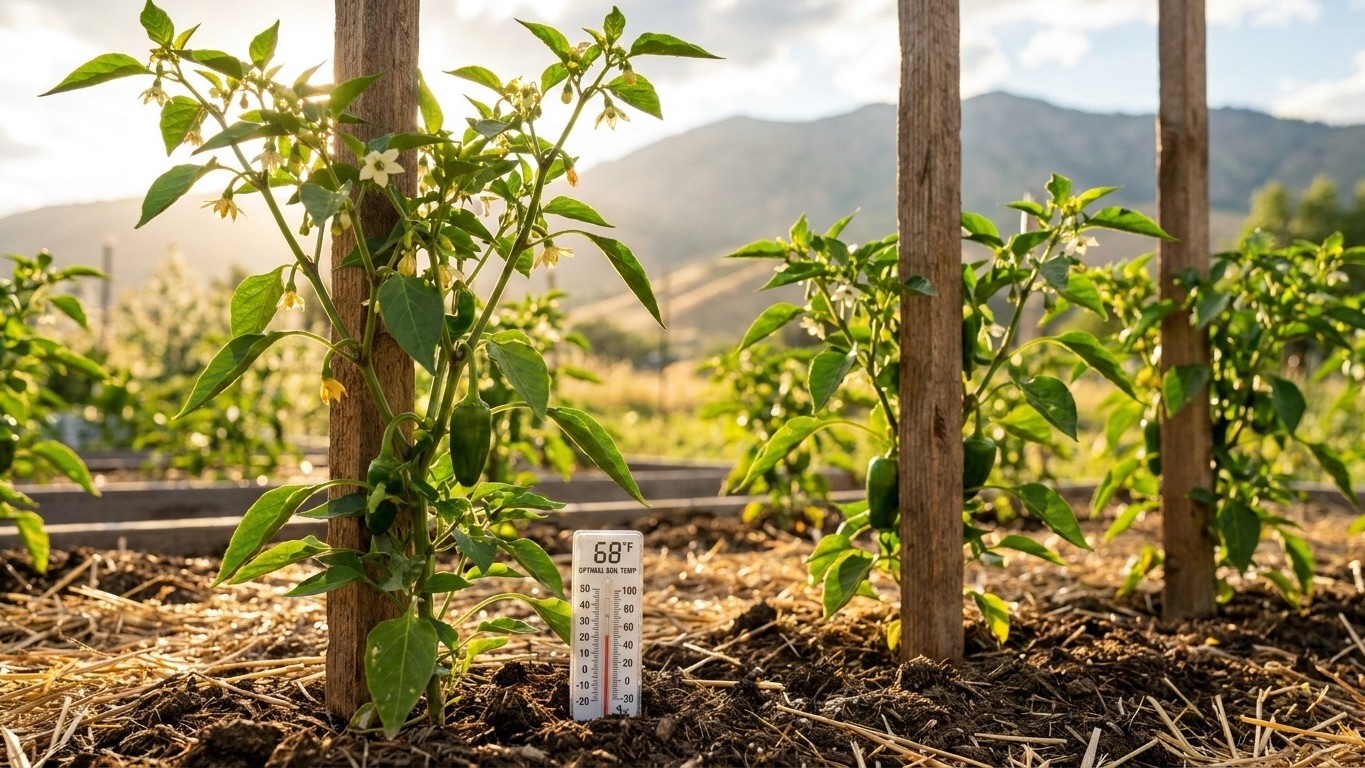

In Quebec, the pepper story is not about heat, it’s about time. The reference station averages 0.0 days a year at 90°F or above, so scorching afternoons rarely threaten fruit set here. What actually decides which varieties ripen is the frost-free window itself, plus whatever nighttime chill shows up in a given yard. Get the seed-starting math right and match your variety choice to a short season, and ripe peppers are realistic.
The short answer

Start with the number that sets this region apart: 0.0 days a year at or above 90°F, measured at the Montreal reference station under Environment and Climate Change Canada’s 1981-2010 normals. For pepper growers, that figure matters because pepper flowers abort when daytime heat climbs past 90°F for stretches, a failure mode common in warmer US states. Quebec growers essentially don’t have to plan around it. The heat-driven half of the fruit-set problem, the one that shows up as flowers dropping in a July heat wave, is not the local risk.
The other half of that same equation is cold, and it works the opposite way. Pepper flowers also abort when nights fall below 55°F, according to Utah State University Extension. That threshold has nothing to do with daytime highs. A garden can sit comfortably in the 70s all afternoon and still lose blossoms overnight if the mercury slides under 55°F before dawn. This is where Quebec growers need to pay attention, and where this site cannot hand you a ready-made number: it carries days-at-or-above-90°F for each territory, but it does not carry summer night minima. Nobody can responsibly infer a nighttime low from a province’s latitude, or from how cold January gets. Those two figures don’t move together. The only reliable fix is a thermometer in your own garden, checked through the early weeks after transplant, because a river valley, a hilltop, and a low frost pocket a few miles apart can post very different overnight lows on the same date.
Put those two facts side by side and the practical picture for Quebec becomes clear. Heat-driven blossom drop is close to a non-issue. Cold-driven blossom drop is the live risk, especially in late spring right after transplant and again in early fall as nights lengthen. That reframes the whole question of which varieties “ripen in a season” here: it’s less about surviving heat and more about how much usable warm-night window a given plant gets between the last spring frost and the first one in fall, and how efficiently it uses that window. Utah State’s guidance names six pepper varieties suited to home gardens, but attaches no heat rating, no days-to-maturity figure, and no fruit size to any of them, so no specific number can be pinned to a specific name. What can be said plainly is that shorter, more compact growing habits and earlier flowering tend to fare better where the frost-free stretch is the limiting factor rather than summer heat. Season-extension tools, black plastic mulch to warm the root zone, floating row cover over young transplants, a sheltered south-facing bed, do more for a Quebec pepper crop than any heat-tolerance trait ever would, because the crop’s real adversary here is a short calendar, not a hot one.
When to start seed here
Working backward from frost to seed tray is the only arithmetic that matters, and it’s worth doing on paper rather than trusting memory, because every input shifts the answer.
- Start from the mean last spring frost date. For the Montreal/St-Hubert A station, Environment and Climate Change Canada’s 1981-2010 normals put that date at May 6. That is a mean, not a guarantee: in one year out of two, frost actually arrives later than May 6. Treat it as the midpoint of a window, not a safe date to circle on the calendar. It also reflects one station; a province is not one climate, and northern or upland districts commonly run weeks behind this reading.
- Add time for the soil, not just the air. Transplanting also depends on soil temperature reaching 60°F, and soil typically lags behind air temperature by a stretch of days to a couple of weeks after the last frost passes, depending on how much sun a bed gets and how the ground drains. A grower working from the May 6 mean should expect the realistic transplant window to land somewhat later once soil catches up, and should confirm it with an actual soil thermometer rather than a date on paper.
- Count back 8 to 10 weeks from that expected transplant date. That range comes directly from Utah State University Extension’s guidance on raising pepper transplants indoors. If a grower expects to set plants out in the second half of May once soil has warmed, counting back 8 weeks lands in late March, and counting back the full 10 weeks pushes into the first half of March. Both ends of that range are defensible; the choice depends on how much buffer a grower wants against a late soil warm-up.
- Redo the math with local dates, not the regional mean. A grower in a low-lying frost pocket, or well north of the Montreal reference station, should shift every step later by however many days their own frost history and soil warm-up actually run behind the regional figure, since the underlying arithmetic (frost date, plus soil lag, minus 8 to 10 weeks) stays the same even when the calendar dates move.
One more figure belongs in this arithmetic but comes in at a different stage: once flowers appear, expect roughly 35 to 45 days from flowering to fruit set, per Utah State University Extension. That clock starts at bloom, not at sowing and not at transplant, so it stacks on top of the seed-start math above rather than replacing it. A grower who wants ripe fruit by a target date needs to work backward through all three intervals: fruit set from flowering, flowering from transplant, and transplant from seed.
What goes wrong here
- Blossom drop from a cool night. This is the dominant local risk given Quebec’s 0.0 average days above 90°F: nights below 55°F cause flowers to abort even when the daytime feels warm enough. Because this site does not track summer night minima, growers need their own thermometer reading through late spring and again in early fall. The remedy is season extension: row cover pulled over plants on forecast-cool nights, black plastic mulch to hold soil warmth, and a sheltered spot that blocks wind and traps a few extra degrees near the plant.
- Blossom drop from a hot spell. Less common here given the region’s near-zero count of 90°F-plus days, but not impossible in a short, intense heat wave. When daytime highs push past 90°F, flowers can abort the same way they do from cold, just from the opposite direction. Shade cloth over the row during the hottest afternoon hours and consistent watering to keep plants from added heat stress are the standard responses.
- Sunscald on exposed fruit. Peppers that lose their leaf cover, from over-pruning, from wind damage, or from disease thinning the canopy, end up with bare fruit taking direct sun. The skin develops a pale, papery patch that can rot. Leave foliage in place rather than pruning hard, and use shade cloth over any plant that’s already lost significant leaf cover.
- Blossom-end rot. This shows up as a sunken, dark patch on the bottom of the fruit and traces back to inconsistent watering interrupting calcium uptake, not to a soil calcium shortage in most gardens. Even, regular watering and a layer of mulch to hold soil moisture steady are the practical fix; wide swings between bone-dry and soaked soil are the real trigger.
Common questions
Does Quebec’s low count of 90°F-plus days mean any pepper variety will ripen there?
No. The near-absence of extreme heat removes one failure mode, but the frost-free window still limits which varieties have enough time to flower, set fruit over the 35-to-45-day window from bloom, and finish ripening before fall frost.
How do I know when my soil has actually reached 60°F for transplanting?
Use a soil thermometer pushed a few inches into the bed, checked in the morning over several days, rather than guessing from air temperature or the calendar date of the regional mean frost.
Is May 6 a safe date to transplant peppers outdoors in Quebec?
No. It’s a mean last frost date from Environment and Climate Change Canada’s 1981-2010 normals for one reference station. In half of all years, frost arrives after that date, and areas north or upland of the reference station typically lag behind it further still.
What should I watch for since this site doesn’t track summer night lows?
Keep a simple outdoor thermometer near your pepper bed through late spring and early fall, and watch for nights dropping under 55°F, since that threshold, not the daytime high, is what triggers cold-driven blossom drop.