
Oregon’s growing season west of the Cascades runs long and mild, which suits peppers better than it hurts them, but timing and variety choice still decide whether the fruit ripens before fall rain sets in. Peppers need a transplant date tied to soil temperature, not the calendar, plus a stretch of steady warmth without extremes. Get the start date right and read your own yard’s microclimate, and most pepper types set fruit reliably in a single Willamette Valley or western Oregon season.
The short answer

At the Portland reference station, the average is 11.9 days a year at or above 90 F, according to NOAA NCEI Climate Normals for 1991-2020. That’s a modest heat load compared to inland growing regions, and it matters because pepper fruit set collapses once daytime temperatures climb past that 90 F mark. Flowers can open and even look healthy, but the pollen turns sterile in extended heat, and the plant drops blossoms rather than setting fruit. With fewer than a dozen days a year crossing that line in the Portland area, most pepper varieties get through a typical summer without a serious heat-driven stall. A run of several 90-plus days back to back, which does happen in July and August some seasons, is the scenario to watch. If you see wilting afternoons and blossoms falling off without turning into peppers, that’s the hot-end failure, and it’s temporary: fruit set usually resumes once temperatures ease back into the 80s.
The other end of the range is just as real and far less talked about. Pepper fruit set also fails when nights drop below 55 F, because the plant needs warm nights to hold flowers and finish pollination. This site does not carry summer night minimum data for Oregon locations, so there’s no published nighttime figure to hand you here. That’s a gap worth naming plainly rather than papering over with a guess. Night temperatures don’t track neatly with latitude, and they don’t track with the coldest month of the year either. A valley floor, a hillside garden, and a lot three blocks from a river can all report different overnight lows on the same date, shaped by elevation, air drainage, and how much pavement or tree cover surrounds the bed.
The practical move is to keep a simple outdoor min-max thermometer near the pepper bed through June and into early July, when marine air can still push overnight temperatures down even after the days have turned warm. If you’re logging nights consistently below 55 F while the plants are in bloom, that’s the likely reason for stalled fruit set, not a disease or a nutrient problem. Once you know your own site’s overnight pattern, you can plan around it, whether that means choosing a warmer microclimate, adding a wall or fence for heat retention, or simply expecting a slower start in a cool-air pocket.
When to start seed here
Working out a start date for pepper seed is arithmetic, not guesswork, once you know two local numbers: your last spring frost date and how many weeks a transplant needs indoors before it goes in the ground.
- Start with the last spring frost window for west Oregon locations near Portland, which NOAA NCEI’s 1991-2020 freeze-probability data puts between March 6 and March 21. That’s the earliest the ground is reliably safe from a killing frost, but it is not yet planting time for peppers.
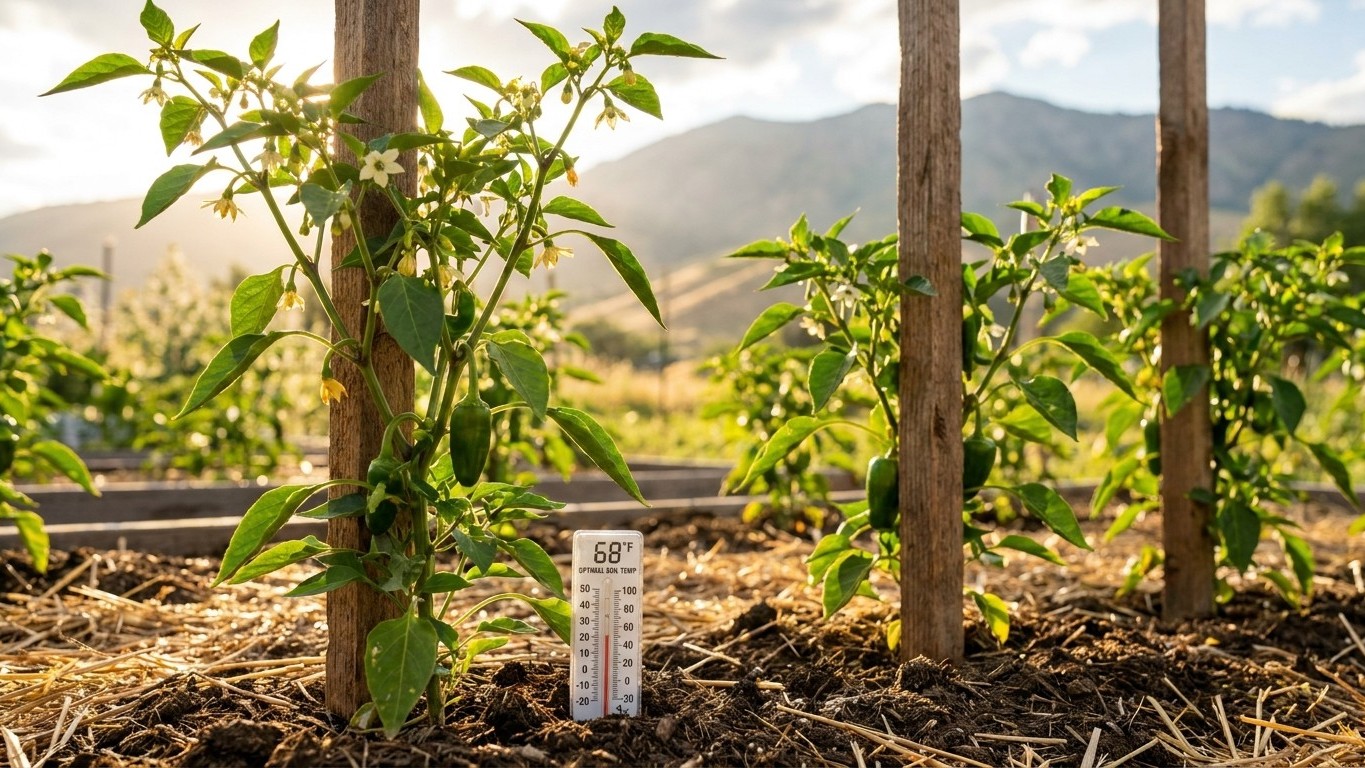
- Peppers need more than frost-free air. Utah State University Extension notes that transplants should go into the ground when soil temperature reaches 60 F, which in most years lands several weeks after the last frost date itself, since soil warms slower than air. Check soil temperature directly with a simple probe thermometer pushed a few inches into the bed rather than assuming a date will do the job.
- Once you have a realistic soil-ready date in mind, count backward 8 to 10 weeks. That’s the indoor seed-starting window Utah State University Extension recommends for peppers, and it’s non-negotiable in one direction: start too late and transplants go out undersized; start too early and they get root-bound on a windowsill waiting for soil to warm.
- Adjust the whole sequence for your own county rather than borrowing Portland’s dates outright. Central and eastern Oregon sit in high-desert conditions with a noticeably shorter season, and the March 6-21 frost window applies to areas west of the Cascades, not statewide. If you garden east of the mountains, your local frost-free date will run later and your indoor countdown needs to shift with it.
- Build in a buffer week for a cool spring. If soil temperature is still sitting in the low 50s past your target date, hold transplants indoors a little longer rather than setting them out on a fixed calendar date regardless of conditions.
What goes wrong here
- Blossom drop from a hot spell. A run of 90 F-plus days pushes flowers to drop without setting fruit, since pollen becomes unviable in that heat. Utah State University Extension identifies this as one of the two thresholds where pepper fruit set fails outright. The fix is patience rather than intervention: hold off on extra fertilizer, keep soil moisture even with regular deep watering, and expect new blossoms to set normally once the heat spell breaks.
- Blossom drop from a cool night. The same failure shows up at the opposite extreme, when overnight temperatures fall below 55 F during bloom. Since this site doesn’t carry summer night minimum data for Oregon, the only reliable fix is to track your own site with a min-max thermometer and, if cool nights are a recurring pattern, choose a warmer spot in the yard, such as against a south-facing wall, for next season’s peppers.
- Sunscald on exposed fruit. Where Oregon summers do turn sunny and dry for stretches, especially inland from the coast and away from marine cloud cover, fruit left exposed on a thinly leaved plant can develop pale, papery patches on the side facing the sun. Avoid heavy pruning of foliage during fruiting, since the leaf canopy is what shades developing peppers, and consider light shade cloth over the row during the hottest afternoon stretch if scald shows up repeatedly.
- Blossom-end rot on developing fruit. A dark, sunken patch at the fruit’s blossom end usually traces back to inconsistent watering, which disrupts the plant’s ability to move calcium to the fruit even when soil calcium levels are adequate. Even soil moisture, achieved with mulch and a regular watering schedule rather than deep soaks followed by dry stretches, is the standard remedy, since chasing the problem with added calcium products rarely fixes an inconsistent-watering root cause.
Common questions
Can I start pepper seed too early for an Oregon garden?
Yes. Starting more than 10 weeks before your soil is ready leaves transplants root-bound and stressed indoors, which sets them back once they finally go in the ground. Counting backward from your realistic soil-ready date, not from the calendar month, keeps the timing honest.
Does a shorter frost-free window in central or eastern Oregon change the plan?
It changes the whole timeline. The March 6-21 frost window applies to areas west of the Cascades; high-desert regions east of the mountains run on a later, shorter season, so the 8-to-10-week indoor count and the 60 F soil check still apply, but the calendar dates shift later.
How do I know if it’s heat or cold causing blossom drop?
Check your own conditions during the days the drop occurs. A stretch of 90 F-plus daytime highs points to the hot-end failure; a run of nights that felt distinctly cool, tracked on a min-max thermometer, points to the cold end. Since night-temperature data isn’t published here for Oregon locations, direct observation at your own site is the only reliable way to tell.
Is one part of Oregon simply better for ripening peppers than another?
West of the Cascades generally offers a longer, milder window with a mean of 11.9 days a year at or above 90 F in the Portland area, according to NOAA NCEI. High-desert central and eastern Oregon run hotter by day and colder by night in ways this site does not measure directly, so gardeners there should track their own site conditions rather than assume the western Oregon pattern applies.